
There is a moment every diver knows — and every non-diver suspects we are exaggerating.
It happens somewhere between the surface and ten meters. Your ears equalize. Your breathing slows. The chaos of the world above — the notifications, the deadlines, the noise — becomes a memory. And then, something shifts. Not in your gear. In your mind.
The water doesn't just hold your body. It holds your attention. Completely. For the first time in weeks, maybe months, you are not thinking about tomorrow. You are not replaying yesterday. You are simply here. Present. Weightless. Silent. And when you surface, something in you has changed in a way that is hard to explain to anyone who hasn't felt it.

We have all tried to describe it. We have all failed. The words sound too small.
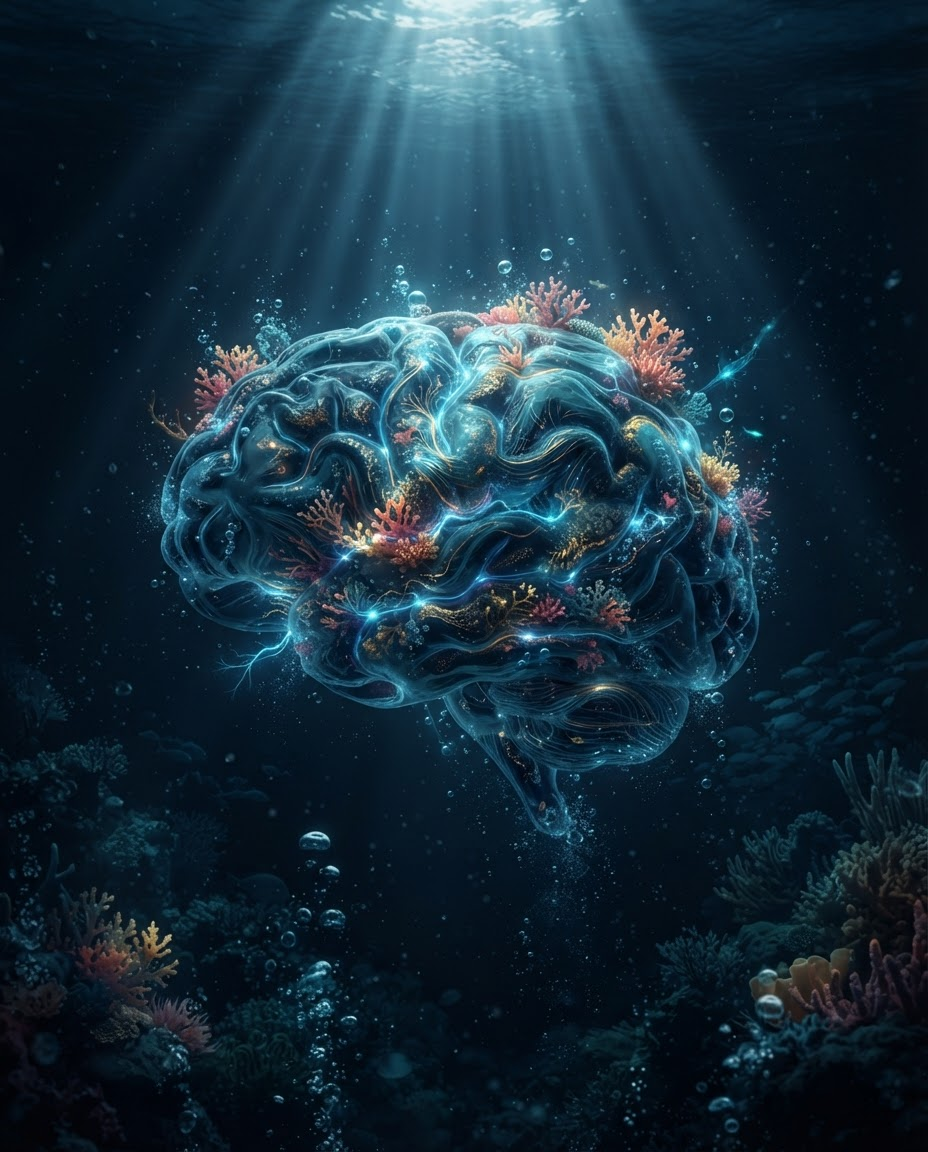
But neuroscience is starting to catch up. And what the research reveals is extraordinary: scuba diving doesn't just feel good. It literally rewires your brain.
The Underview Effect: Scuba's Answer to the Overview Effect
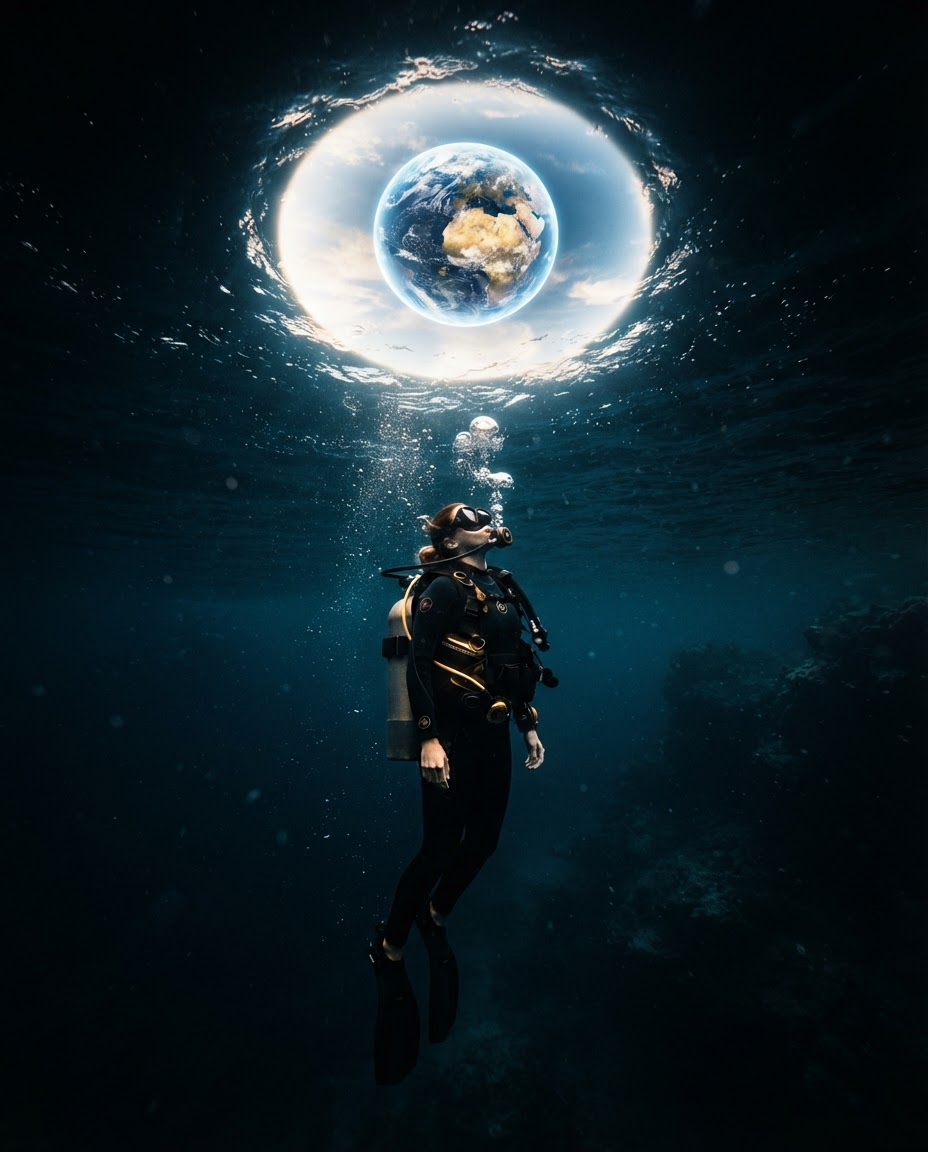
Astronauts who see Earth from space describe something called the overview effect — a profound cognitive shift in which national boundaries dissolve, personal conflicts shrink, and a deep sense of connection to the planet takes hold. It changes them forever.
Divers experience something strikingly similar. Researchers are calling it the underview effect.
When you descend beneath the surface, the world as you know it inverts. Gravity weakens. Sound changes. Color shifts. And your brain, faced with an environment it did not evolve to process, does something remarkable: it lets go.
A 2022 study in Frontiers in Psychology found that underwater environments trigger what psychologists call self-diminishment — a temporary softening of the ego that makes room for awe, connectedness, and what the researchers termed "oceanic boundlessness." Participants who had recently dived scored significantly higher on measures of transcendence and lower on self-focused rumination than control groups who had engaged in other adventure sports.
In other words: the ocean doesn't just distract you from your problems. It dissolves the part of your brain that generates them.
"The moment the surface closed above my head, my to-do list disappeared. Not because I forgot it. Because it stopped mattering." — DeepBeat Tribe Member, Havelock Island, 2025
What the Research Actually Says
The diving community has always known that the ocean heals. Now we have the data to prove it.
Anxiety and Cortisol: The Diving Prescription
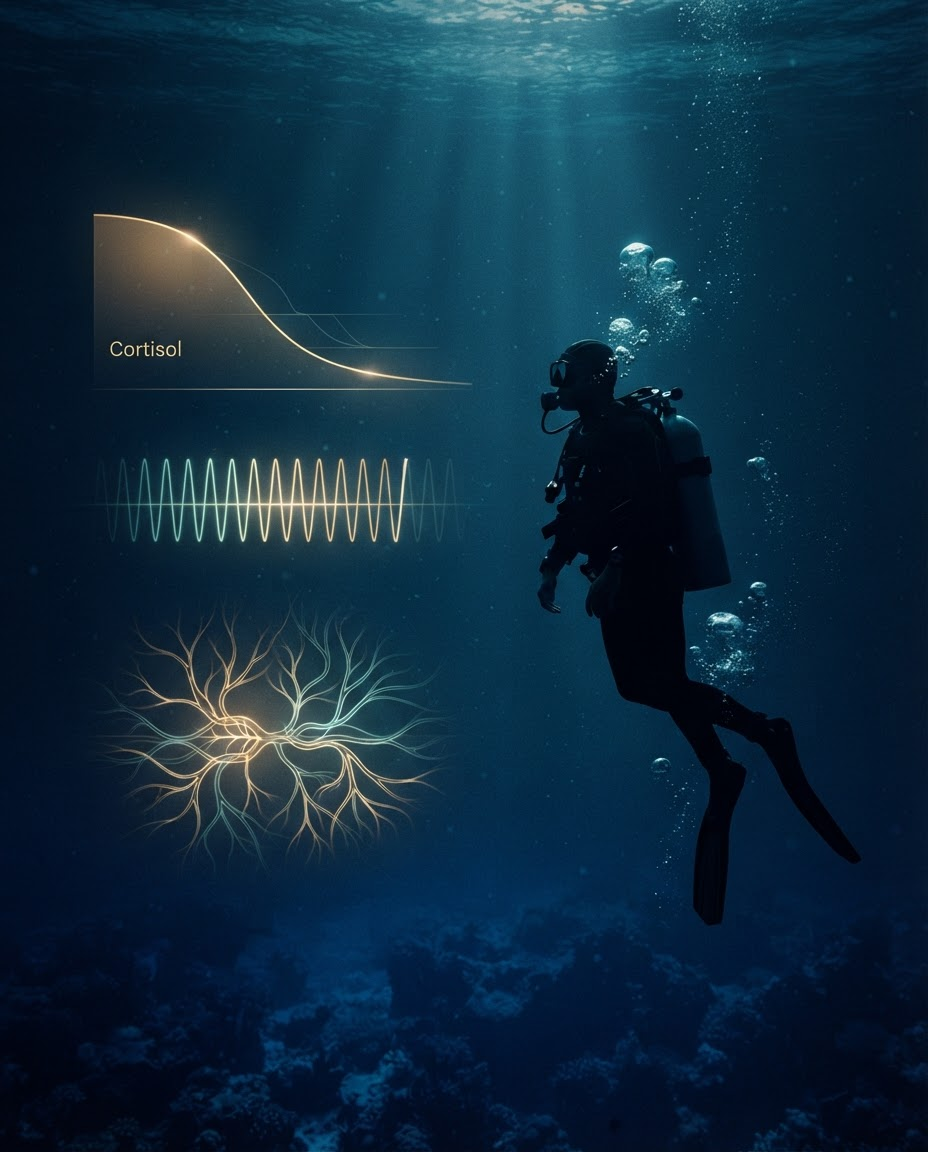
A landmark 2018 study published in the British Journal of Sports Medicine tracked 48 adults with no prior diving experience through a four-week scuba program. The results were staggering:
- 22% reduction in cortisol (the body's primary stress hormone)
- 18% improvement in heart rate variability (a key marker of nervous system resilience)
- 71% of participants showed clinically significant reductions in anxiety scores on the GAD-7 scale
And here's what makes this different from, say, going for a run: these effects were measured after the dives, not during. The calm outlasted the activity. Participants reported feeling "centered" and "mentally lighter" for days after a single session.
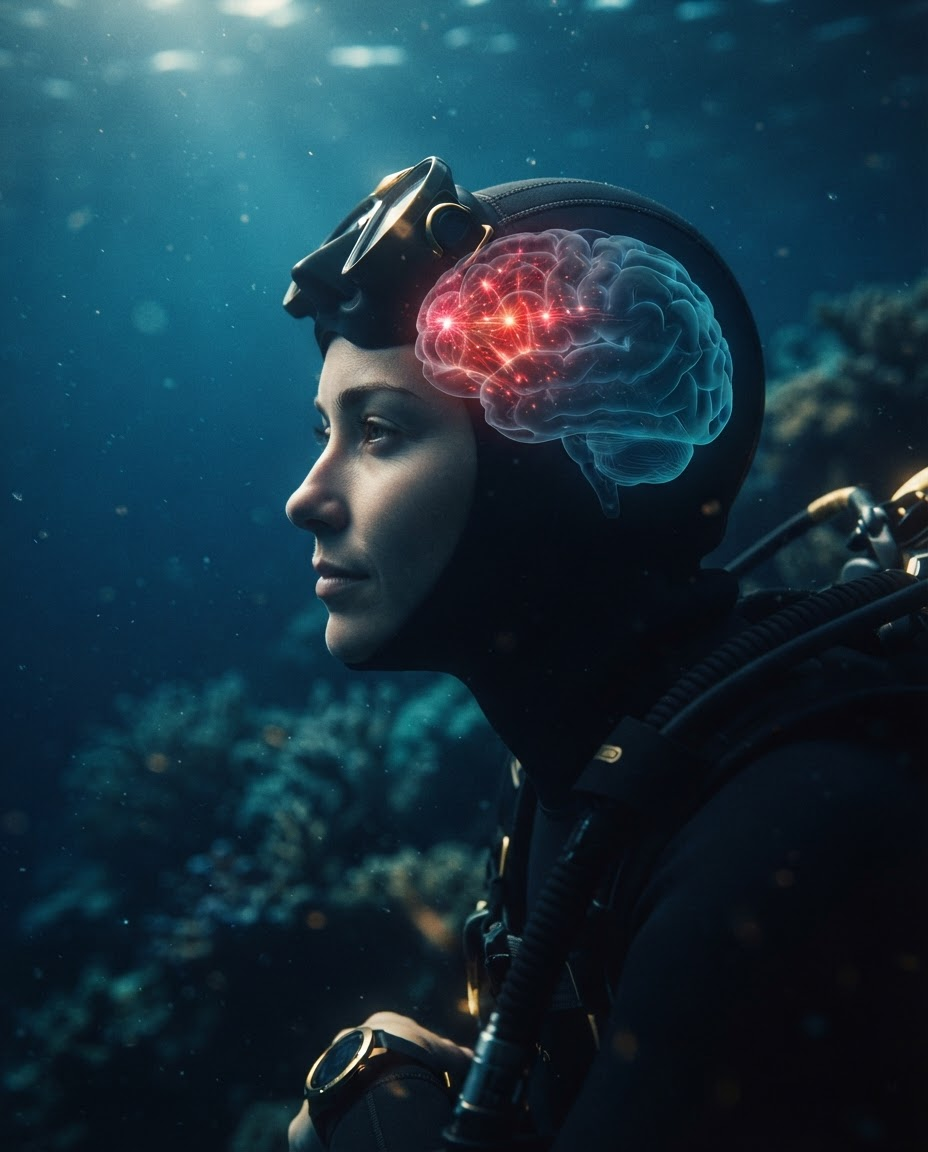
A follow-up study in Frontiers in Psychology (2021) used functional near-infrared spectroscopy (fNIRS) to observe divers' brains in real time. What they found was remarkable: the prefrontal cortex — the part of the brain responsible for rumination, worry, and self-critical thought — showed significant deactivation within the first five minutes of submersion. The brain wasn't just relaxed. It was deliberately switching off the noise.
The Long Game: Diving and Well-Being
The effects aren't just immediate. They're cumulative.
A longitudinal study published in Health Psychology Open (2020) followed recreational divers over 18 months, comparing them to matched controls who engaged in other forms of exercise and travel. The divers consistently reported:
- Lower levels of insomnia
- Reduced anxiety and depression scores
- Higher scores on measures of life satisfaction and purpose
The researchers controlled for income, exercise frequency, and vacation days. The effect held. Something about the specific combination of breath control, weightlessness, sensory deprivation, and marine immersion creates a neurochemical environment that is difficult to replicate on land.
The Parasympathetic Switch: Your Body's Ancient Reset Button
The moment your face submerges, something ancient wakes up in your nervous system.
It's called the mammalian dive reflex — a suite of physiological responses hardwired into our biology over 375 million years of evolution. Your heart rate drops by 10–25%. Blood shifts from your extremities to your heart and brain. Your metabolism slows. And your vagus nerve — the longest cranial nerve in your body, and the primary highway of the parasympathetic "rest and digest" system — fires into high gear.
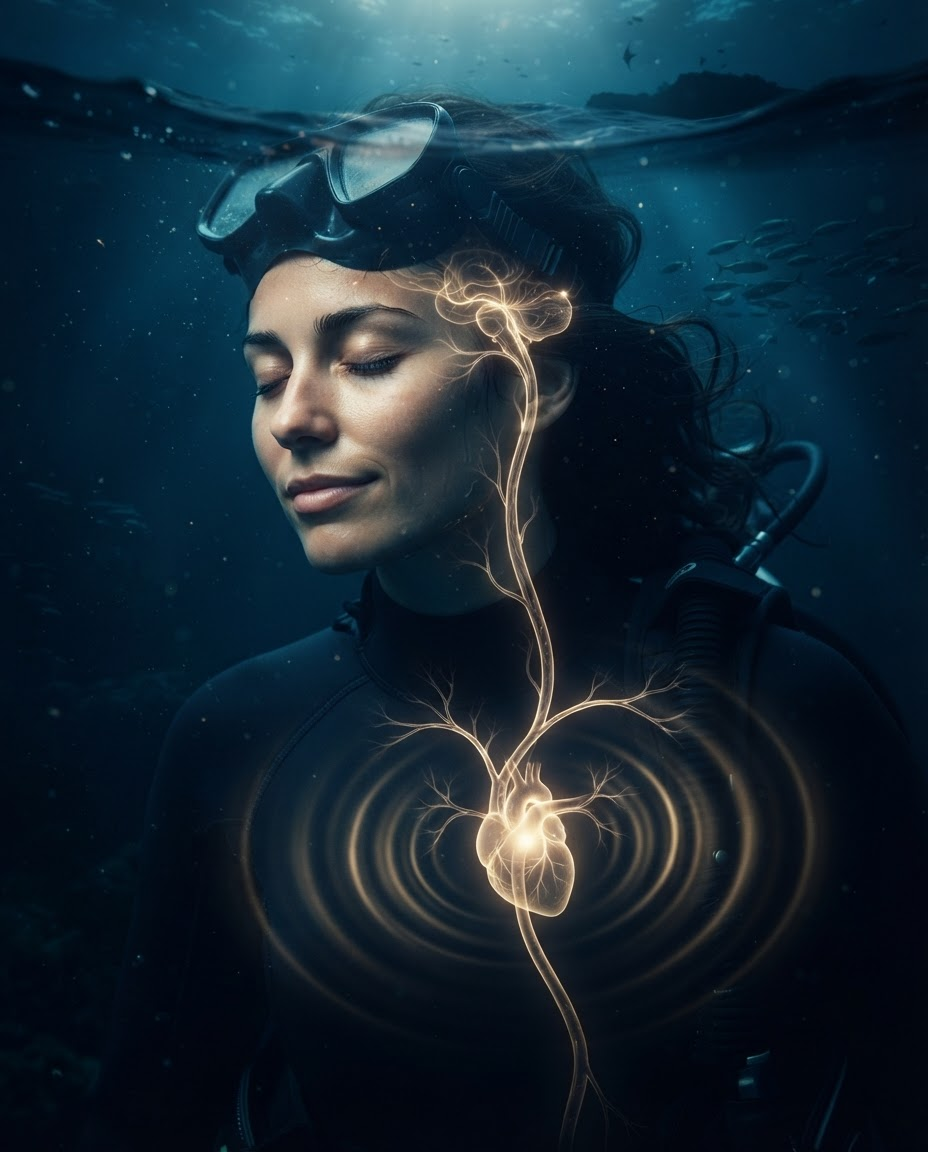
This isn't relaxation. It's a biological override.
In a world of chronic stress, where most of us live in a constant low-grade state of sympathetic activation (fight or flight), the dive reflex is a hard reset. It tells your body: we are safe now. We can stop preparing for danger. We can heal.
Dr. Wallace J. Nichols, author of Blue Mind, describes water as a "neurochemical cocktail" — an environment that simultaneously reduces cortisol, increases dopamine, and floods the brain with oxytocin. Scuba diving, because it immerses you so completely, delivers this cocktail in a concentration that few other activities can match.
Why Divers Become Obsessed: The Neurochemistry of Awe
Here's where it gets really interesting — and slightly inconvenient for anyone trying to maintain a "normal" life after their first dive.
Scuba diving triggers a powerful combination of neurochemical rewards:
Dopamine — from novelty, exploration, and the thrill of discovery. Every dive is different. Your brain never habituates.
Oxytocin — from the buddy system, shared silence, and the wordless trust between divers. The ocean forces a level of social connection that is rare on land.
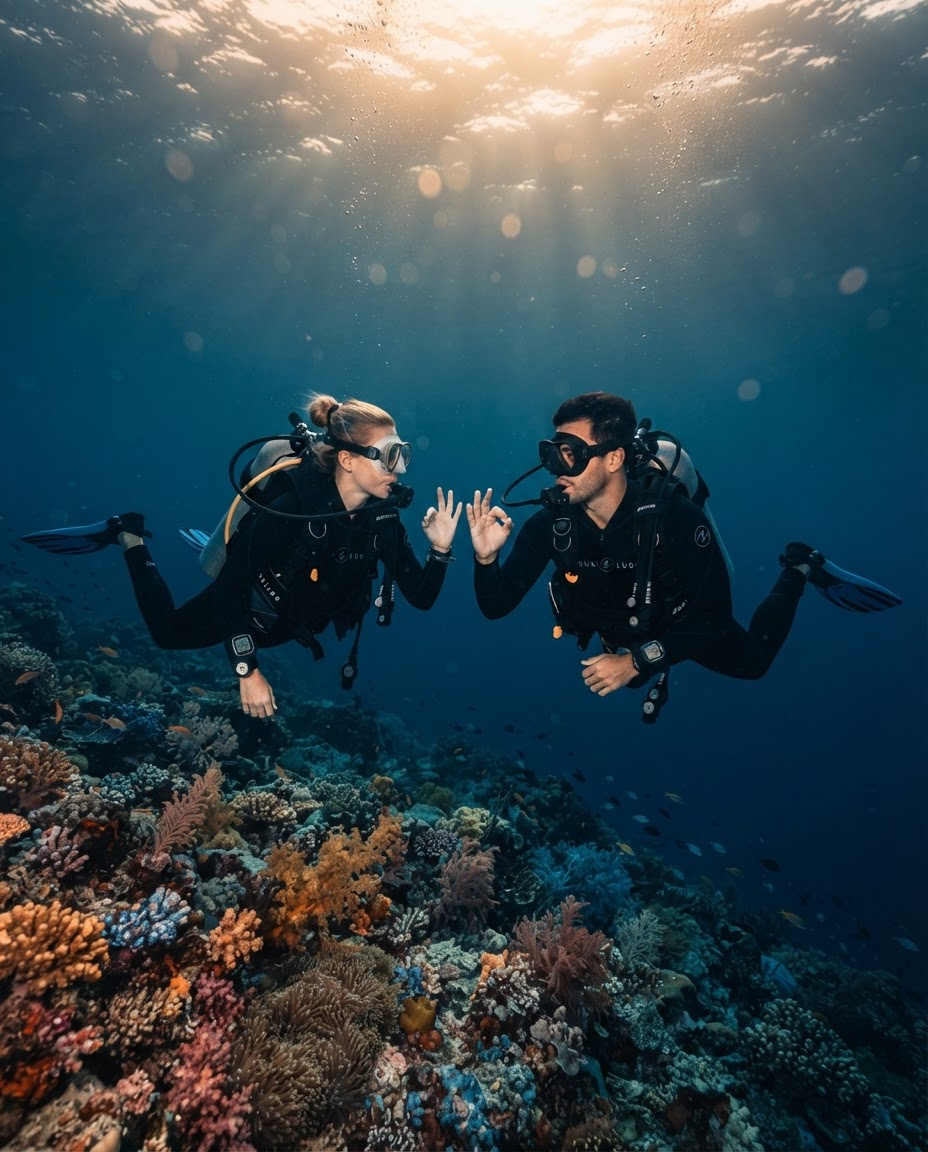
Serotonin — from mastery, competence, and the gradual progression of skills. Every certification level, every new depth, every improved technique delivers a hit of earned satisfaction.
Endorphins — from physical exertion, cold water immersion, and the body's natural response to controlled stress.
Anandamide — the "bliss molecule," which increases in response to novel, rewarding experiences and is associated with the state of flow.
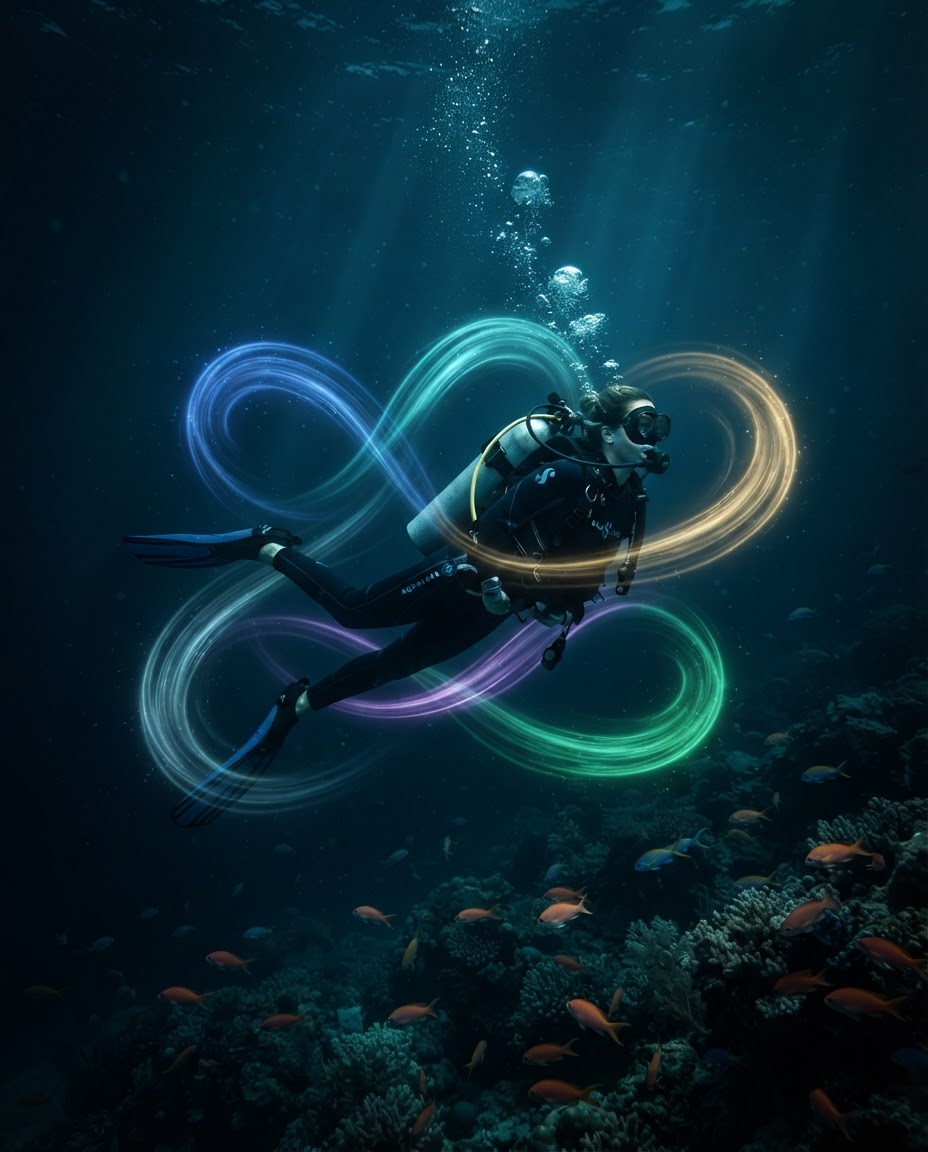
Individually, any of these would be pleasurable. Combined, they create something closer to addiction. But it's not addiction. It's alignment. Your brain has found an activity that satisfies almost every reward pathway simultaneously — and it wants more.
"I used to think I was chasing fish. Then I realized I was chasing a feeling I couldn't get anywhere else." — DeepBeat Tribe Member, 200+ logged dives
The Hidden Risk: Why Divers Sound Like Cult Members to Non-Divers
There is a downside to all of this. And it is social.
Once your brain has experienced the underview effect, once it has tasted the parasympathetic reset, once it has bathed in that neurochemical cocktail — normal life feels slightly... flat. Meetings feel louder. Traffic feels more absurd. The things that used to matter seem smaller.
And when you try to explain it, you sound unhinged.
"You just have to feel it." "It's like meditation, but deeper." "The ocean doesn't care about your job title."
These phrases make perfect sense to divers. To everyone else, they sound like the ramblings of someone who has joined a very specific, very water-based cult.

But the research suggests something else: it's not that divers are disconnected from reality. It's that they have reconnected to a deeper layer of it — one that most people never access because they never submerge long enough to let their brain switch modes.
The Invitation Beneath the Science
We could fill this page with more studies. More statistics. More brain scans and cortisol charts and peer-reviewed papers.
But here's what the science can't capture: the way the light fractures at 15 meters. The sound of your own breathing — the only sound — in a cathedral of blue. The moment a manta ray locks eyes with you and you realize you are not the visitor here. You are the guest.
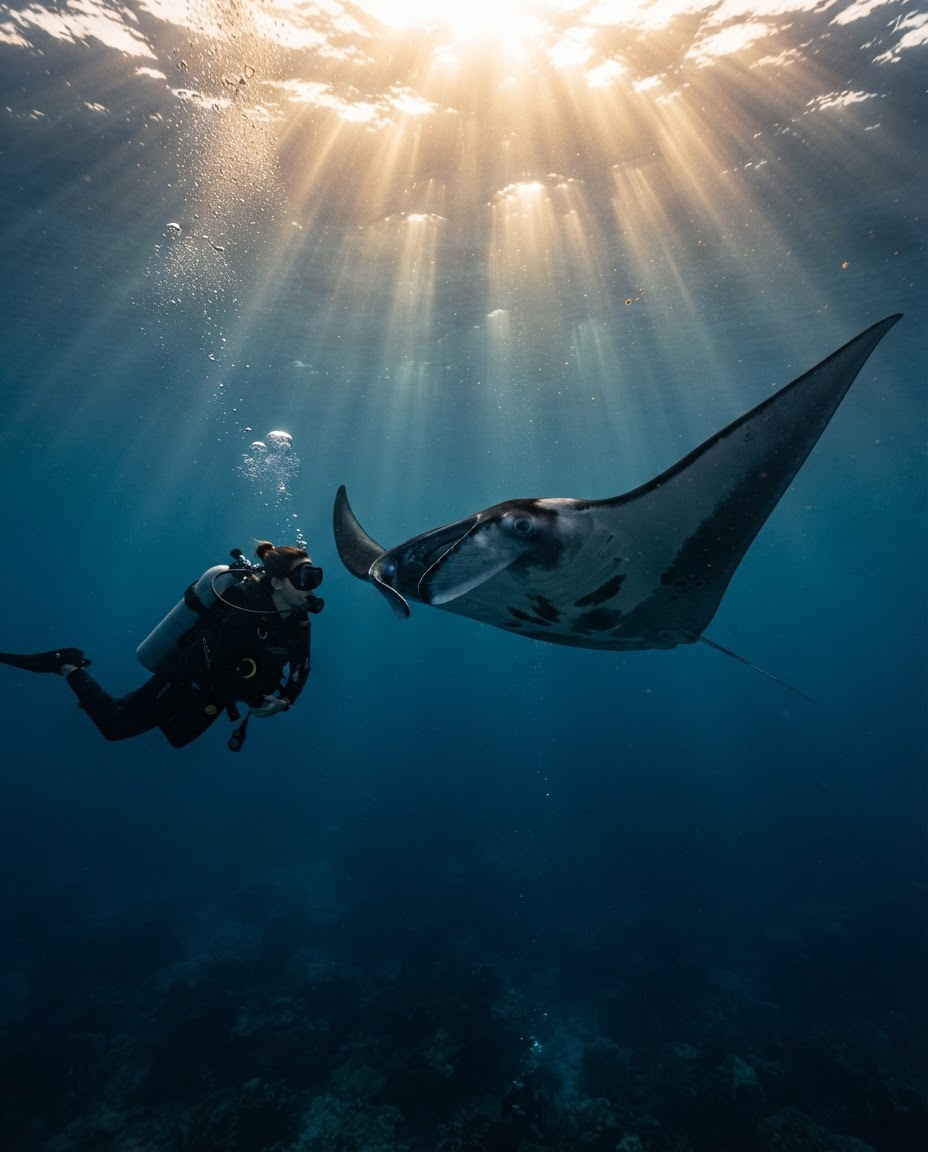
The brain science explains why it feels so good. It doesn't explain why it matters. That part is yours to discover.

🧠 The DeepBeat Dispatch
Every week, we send one deep-dive science story that changes how you see the ocean.
Not a diver yet? Start here. Already certified? Level up.
Join the tribe — get smarter underwater.
📥 Free Download: The 30-Day Dive-Curious Starter Guide
- Week-by-week plan from "curious" to "certified"
- Cost breakdown for Open Water in India, Southeast Asia, and the Maldives
- Anxiety-management techniques for nervous first-timers
- What to expect on your first dive — no surprises, no shame
Subscribe to the DeepBeat Dispatch →
DeepBeatDives is not attended. It is accessed. And the first depth you reach is 18 centimeters — the distance between your ear and your regulator. Everything after that is up to you.
Sources:
- Godde et al. (2022). Frontiers in Psychology — "The Underview Effect: Self-Diminishment in Underwater Environments."
- British Journal of Sports Medicine (2018) — "Scuba Diving and Stress Reduction: A Four-Week Intervention Study."
- Egan et al. (2021). Frontiers in Psychology — "Prefrontal Cortex Deactivation During Submersion: An fNIRS Study."
- Nichols, W.J. (2014). Blue Mind: The Surprising Science That Shows How Being Near, In, On, or Under Water Can Make You Happier, Healthier, More Connected, and Better at What You Do.
- Lemercier et al. (2020). Health Psychology Open — "Longitudinal Well-Being Outcomes in Recreational Divers."