The Question We Hear Most Often in the DeepBeatDives Safety Briefing
"If decompression sickness is so dangerous, why doesn't everyone get it?"
Fair question. And the answer is both simpler and more fascinating than most divers realize.
The truth is, your body is performing a delicate chemical ballet every single second you're underwater. Most of the time, it performs beautifully. But when the music stops too suddenly — when you ascend too fast, skip a safety stop, or board a plane too soon — the consequences can turn a perfect dive into a medical emergency.
At DeepBeatDives, we don't believe in scaring our tribe. We believe in arming you with knowledge. Because the divers who understand why the rules exist are the ones who follow them instinctively — not out of fear, but out of respect for the physics that govern every breath beneath the surface.
This is the briefing we give every guest before their first dive with us. Consider it your invitation to dive smarter.
The Soda Can Secret: Understanding Henry's Law

Let's start with something you've already experienced.
You've opened a bottle of soda. The moment you twist the cap, you hear that satisfying hiss. Bubbles rise to the surface. The drink fizzes. What just happened?
Inside a sealed soda bottle, carbon dioxide gas is dissolved in the liquid under pressure. The gas is there — you just can't see it. When you release the pressure by opening the bottle, the gas comes out of solution and forms bubbles.
Your body does the exact same thing underwater.
This principle is called Henry's Law, named after English chemist William Henry, who described it in 1803. In plain language: the amount of gas that dissolves in a liquid is directly proportional to the pressure of that gas above the liquid.
At the surface, you breathe air at 1 atmosphere of pressure (1 ATA). The nitrogen in that air — about 78% of every breath — dissolves into your blood and tissues at a baseline level. Your body handles this effortlessly. You exhale the excess nitrogen without even noticing.
But every 10 meters (33 feet) you descend, the pressure around you increases by another full atmosphere.
- At 10 meters: 2 ATA — twice the surface pressure
- At 20 meters: 3 ATA — three times the surface pressure
- At 30 meters: 4 ATA — four times the surface pressure
According to Henry's Law, that increased pressure forces more nitrogen to dissolve into your blood and tissues. At 20 meters, you're absorbing roughly three times as much nitrogen as you do on land. At 30 meters, it's four times as much.
🫧 INFOGRAPHIC DESCRIPTION: A split-screen illustration showing a human silhouette at three depths (surface, 20m, 30m) with progressively more blue "nitrogen particles" filling the body. Surface = sparse blue dots. 20m = moderate density. 30m = dense saturation. A simple pressure gauge icon accompanies each depth with "1 ATA," "3 ATA," and "4 ATA" labels. Caption: "The deeper you go, the more nitrogen your body absorbs."
The nitrogen doesn't harm you while you're at depth. It's inert — your body doesn't metabolize it. It simply sits there, dissolved in your tissues like the CO₂ in an unopened soda bottle, waiting for the pressure to change.
And that's where things get interesting.
The Ascent: Why Slow and Steady Saves the Dive

Here's the critical moment: when you begin your ascent, the surrounding pressure decreases. Henry's Law now works in reverse. The nitrogen that dissolved into your tissues under pressure starts coming out of solution.
If you ascend slowly — at the recommended rate of 9–18 meters per minute (30–60 feet per minute), the same controlled pace that separates good buoyancy control from the mistake 90% of certified divers still make — your body has time to transport that nitrogen through your bloodstream to your lungs, where you exhale it harmlessly. Think of it as gently opening that soda bottle — a slow release, manageable bubbles.
But if you ascend too quickly? It's like shaking the soda bottle and popping the cap off. The nitrogen comes out of solution faster than your body can handle it. Microscopic bubbles form in your blood and tissues. These bubbles can block blood vessels, press against nerves, and cause damage to organs.
That, in essence, is decompression sickness (DCS) — commonly known as "the bends."
The name "bends" comes from one of the most characteristic symptoms: joint pain so severe that sufferers literally bend over in agony. But DCS can manifest in far more sinister ways than sore elbows.
Know the Enemy: DCS Symptoms Every Diver Must Recognize
DCS isn't a single condition — it's a spectrum. And the symptoms can appear anywhere from immediately after surfacing to 24 hours later (with most cases showing up within 15 minutes to 12 hours).
The Divers Alert Network (DAN) — the gold standard in dive safety research — classifies DCS into two main types:
Type I DCS (The "Mild" Form — But Don't Be Fooled)
- Joint and muscle pain (especially in large joints: shoulders, hips, elbows, knees)
- Itching or rash (sometimes called "skin bends")
- Fatigue beyond normal post-dive tiredness
- Swelling in lymph nodes
About 75% of DCS cases fall into this category. It might not sound serious, but untreated Type I can progress to Type II. And the pain? Divers describe it as deep, aching, and unlike anything they've felt before.
Type II DCS (The Serious Form — Medical Emergency)
- Numbness, tingling, or paralysis
- Difficulty walking or loss of coordination
- Confusion, memory loss, or altered mental state
- Dizziness, vertigo, ringing in the ears
- Shortness of breath or chest pain (the "chokes")
- Coughing up frothy, bloody sputum
- Unconsciousness
Type II DCS can be life-threatening. It means nitrogen bubbles have reached your brain, spinal cord, or lungs. This is not a "wait and see" situation — this is a "get to a hyperbaric chamber immediately" situation.
💬 PULL QUOTE: "The #1 fear of certified divers? DCI. The #1 way to prevent it? Understanding this one thing."
Here's a statistic that should reassure you while keeping you vigilant: the risk of DCS on a typical recreational dive is approximately 1 in 10,000. That's remarkably low. But here's the catch — most cases are caused by diver error, not equipment failure or unpredictable physiology.
The bends is almost entirely preventable. And prevention starts with understanding the tools we use to stay safe.
The Safety Stop: Your 3-Minute Insurance Policy

Somewhere between 5 and 6 meters (15–20 feet) on your ascent, you pause. You hover. You check your buoyancy. And you wait.
Three to five minutes. That's all.
This is your safety stop, and it's one of the simplest, most effective safety measures in all of scuba diving.
The science behind it is elegant. As you ascend from depth, the pressure drops most dramatically in the final 10 meters. The difference between 20 meters and 10 meters is 1 ATA. The difference between 10 meters and the surface? Another full ATA. That means half of your total pressure change happens in the last third of your ascent.
By pausing at 5 meters for 3–5 minutes, you give your body extra time to off-gas nitrogen in a zone where the pressure is still elevated enough to keep bubbles small — but reduced enough to accelerate the release. It's like letting the soda bottle sit for a few minutes after loosening the cap, before removing it completely.
At DeepBeatDives, our safety team enforces safety stops on every single dive, no exceptions. Not because we're cautious to a fault, but because we've seen what happens when divers skip them.
Think of it this way: a 3-minute safety stop costs you almost nothing. Skipping it could cost you everything.
🫧 INFOGRAPHIC DESCRIPTION: A vertical depth gauge graphic showing ascent from 30m to surface. Highlighted zones: red zone (fast ascent from 30m→10m = danger), yellow zone (safety stop at 5m for 3-5 min = protection), green zone (slow final ascent to surface = safe). Small nitrogen bubble icons get progressively smaller and fewer from bottom to top. Caption: "The Safety Stop: Where bubbles shrink and safety grows."
No-Fly Times: Why Your Post-Dive Flight Can Kill You

Here's a scenario that plays out at dive destinations worldwide:
A diver finishes their final dive at 4 PM. Their flight home departs at 8 PM. Four hours on the surface — that should be plenty of time, right?
Wrong. Potentially dead wrong.
Remember the soda bottle? Now imagine opening it inside a commercial airplane cabin, where the pressure is equivalent to being at 1,800–2,400 meters (6,000–8,000 feet) above sea level — significantly lower than sea-level pressure.
Even hours after surfacing, your body still contains residual nitrogen. If you ascend to altitude too soon, the additional pressure drop can trigger exactly the same bubble formation you were trying to avoid underwater. Divers have developed DCS while sitting in their airplane seats, hours after what seemed like an uneventful dive.
The industry consensus, backed by DAN, is clear:
| Dive Profile | Minimum Wait Before Flying |
|---|---|
| Single no-decompression dive | 12 hours |
| Multiple dives in a day | 18–24 hours |
| Multiple days of diving | 24 hours |
| Dives requiring decompression stops | 48 hours |
At DeepBeatDives, our standard policy is simple: 24 hours minimum between your last dive and any altitude exposure — including flights, mountain drives, or even ziplining at elevation. It's not negotiable because it's not our rule — it's physics.
🫧 INFOGRAPHIC DESCRIPTION: A timeline graphic showing a diver's last dive at 4 PM, with a "NO-FLY ZONE" red bar extending to 4 PM the next day. A small airplane icon appears just after the red zone ends, with a green checkmark. Below, a smaller caution showing a diver inside an airplane with expanding nitrogen bubbles and a red X. Caption: "The 24-hour rule isn't paranoia. It's physics."
Dive Tables vs. Dive Computers: The Evolution of Safety
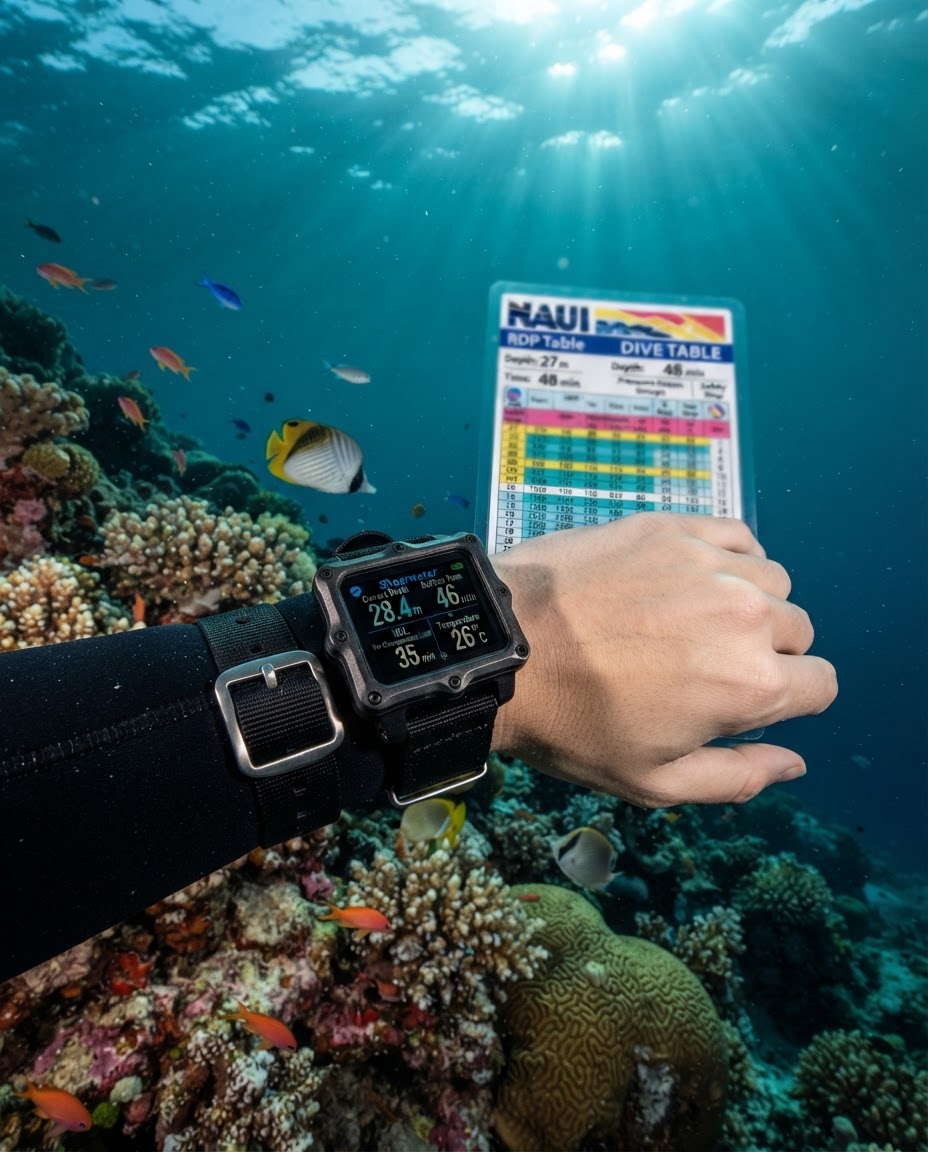
Once upon a time, divers carried laminated plastic cards called dive tables — mathematical charts developed by the U.S. Navy in the mid-20th century. These tables told you how long you could stay at a given depth before requiring decompression stops.
The concept was revolutionary for its time. But dive tables had a critical limitation: they assumed every dive was a "square profile." That means they calculated your nitrogen exposure as if you spent your entire bottom time at your maximum depth. If you dove to 25 meters but spent half your time at 15 meters, the table didn't care. It assumed the worst-case scenario.
This made tables conservative — sometimes excessively so. Divers often had to cut their dives short because the math couldn't account for real-world behavior.
Then came dive computers.
A dive computer is essentially a tiny, waterproof computer strapped to your wrist. It measures your depth every few seconds and continuously recalculates your nitrogen load in real-time using mathematical models of how different body tissues absorb and release gas.
The advantage is enormous. If you dive to 25 meters but then ascend to 15 meters to explore a coral wall, your computer knows. It adjusts your no-decompression time accordingly, often giving you significantly more bottom time than tables would allow — while staying within safe limits.
As the Ocean Foundation notes, "Dive computers are devices that can be programmed with a variety of decompression models (algorithms) and are able to calculate decompression status on the fly using the actual dive profile, thus freeing divers from the limitations of decompression table formats."
But here's what every diver must understand: computers are tools, not oracles.
Different computer brands use different algorithms. Some are more conservative than others. And no algorithm knows your individual physiology — your age, hydration level, body composition, or whether you have a patent foramen ovale (PFO), a heart condition that increases DCS risk by up to 5 times.
💬 PULL QUOTE: "Many divers have blind faith in their computers and assume that following the computer will always be a protection from DCS. This is no more true of computers than tables." — Diving Hyperbaric Medicine Journal
The best divers don't choose between tables and computers — they understand both. They use their computer as their primary tool but keep a backup timer and depth gauge. They know their computer's algorithm and whether it runs conservative or liberal. And they never, ever let their no-stop time drop below 5 minutes before ending a dive.
Our recommendation: Use a dive computer. Always. But understand what it's doing, not just what it's saying. The diver who blindly follows numbers on a screen is only slightly safer than the diver who follows none at all.
The Myth-Busting Sidebar: What Actually Causes DCS?
Let's clear up some common misconceptions:
❌ Myth: "You only get the bends from deep diving." ✅ Truth: DCS can occur on shallow dives too. Repetitive shallow dives can accumulate more nitrogen than a single deep dive. Depth matters, but so does time and frequency.
❌ Myth: "If you follow your computer, you're 100% safe." ✅ Truth: Computers reduce risk dramatically, but DCS can still occur within no-decompression limits. Individual physiology varies. Hydration, fitness, age, and even dehydration all play a role.
❌ Myth: "Alcohol after diving is fine if you wait an hour." ✅ Truth: Alcohol contributes to dehydration — a known DCS risk factor — and can mask early symptoms. Best practice? Wait several hours, hydrate first, and keep it moderate.
❌ Myth: "Hot showers and baths help after a dive." ✅ Truth: Heat increases circulation, which can accelerate nitrogen release too quickly. Warm showers are fine, but hot tubs and saunas should wait until your body has fully off-gassed — part of the same panic-to-presence physiological reset divers experience once they surface.
The Bottom Line: Respect the Physics, Trust the Process
Decompression theory isn't just for technical divers, instructors, or physicists. It's for every single person who straps on a tank and descends below the surface.
The good news? You don't need to memorize equations or understand tissue half-times to dive safely. You need to understand four things:
- Pressure dissolves nitrogen into your body. The deeper you go, the more you absorb.
- Slow ascent lets your body release it safely. Fast ascent creates bubbles. Bubbles create problems.
- Safety stops work. That 3-minute pause at 5 meters is your best defense.
- Altitude is the enemy of off-gassing. Respect no-fly times as seriously as you respect depth limits.
At DeepBeatDives, we believe that safety and wonder aren't opposites — they're partners. The better you understand the physics, the more confidently you can explore. And the more confidently you explore, the deeper the ocean reveals itself.
Dive Doctor's Inbox 💌
Every week, we answer one safety question from the tribe — the kind you might be too embarrassed to ask your instructor. From nitrox myths to rescue scenarios, no question is too basic and no detail too small.
This week's question: "I did two dives yesterday and feel fine. Can I really not fly today?"
Our answer: We get this one constantly. And we get it — you've paid for the flight, the taxi is booked, and you feel absolutely fine. But DCS doesn't care how you feel. Symptoms can be delayed up to 24 hours, and altitude exposure is the single biggest trigger for turning "fine" into "medical emergency." We've seen divers develop symptoms at 30,000 feet who felt perfect on the boat. The 24-hour rule isn't paranoia. It's the difference between a story you tell at dinner and a story told about you. Wait. Hydrate. Fly tomorrow. The ocean will still be there.
Your Next Step: The Safety-First Diver's Checklist
📋 Download The Safety-First Diver's Checklist: 10 Things to Know Before Every Dive — a free PDF we give every guest at DeepBeatDives. It covers pre-dive checks, ascent protocols, emergency procedures, and the post-dive habits that separate safe divers from sorry ones.
Join the tribe to get the Checklist and the DeepBeat Dispatch.
Safety isn't boring. It's what lets you go deeper. Subscribe to the DeepBeat Dispatch for the weekly safety brief — one question, one answer, one reason to dive smarter.
Join the tribe. Get the ocean's best-kept secrets delivered to your inbox.
Published by DeepBeatDives | The world's first premium deep-sea scuba + music destination festival. Coming to the Maldives, November 2026.