
The cheat sheet our marine biologists use on the Maldives reef at dawn. What to look for. What it means. And why it changes everything.
There is a moment on every reef dive when something shifts.
You've cleared your ears, found your buoyancy, and you're drifting along the coral wall when it happens. The chaos resolves into patterns. The "pretty colors" become language. The fish aren't random anymore — they're characters in a story. And you realize the reef isn't just a backdrop for your Instagram story. It's a living, breathing text that you can learn to read.
Most divers never get past the first page. They see a parrotfish. They photograph a sea turtle. They surface with a memory — but not an understanding. And that's fine. The ocean doesn't demand literacy.
But once you learn to read a reef, diving changes forever. Every descent becomes a detective story. Every coral formation becomes a clue. Every fish behavior becomes a sentence in a narrative written in salt water and sunlight. You don't just see more. You understand more. And understanding is the gateway to awe.
This is what marine biologists do every day. And here's the secret: most of it isn't PhD-level science. It's pattern recognition. It's knowing what questions to ask. And it's noticing the details that everyone else swims past.
At DeepBeatDives, our marine biologists spend every dawn dive on the Maldives reef reading these underwater texts. We've distilled their field notes into this guide — a visual, practical manual that will transform how you see every reef you ever dive. Think of it as marine biology for divers: no PhD required, just curiosity and a willingness to look closer. By the end, you'll have a working knowledge of coral reef identification that changes every descent.
Welcome to the tribe's reading list. The reef is open.
The First Principle: The Reef Is Not Decoration
Before we get to identification cards and checklists, we need to reframe how you look at coral. Because the biggest barrier to reading a reef isn't knowledge — it's assumption.
Most divers approach a reef like tourists approaching the Louvre. They walk in, look at the famous paintings, take a photo, and leave. But a marine biologist approaches a reef like a detective approaching a crime scene. Every detail means something. Nothing is random.
That cluster of staghorn coral? It's not just "pretty branching coral." It's a habitat engineer that provides shelter for over 150 species of fish. That school of fusiliers streaming past like silver confetti? They're not just "fish." They're indicators of current flow, water temperature, and plankton abundance. That sea urchin tucked in a crevice? It's a grazing machine that keeps algae from smothering the coral — or, if it's absent, a warning sign that the predators that control its population have been overfished.
The reef is an ecosystem in constant conversation with itself. Your job as a reader is to eavesdrop on that conversation. And once you start listening, you can't unhear it.
Here's the framework our biologists use on every dive:
Start wide, then zoom in. Begin with the big picture — reef zone, current direction, water clarity, overall color. Then focus on specific formations and their inhabitants. The context shapes everything.
Look for relationships, not objects. Don't just identify what you see. Notice who is near whom, who is eating what, who is hiding from whom. The drama of the reef is relational.
Ask "Why here? Why now?" Every organism on a reef is there for a reason. If you can answer those two questions, you're thinking like a marine biologist.
Document what you don't understand. The best reef readers aren't the ones who know everything. They're the ones who know what they don't know — and come back to learn.
Coral Architecture: The Skeleton of the Story
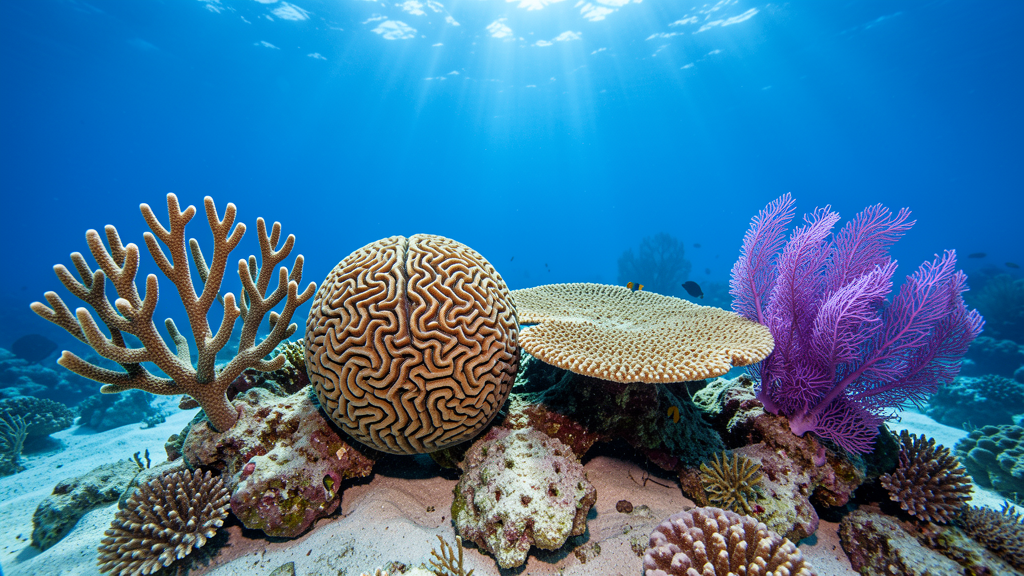
Coral is the foundation of everything on a reef. Literally. But not all coral is created equal, and different coral types tell very different stories about the reef's health, age, and history. Learning coral reef identification — recognizing the major growth forms — is the first skill any reef reader develops.
Our biologists divide coral identification into four categories, each with distinct visual signatures and ecological meaning:
Branching Coral: The Skyscrapers of the Shallows
What to look for: Tree-like, antler-shaped, or finger-like structures that grow upward toward the light. Staghorn coral (Acropora cervicornis) and elkhorn coral (Acropora palmata) are the classic examples, though in the Maldives you'll primarily encounter various Acropora species with their distinctive branching forms.
What it means: Branching corals are the reef's architects. They create the three-dimensional structure that makes coral reefs the most biodiverse ecosystems on Earth — home to roughly 25% of all marine species despite covering less than 1% of the ocean floor. When the Ocean Census announced 1,121 new species, many were found in exactly this kind of complex coral habitat. Healthy branching coral indicates good light penetration, moderate water flow, and a reef in its growth phase.
Red flags: If you see broken branches scattered on the reef floor, recent storm damage or anchor impact may have occurred. If the branches are pale or white, you're looking at bleaching — the coral expelling its symbiotic algae due to heat stress. According to Reef Check Malaysia's 2025 survey data, mass coral bleaching events continue to threaten reef health across the Indian Ocean region. White, skeleton-like branching coral without tissue is dead coral — a ghost of structure that may soon be overgrown by algae.
Boulder/Brain Coral: The Ancient Sentinels
What to look for: Massive, rounded formations that look like giant brains, boulders, or domes. Brain corals (Platygyra, Symphyllia) have characteristic maze-like ridges. Boulder coral (Porites) forms solid, rock-like mounds that can grow to the size of a car.
What it means: These are the old souls of the reef. Massive corals grow slowly — sometimes just 1 centimeter per year — but they live for centuries. The largest Porites colonies in the Maldives may be over 500 years old. Their presence indicates a stable, mature reef that has weathered decades or centuries of storms, heat waves, and human impact. When you see massive coral dominating a reef, you're looking at a reef with history.
Red flags: Look for dark spots, banding, or tissue loss on these ancient structures. Coral diseases often target massive corals, and their slow growth means recovery takes decades, not years.
Table/Plate Coral: The Sun Catchers
What to look for: Flat, plate-like structures that extend horizontally like underwater tables or shelves. Acropora species dominate this form in the Maldives, creating tiered formations that can stack like underwater wedding cakes.
What it means: Table corals are light maximizers. They grow in horizontal planes to capture as much sunlight as possible for their symbiotic algae. You'll find them in slightly deeper water (10–25 meters) where light begins to attenuate, or in areas where competition for sunlight is fierce. Their presence indicates a healthy photosynthetic base and a reef with good water clarity.
Red flags: Broken table edges or overturned plates suggest recent physical damage — from storms, anchors, or careless diver contact. Table corals are fragile; a single fin kick can destroy decades of growth.
Soft Coral: The Flow Dancers
What to look for: Flexible, flowing structures that sway with the current. Unlike hard corals with their rigid calcium carbonate skeletons, soft corals (Alcyonacea) are flexible and often brightly colored — purples, yellows, oranges, and reds that look like underwater gardens in bloom.
What it means: Soft corals are the poets of the reef. They thrive in areas with moderate to strong current, which brings them food and oxygen. In the Maldives, soft coral gardens are signature habitats — particularly in channels and around thilas (submerged pinnacles) where current flow is consistent. Their presence indicates good water movement and, often, a reef with lower sedimentation.
Red flags: Retracted polyps, dull coloration, or excessive mucus production indicate stress — often from temperature spikes, sedimentation, or pollution.
The Coral Color Code: What Hue Tells You
Our biologists use a simple color-based health assessment:
- Vibrant, saturated colors (deep greens, rich browns, bright purples): Healthy, thriving coral with dense symbiotic algae (zooxanthellae). This is what you want to see.
- Pale or pastel versions of normal color: Early-stage bleaching. The coral is stressed and has expelled some zooxanthellae. Recovery is possible if conditions improve.
- Bright white: Severe bleaching. The coral skeleton is visible through translucent tissue. Without symbiotic algae, the coral is starving. Recovery is possible but not guaranteed.
- Fluorescent neon colors (glowing pinks, blues, yellows): Some corals produce fluorescent proteins as a protective response to stress — a kind of "sunscreen" against excessive light. It's beautiful but potentially a warning sign.
- Brown, fuzzy, or filamentous overgrowth: Algae colonization. This is often the first stage of reef degradation, where algae outcompete coral for space and light.
- Bare white skeleton with no tissue: Dead coral. The structure may remain for years, but the living organism is gone.
The Fish Are Talking: Behavior as Language
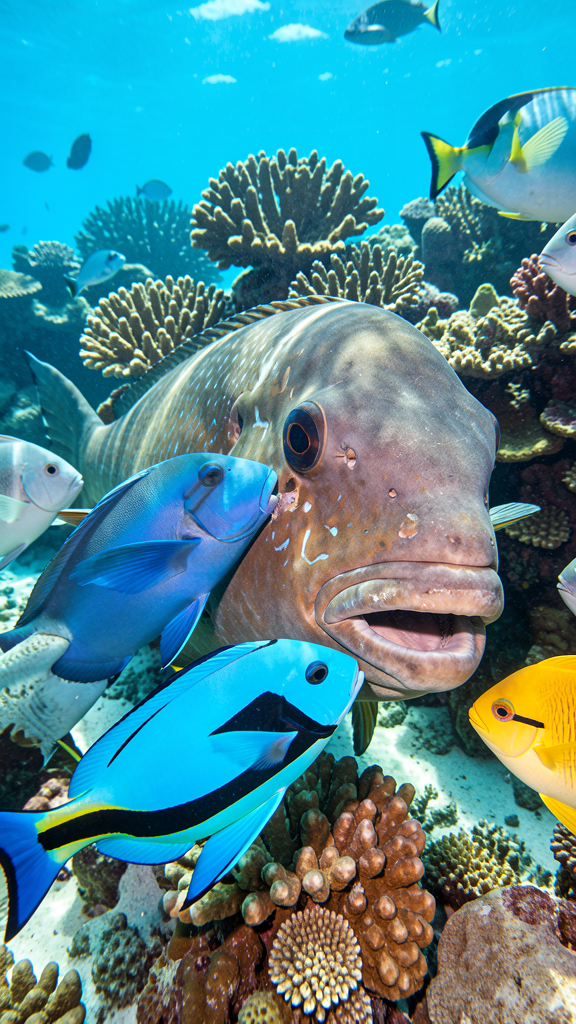
If coral is the reef's skeleton, fish are its bloodstream — constant motion, constant communication, constant interaction. And fish behavior underwater is the most accessible entry point into reef reading because it's dynamic, dramatic, and often hilarious.
Here are the behavioral patterns our biologists watch for on every dive:
The Cleaner Station: The Reef's Health Clinic
What to look for: Small, brightly colored wrasses or shrimp gathered at prominent coral outcrops or rocky ledges. Larger fish — groupers, barracuda, even sharks — line up like patients at a doctor's office, mouths agape or fins extended.
What it means: You're watching the reef's healthcare system in action. Cleaner wrasses (Labroides dimidiatus) and cleaner shrimp remove parasites, dead tissue, and debris from other fish. The behavior is so reliable that entire food webs depend on it. A healthy reef will have multiple active cleaner stations. Their absence can indicate overfishing (cleaner fish are often targeted for the aquarium trade) or ecosystem stress.
Maldives signature: Look for the Bluestreak Cleaner Wrasse — a small fish with a black stripe running from head to tail, neon blue body, and an attitude far larger than its size. They're common on Maldivian reefs and fearless around divers.
The Bait Ball: Panic in Silver
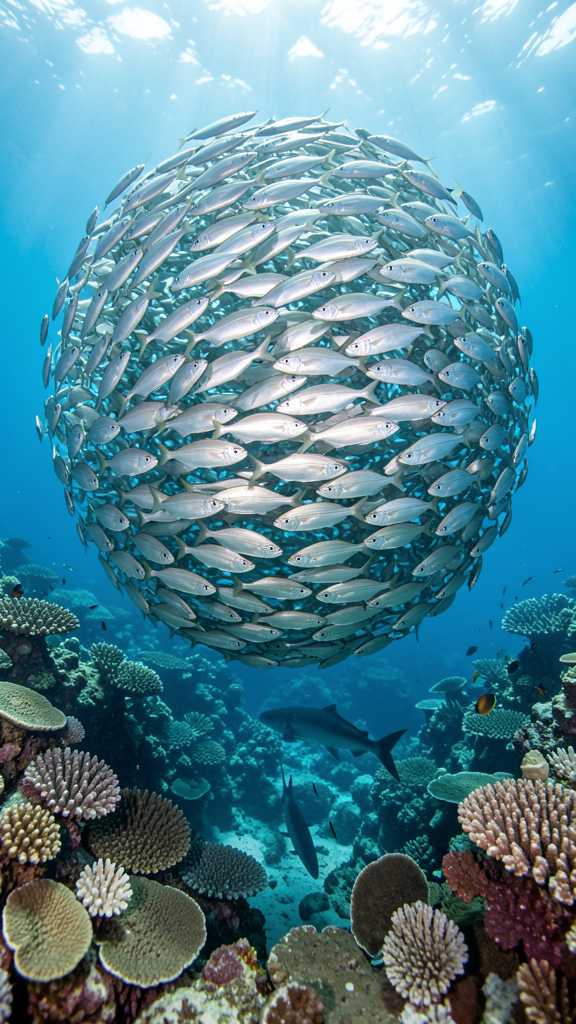
What to look for: A dense, swirling ball of small fish (fusiliers, anchovies, or sardines) that moves as one organism, constantly changing shape as if controlled by a single mind.
What it means: This is fear made visible. The bait ball forms when small fish are being hunted from below. The swirling mass confuses predators and reduces the chance of any individual being picked off. If you see a bait ball, look deeper — there's almost always a predator driving the behavior. Trevallies, barracuda, or sharks are likely circling below.
The deeper read: A healthy reef produces enough small fish to sustain regular bait ball formations. If you never see them, it may indicate overfishing of the small fish that form them or the predators that drive them.
The Stationary Hover: Territory Defense
What to look for: A single fish hovering in one spot, often near a coral bommie or rock formation, facing outward with fins slightly spread. Damselfish are the classic example — tiny fish with massive territorial attitudes.
What it means: This fish is guarding something. Usually a nest of eggs, a preferred feeding spot, or a shelter crevice. Damselfish are particularly aggressive defenders, known to "attack" divers many times their size. The behavior indicates a reef with stable territory structures — the coral or rock formations that enable territoriality.
The Maldives example: The Maldives is home to several aggressive damselfish species, including the ubiquitous Dascyllus carneus, which forms dense schools in branching coral heads. Their presence in large numbers is actually a good sign — it means the coral structure is complex enough to support their social system.
The Shadow Follow: Commensalism in Action
What to look for: A smaller fish swimming just above or beside a larger fish, matching its movements perfectly. Remoras attaching to sharks, rays, or turtles. Small jacks swimming in the slipstream of large groupers.
What it means: This is the reef's public transportation system. The smaller fish gets protection, food scraps, or reduced drag. The larger fish may get parasites removed or simply tolerates the hitchhiker. Commensal relationships are everywhere once you start looking for them.
The Maldives signature: Brown remoras (Remora remora) are common in Maldivian waters, often attaching to whale sharks, manta rays, or even sea turtles. Their distinctive sucking disc — a modified dorsal fin — is unmistakable once you've seen it.
The Sand Cloud: Feeding Frenzy
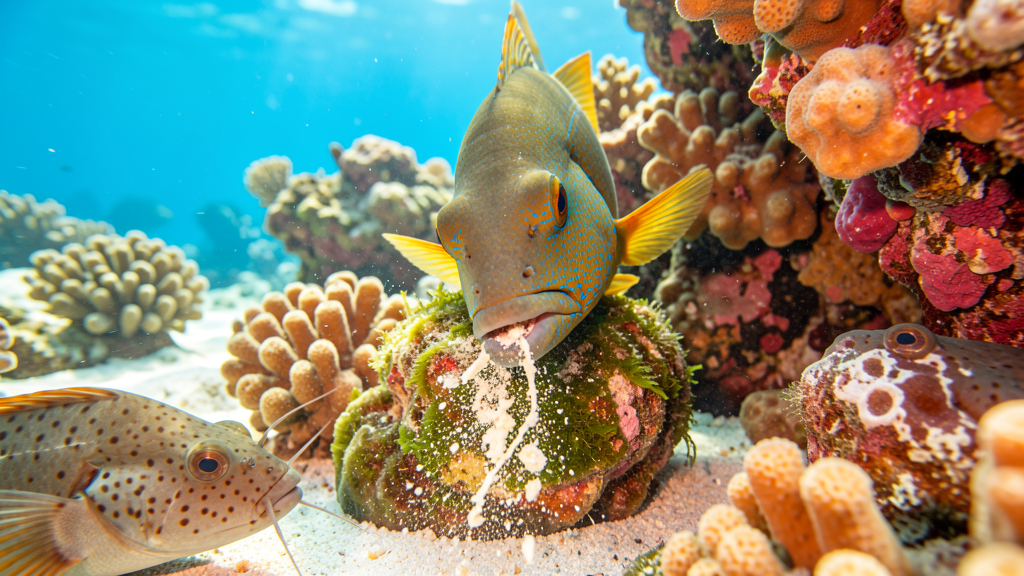
What to look for: Puffs of sand or sediment rising from the reef floor. Goatfish with their whisker-like barbels buried in the sand. Parrotfish scraping algae from coral with their beak-like mouths.
What it means: The reef is eating. Goatfish use their barbels to detect invertebrates buried in the sand. Parrotfish are the reef's lawnmowers — a single parrotfish can consume over 5 tons of reef material per year, much of which is excreted as the fine white sand that makes Maldivian beaches famous. If you see active feeding, you see a functioning ecosystem.
The Maldives angle: The Maldives has over 2,031 distinct coral reefs covering 3.14% of global reef area. Parrotfish are particularly crucial here — without their grazing, algae would overgrow the coral, and without their sand production, the iconic white-sand islands would erode.
Ecosystem Signatures: Reading the Reef's Vital Signs
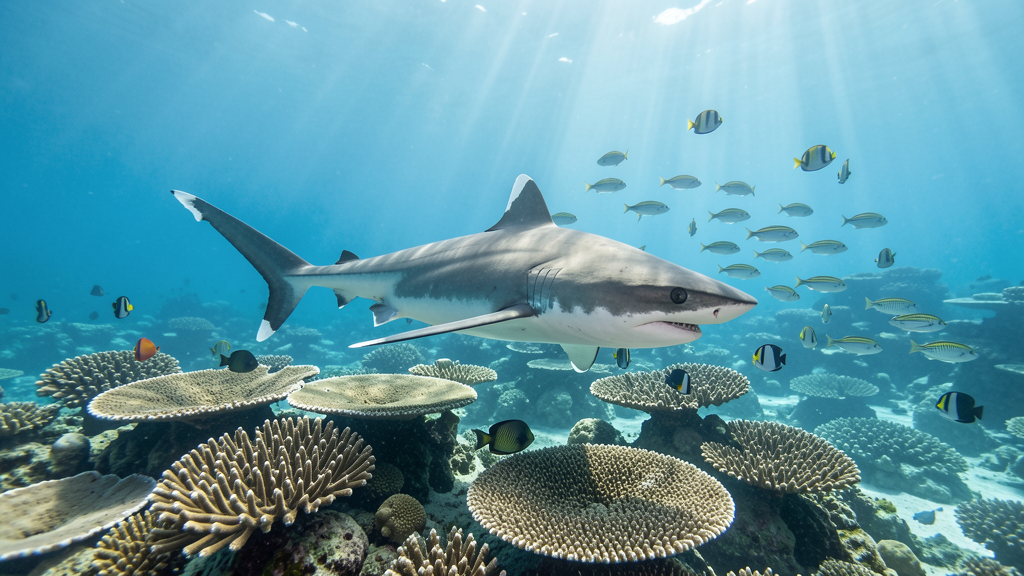
Beyond individual species, our biologists look for ecosystem-level patterns that reveal the reef's overall health. These are the vital signs — reef health indicators that act as the pulse, temperature, and respiration of the underwater world.
The Predator Pyramid
On a healthy reef, you should see a pyramid of predator abundance: lots of small fish, fewer medium fish, and a small number of large predators. This is the natural order.
If you see no large predators — no sharks, no large groupers, no big barracuda — but plenty of small fish, you're likely diving on an overfished reef. In the Maldives, sharks and rays are protected by law, and healthy reefs should have regular sightings of whitetip reef sharks, grey reef sharks, and the occasional silvertip on deeper walls.
The Maldives reef shark guide:
- Whitetip Reef Shark: Slender body, distinctive white tips on first dorsal and tail fins, square snout. Often seen resting in caves or on sandy bottoms during the day. They don't need to swim to breathe — a unique adaptation among reef sharks.
- Grey Reef Shark: Slender body, no white fin tips, broad black margin on tail. Found in strong current areas. Known for a dramatic hunched threat display when feeling threatened — a warning, not an attack.
- Silvertip Shark: Rounded snout, conspicuous white tips on all fins. Deeper channels and outer reef walls. More open-water swimmer, often seen cruising along drop-offs.
The Herbivore Index
Parrotfish, surgeonfish, and rabbitfish are the reef's gardeners. Their job is to eat algae before it overgrows the coral. On a healthy reef, you should see constant grazing activity — fish scraping, nipping, and browsing across the coral surface.
If the reef is covered in fuzzy brown or green algae and you see few herbivores, the ecosystem is out of balance. This can happen due to overfishing of herbivorous fish or nutrient pollution from land-based sources (agricultural runoff, sewage) that fertilizes algae growth.
The Invertebrate Indicator Panel
Reef Check, the global citizen science program founded in 1996 (reefcheck.org), identified 16 global indicator organisms that best reflect reef health. Our biologists keep a mental checklist of these on every dive:
Butterflyfish (Chaetodontidae): Sensitive to coral condition. Their presence in healthy numbers indicates good coral cover and diversity. Absence or scarcity suggests coral degradation or overfishing.
Parrotfish >20cm (Scaridae): Critical herbivores. Large parrotfish are often the first to disappear from overfished reefs. Their presence indicates a functioning grazing ecosystem.
Grouper >30cm (Serranidae): Apex predators and keystone species. Large groupers are rare on most reefs now due to overfishing. Seeing one is a privilege — take notes, not selfies that disturb them.
Moray Eels (Muraenidae): Top predators that control fish populations. Their presence indicates a balanced food web.
Humphead Wrasse (Cheilinus undulatus): The most sought-after fish in the live food trade and an excellent indicator of fishing pressure. Adults can reach over 2 meters. Seeing one is like seeing a unicorn on most reefs, but the Maldives' protected waters still hold healthy populations.
Banded Coral Shrimp (Stenopus hispidus): Collected for the aquarium trade. Their presence indicates low collection pressure.
Long-Spined Sea Urchin (Diadema spp.): In high numbers, these indicate overfishing of their predators (triggerfish, pufferfish). Absence may indicate past disease outbreaks — a Diadema mass mortality event in 1983 devastated Caribbean reefs and changed coral ecology forever.
The Soundscape Signal
Here's something most divers never consider: healthy reefs are noisy. Degraded reefs are silent. If you've ever wondered why sound travels 5x faster underwater, the reef's soundscape is the perfect place to hear it in action.
A healthy coral reef is a cacophony of snaps, crackles, pops, and grunts — fish feeding, shrimp snapping, coral polyps clicking. The sound of a healthy reef can be heard from kilometers away by larval fish searching for a place to settle. When a reef degrades, the first thing to disappear isn't the coral or the fish — it's the sound.
Marine biologists now use hydrophones to monitor reef health remotely, and the results are stark. A dying reef goes quiet before it goes white. If you're on a reef and the underwater world sounds like a library, pay attention. Something is wrong.
At DeepBeatDives, we're obsessed with this soundscape. It's one reason our underwater music experiences feel so profound — we're adding to a conversation that's been happening for millions of years. When you hear a healthy reef, you hear the ocean's heartbeat.
The Spotter's Checklist: Your Field Companion
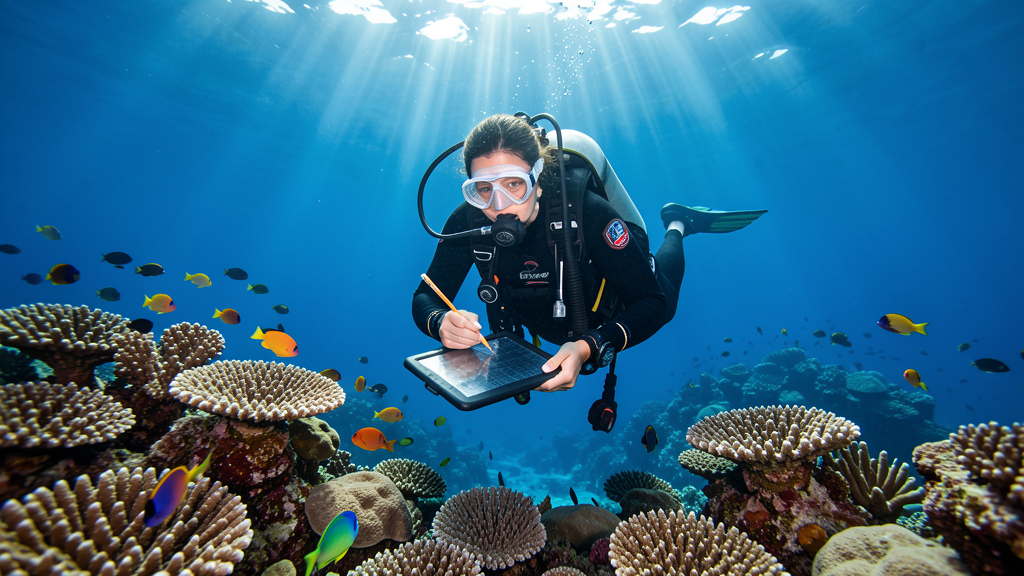
Print this. Laminate it. Take it on every dive. Our marine biologists use a version of this on every survey, and it's the fastest way to build your reef literacy.
Pre-Dive: Set Your Intention
- What zone of the reef am I diving? (lagoon, reef flat, reef slope, wall, channel)
- What's the current direction and strength?
- What's the water temperature and visibility?
- What was the tide at entry?
During the Dive: The 5-Minute Scan
Every 5 minutes, pause and scan:
- Coral cover: What percentage of the bottom is live coral vs. sand vs. algae?
- Coral health: What colors do I see? Any bleaching, disease, or damage?
- Fish abundance: Are there schools of small fish? Any large predators?
- Key species: Can I spot any Reef Check indicator organisms?
- Behavior: What are the fish doing? Feeding, cleaning, territorial defense?
- Physical signs: Any trash, anchor damage, or sedimentation?
Post-Dive: The 3-Minute Log
Before you peel off your wetsuit, answer these:
- What was the healthiest thing I saw?
- What was the most concerning thing I saw?
- What did I not understand that I want to research?
- Did I see anything I've never seen before?
The Maldives Quick-ID Card
Common Coral Types: (Maldives coral identification quick reference)
- Staghorn (Acropora) — branching, tree-like, shallow water
- Table (Acropora) — flat, plate-like, horizontal growth
- Brain coral (Platygyra) — maze-like ridges, massive form
- Finger coral (Porites) — cylindrical branches, stubby fingers
Common Fish Families:
- Butterflyfish — disk-shaped, small mouths, coral feeders
- Parrotfish — beak-like fused teeth, scrape algae from coral
- Surgeonfish — oval body, sharp spine near tail (the "scalpel")
- Grouper — large mouth, heavy body, ambush predator
- Trevally/Jacks — streamlined, fast, often in schools
- Snapper — sloped forehead, canine teeth, nocturnal hunter
- Wrasse — elongated, protractile mouth, often brightly colored
- Damselfish — small, territorial, often in coral heads
Indicator Invertebrates:
- Giant clam (Tridacna) — massive bivalve, iridescent mantle
- Banded coral shrimp — red and white bands, cleaner
- Sea cucumber — elongated, sausage-like, sand feeder
- Crown-of-thorns starfish — venomous spines, coral predator (BAD SIGN)
Citizen Science: When Observation Becomes Contribution
Here's where reef reading becomes something bigger than personal enrichment. Your observations matter. They can contribute to global databases that track reef health, inform conservation policy, and direct restoration funding. This is citizen science diving at its best — turning every dive into data.
Reef Check: The Gold Standard
Founded in 1996, Reef Check is the world's largest international coral reef monitoring program. It was designed specifically for non-scientists — trained volunteer divers who collect standardized data on reef health using simple, repeatable methods.
In 2025, citizen science projects in marine protected areas increased data collection by over 300% compared to traditional scientific surveys alone. Your dive can be part of that.
The Reef Check protocol is straightforward:
- Site description: Record environmental conditions, human impacts, and site characteristics.
- Substrate survey: Swim along a 100-meter transect and record what's on the bottom every 0.5 meters — live coral, dead coral, rock, sand, algae.
- Invertebrate counts: Count indicator invertebrates in a 5-meter wide belt along the transect.
- Fish counts: Count indicator fish species in the same belt.
Data is submitted to a global database where scientists analyze trends, identify threats, and prioritize conservation action. One dive, one data point. Hundreds of dives, a dataset that changes policy.
iNaturalist & AI-Powered ID
For the tech-forward diver, apps like iNaturalist allow you to photograph species and submit observations with GPS coordinates. The app's AI can often identify species automatically, and the global community of naturalists confirms or corrects the ID.
Newer tools are even more powerful. AI-powered image recognition can now identify coral species and assess health from a simple photograph. Underwater drones (ROVs) can survey areas too deep for recreational divers. And eDNA sampling — collecting water samples that contain genetic material from every organism that has passed through — can reveal species presence without ever seeing them.
The DeepBeatDives Reef Brief
At DeepBeatDives, we believe every diver is a potential scientist. That's why we're building the Weekly Reef Brief — a citizen science program that turns your Maldives dives into data.
Here's how it works: Before your dive, you receive a briefing on what species and behaviors to look for. During your dive, you use a waterproof spotter's checklist (included in your welcome kit). After your dive, you submit your observations via a simple mobile form. Our marine biologists compile the data weekly and share the results with the tribe — reef health trends, species sightings, behavioral observations.
It's not just science. It's belonging. You're not just visiting the reef. You're part of its story.
The Maldives Reef: A Case Study in Blue
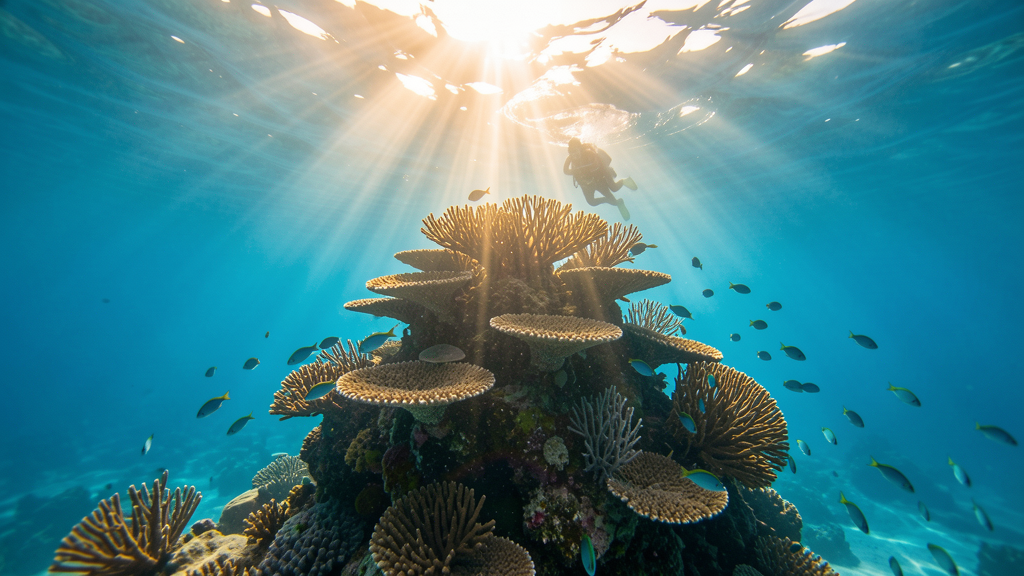
Let's put this all together with a real example — a typical dawn dive on a Maldivian thila (submerged pinnacle).
You descend through 15 meters of clear blue water. As the thila comes into view, you start wide. The pinnacle rises from 30 meters to 5 meters below the surface, its top encrusted with table corals that catch the morning light like underwater solar panels. The current is moderate, coming from the northeast — you can tell by the direction the soft corals are leaning, all pointing southwest like weather vanes.
You zoom in. The table corals are vibrant brown with hints of purple — healthy, photosynthesizing, thriving. Between them, staghorn coral creates a dense forest of branches where schools of blue-green chromis dart in and out like neon sparks.
You notice a cleaning station at 12 meters. A Bluestreak Cleaner Wrasse is working on a parrotfish twice its size, the client hovering patiently with mouth agape. This tells you the reef has stable territory structures and low fishing pressure — cleaner fish are among the first to disappear from overharvested reefs.
At 18 meters, you spot a humphead wrasse cruising along the wall. It's over a meter long, its forehead bulging with age and authority. This is a unicorn sighting on most reefs, but here in the Maldives' protected waters, it's a sign that the ecosystem is intact enough to support large, long-lived predators.
You hear the reef before you see the next clue — a constant snap-crackle-pop of pistol shrimp and feeding fish. The soundscape is rich, layered, alive. This is not a quiet reef.
On the sandy bottom at 25 meters, a school of goatfish probes the sediment with their barbels, sending up puffs of white sand. Nearby, a giant clam the size of a suitcase gapes its iridescent mantle — blue, green, and gold catching your dive light like a stained-glass window.
You complete your 5-minute scan. Coral cover: roughly 60% — excellent. Fish abundance: high, with multiple schools and several large individuals. Key species: parrotfish, butterflyfish, grouper, snapper, wrasse — all present in healthy numbers. Behavior: active feeding, cleaning, territorial defense — a functioning ecosystem.
This is a healthy reef. You know it not because someone told you, but because you read the signs. You understood the language. And that understanding transforms a pretty dive into a profound one.
The Invitation: From Reader to Guardian
Reading a reef is a skill. But it's also a responsibility. Because once you can read the reef, you can no longer pretend you don't see what's happening to it.
You'll notice the bleached coral that others swim past. You'll recognize the absence of predators that should be there. You'll hear the silence where there should be sound. And you'll feel the urgency that comes with understanding.
That urgency is the gateway to action. Citizen science. Sustainable dive practices. Conservation advocacy. The choices you make as a diver — where you put your fins, what you touch, what you photograph, what you report — become part of the reef's story.
At DeepBeatDives, we believe the tribe that reads together, protects together. We're building a community of reef-literate divers who don't just visit the ocean — they understand it, contribute to it, and defend it.
The Weekly Reef Brief is your invitation to join that community. Every Friday, we send one species profile, one skill breakdown, and one song inspired by the deep. It's not a newsletter. It's a continuing education in awe.
Subscribe to the Weekly Reef Brief →
And for your next Maldives dive — or any reef dive, anywhere — take the Maldives Reef Cheat Sheet with you. Our marine biologists distilled their field notes into a waterproof, pocket-sized guide to the species, behaviors, and vital signs that matter most in Maldivian waters. Print it. Laminate it. Let it change how you see the reef.
Download the Maldives Reef Cheat Sheet →
The reef is talking. The question is: are you ready to listen?
We'll see you at 18 meters. Notebook optional. Wonder required.