
There is a moment that every diver remembers — though most cannot name it until it is pointed out to them. It happens somewhere around 10 meters, when the chaos of the surface world has faded, when your breathing has slowed to a rhythm you did not know you possessed, and when the only thing more silent than the water around you is the thought forming in your mind: I am somewhere I was never meant to be.
And then, sound arrives.
Not the sharp, directional burst of a car horn or the stereo separation of headphones. Something else entirely. A low-frequency hum that seems to come from everywhere and nowhere at once. A vibration you feel in your sternum before you register it as music. A soundscape so immersive, so alien, so complete that for a few suspended seconds, you forget whether your eyes are open or closed.
This is why sound travels faster underwater than anywhere else on the planet — and why it feels nothing like sound in air. That is the physics of underwater acoustics. That is what happens when music meets a medium that obeys laws far older than any concert hall. And that is exactly why the most forward-thinking musicians, festival architects, and sonic explorers on the planet are trading amplifiers for hydrophones — and turning the ocean into the ultimate venue.
This is the science. This is the art. This is why we are building something that has never existed before.
The Physics: Why Water Changes Everything
In the air, sound travels at roughly 340 meters per second — fast enough that a shout across a canyon reaches your ears before the echo has time to embarrass you. Underwater, that same sound wave accelerates to approximately 1,500 meters per second. That is not a minor increase. That is a fundamental shift in how the universe transmits vibration.
The reason is deceptively simple: water is denser. Far denser. While air is a loose, chaotic soup of nitrogen and oxygen molecules that sound waves must push through like a swimmer fighting chop, water is a comparatively incompressible, tightly packed medium. Sound — which is, at its core, nothing more than a mechanical disturbance propagating through a fluid — finds far less resistance in water. The molecules are already close together. They pass the vibration along with ruthless efficiency.
But density alone does not tell the full story. Water is also far less compressible than air, meaning it springs back from deformation much faster. That elastic response, combined with its mass, creates the perfect conveyor belt for pressure waves. The result: sound does not merely travel faster underwater. It travels differently.

The speed of sound underwater is not constant, either. It shifts with temperature, salinity, and depth. Colder water slows sound down. Higher salinity speeds it up. Deeper water, where pressure intensifies, accelerates it further. The empirically derived formula for sound speed in seawater runs to multiple terms, with the most precise equations involving 19 coefficients and values calculated to 12 significant figures. But for our purposes, the principle is what matters: the ocean is not a static stage. It is a living, breathing acoustic environment that reshapes every note in real time.
The Soundscape: What Happens to Music Beneath the Surface
Here is where it gets strange — and beautiful.
Sound underwater does not simply arrive faster. It arrives transformed. The medium that accelerates low frequencies into spanning hundreds of kilometers is the same medium that devours high frequencies within meters. Water is an acoustic filter of extraordinary precision, and it has strong opinions about what it will carry.
Low frequencies — the deep rumbles, the basslines, the whale songs at 2 to 50 Hz — travel almost without resistance. In the right conditions, within the ocean's natural "sound channel" (a layer where temperature and pressure create a waveguide effect known as the SOFAR channel), these frequencies can propagate for thousands of kilometers. Hydrophones placed at the proper depth have recorded whale calls from animals hundreds of miles away. During the Cold War, naval listening stations detected Soviet submarine propeller noise across entire ocean basins. The deep does not forget a low note.
High frequencies — the sparkle of a cymbal, the upper harmonics of a human voice, the crisp attack of a plucked string — face a very different fate. Water's mass absorbs high-frequency energy with brutal efficiency. Frequencies in the 100 kHz to 500 kHz range attenuate to near-silence after only a few hundred meters. Even within the human hearing range, the upper registers that give music its air and definition are the first casualties of submersion.
This is why underwater music sounds the way it does: not deficient, but otherworldly. The high-end shimmer is stripped away. What remains is a warm, resonant, almost womb-like cocoon of mid and low frequencies — a soundscape that feels less like listening and more like being held.
It is no accident that Laila Skovmand, artistic director and lead vocalist of the Danish underwater ensemble Between Music, spent years studying whale song to develop her underwater vocal technique. Whales have been engineering the perfect underwater mix for millions of years. They sing in the exact frequency range that water preserves. When Skovmand and her collaborators created AquaSonic — the world's first fully submerged concert experience, performed inside glass water tanks with custom-built instruments — they were not fighting the physics. They were learning to speak its language.
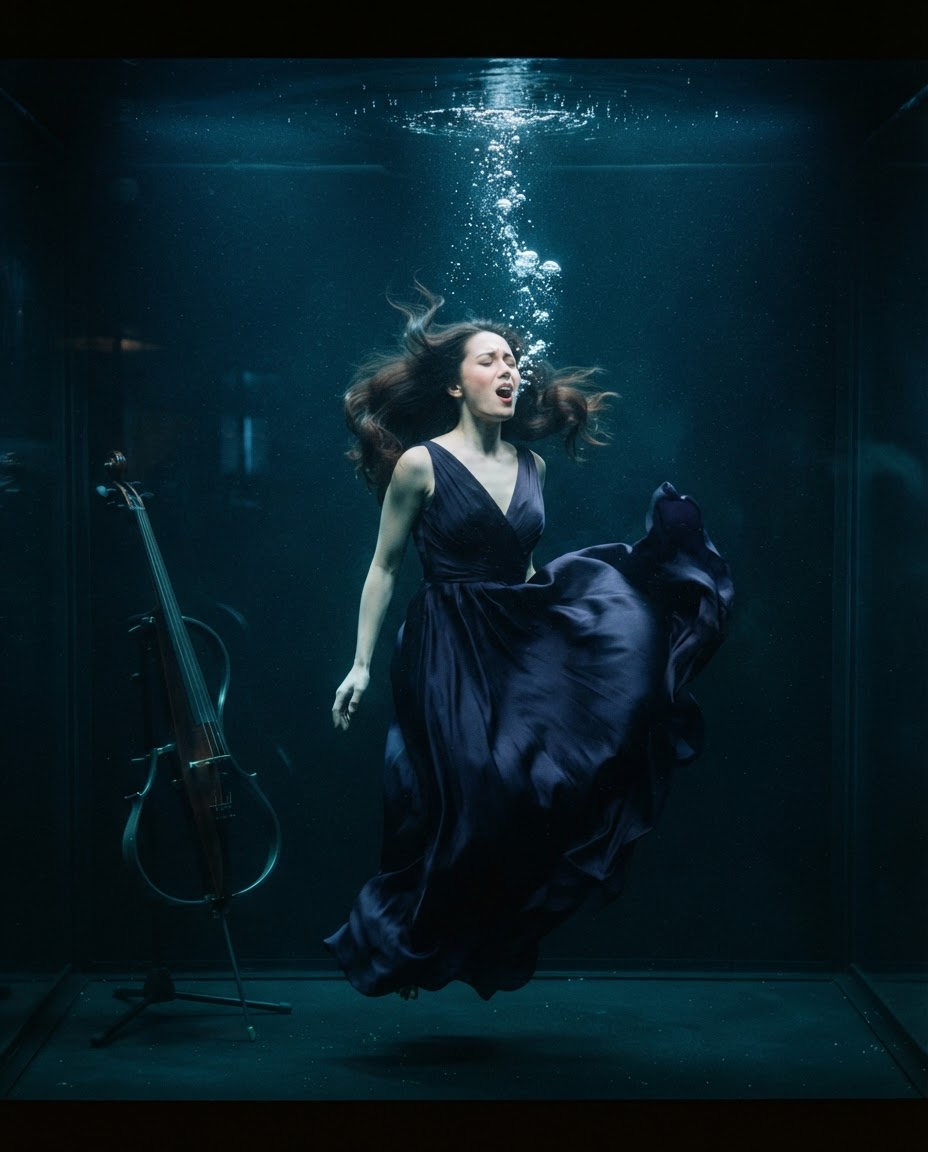
Robert Karlsson, co-founder of Between Music, described the breakthrough in capturing their sound: "Especially since it's difficult to get the high frequencies through the mass of water... when we had the Teledyne hydrophone, it was like we could hear all these sparkling high frequencies, and that was quite amazing." Even with professional hydrophones, the underwater world reshapes what is possible. The ocean is not a passive listener. It is a co-producer.
The Human Ear: How You Actually Hear Down There
Your ears, as beautifully evolved as they are, were not built for this.
In air, your auditory system is a masterpiece of directional processing. Sound arrives at each ear at slightly different times and with slightly different intensities. Your brain measures these micro-differences — delays measured in fractions of milliseconds — and calculates direction, distance, and space with astonishing precision. That is how you know a bird is to your left, or that a voice is coming from the balcony, or that the drummer is stage right.

Underwater, that system collapses.
The density of water is so close to the density of your eardrums that the tympanic membrane barely vibrates in response to sound pressure. Instead, sound propagates through your body itself — this is bone conduction underwater, the mechanism working invisibly beneath every note — reaching your inner ears through the bones of your skull. The vibrations arrive at both inner ears nearly simultaneously. The directional cues your brain depends on vanish.
The result is one of the most disorienting and transcendent experiences a human can have: the complete loss of sound localization combined with total sonic immersion. You cannot point to where the music is coming from because it is coming from everywhere. It enters through your jaw, your temples, the base of your skull. It surrounds you not as a wavefront approaching from a stage, but as a field you inhabit. A 360-degree sphere of sound with no center and no edge.
This is not surround sound. Surround sound is a clever trick — speakers placed around a room, simulating space. Underwater listening is the reality that surround sound has been trying to approximate for decades. It is the genuine article: true immersion, unmediated by technology, delivered by the oldest medium on Earth.
Research suggests that underwater hearing involves a complex combination of bone conduction and limited tympanic conduction, with bone conduction dominating at higher frequencies and some tympanic involvement at lower frequencies allowing limited localization. But the overall effect remains unmistakable: the sound finds you. You do not find the sound. It is the same nervous-system surrender we explored in The Blue Mind Effect — the moment the body stops scanning for threats and simply lets the water hold it.
The Culture: Where Musicians Are Already Diving In
The idea of underwater music is not new. But until recently, it was a novelty — a curiosity, a stunt, a one-off experiment. That is changing. Fast.
For over four decades, the Lower Keys Underwater Music Festival has turned Looe Key Reef in the Florida Keys into one of the most unusual concert venues on the planet. Every July, divers and snorkelers descend into the Florida Keys National Marine Sanctuary while music is piped underwater through waterproof speakers suspended from boats. The playlist is gloriously on-brand: The Beatles' "Octopus's Garden" and "Yellow Submarine," Jimmy Buffett's "Fins." Costumed "mermaids" and mock underwater bands jam among the coral. This underwater music festival draws hundreds of participants annually, all floating in the blue while conservation messages intersperse the setlist — reminders that the reef they are enjoying is the very thing they are there to protect.
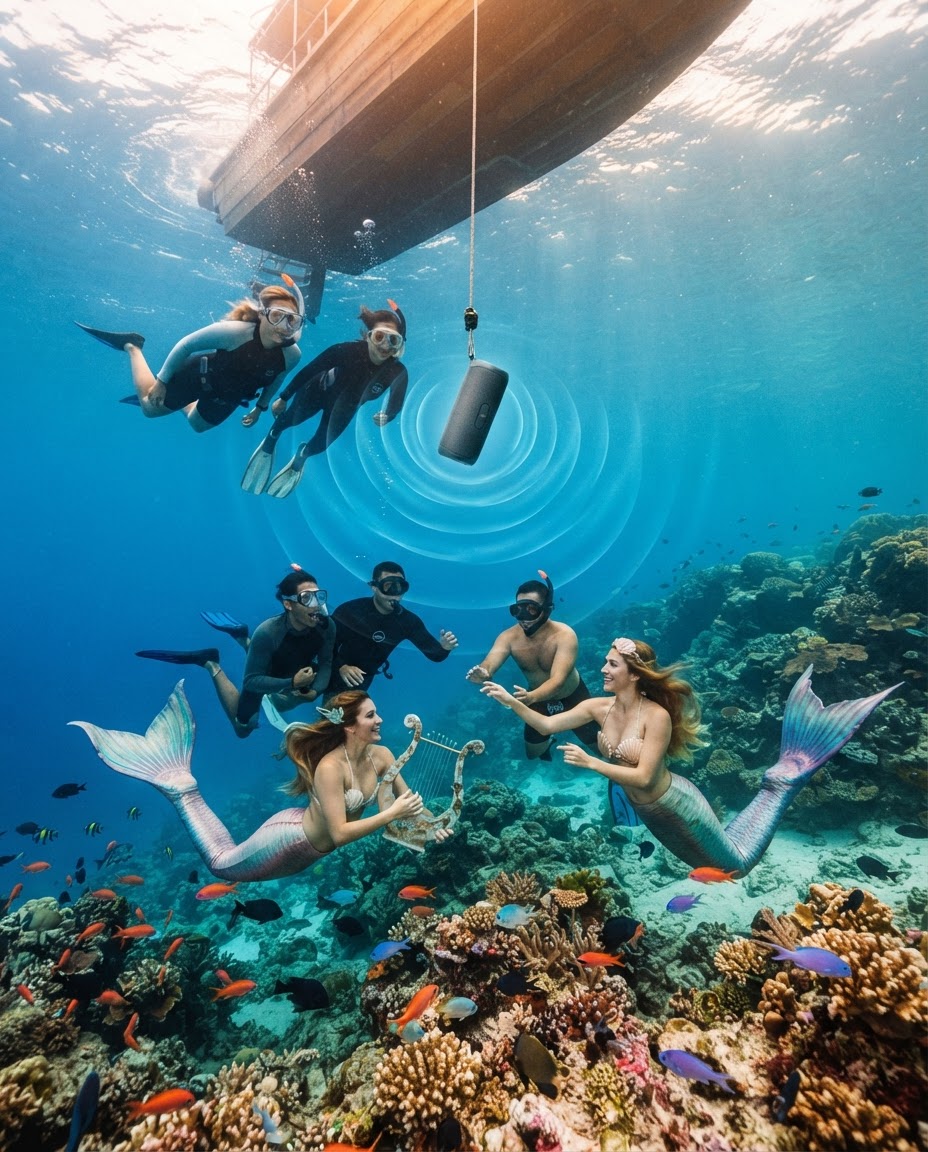
It is playful. It is kitschy. And it is profound in its own way — proof that the ocean has always been waiting for us to bring our music to it.
But AquaSonic represents something else entirely: the artistic potential of submerged performance taken to its logical extreme. Since its 2016 world premiere at the Operadagen Festival in Rotterdam, the Danish ensemble has performed across the globe — Sydney, Vilnius, Struer, Grenaa, Hong Kong — refining a vocabulary of underwater music that did not exist before they invented it. Five performers submerged in glass tanks. Custom-built instruments: a hydraulophone (underwater organ), a crystallophone (glass bowls producing ethereal friction tones), a rotacorda (an underwater bowed string instrument), a carbon-fiber violin engineered to resist water degradation, percussion, and vocals performed entirely while breath-holding.
The musicians do not wear scuba gear. They hold their breath, perform, surface, breathe, descend again. The physical limitation becomes part of the aesthetic — phrases shaped by lung capacity, compositions structured around the biology of the performers. Karlsson noted: "You can't just think about something else. And I think that's exactly what the audience can feel." The vulnerability is the point. The constraint is the art.
Between Music has also taken their hydrophones into open water, recording the reverb and echo patterns that bounce off underwater rocks and refract through temperature layers. "By listening to the sound bouncing off rocks and bouncing to the surface of the water, you can kind of start to imagine how this landscape is," Karlsson said. "It was amazing. It was otherworldly somehow."
They have not yet performed in open water. But they want to. And when they do, it will mark a new chapter in the history of music — one where the venue is not a building, but an ecosystem. Not a stage, but a seascape.
The Vision: Why DeepBeatDives Exists at This Intersection
We did not invent the physics. We did not discover bone conduction. We did not build the first underwater instrument or pipe the first playlist through a hydrophone.
But we are the first to ask: What if this was not a stunt? What if it was a culture?
The Lower Keys festival proves that divers want music underwater. AquaSonic proves that musicians can create art specifically for that environment. The science proves that the medium itself — the ocean — offers an acoustic experience that no land-based venue, no matter how technologically advanced, can ever replicate.
DeepBeatDives is the convergence point. We are building the world's first premium deep-sea scuba and music destination festival because we believe the ocean is not merely a backdrop for music — it is a medium for it. A collaborator. A co-creator. The 5x speed of sound underwater is not a footnote in a physics textbook. It is the foundation of an entirely new way to experience music, community, and the self — the same descent into presence we trace back to our ancient physiology in Your Brain on Scuba.
Imagine descending to 18 meters in the Maldives, where the water temperature, salinity, and clarity create ideal acoustic conditions. Imagine a soundscape designed specifically for those conditions — compositions that leverage the natural low-frequency propagation, that embrace the high-frequency attenuation rather than fighting it, that turn the 360-degree bone-conduction immersion from a limitation into a feature. Imagine not attending a concert, but inhabiting one. Surrounded by your tribe. Suspended in sound and saltwater. No stage. No speakers pointed at you. Just vibration, biology, and the ancient physics of the deep.
That is what we are building. That is the invitation.
The Underwater Playlist: 10 Tracks for 20 Feet Down
Not everyone can join us in the Maldives this November. But everyone can experience a taste of what underwater listening feels like — with the right headphones, the right mindset, and the right soundtrack.
We have curated "The Underwater Playlist" — ten tracks specifically selected for how they transform when you imagine them through the physics of the deep. These are songs that rely on low-end warmth, on spacious midranges, on sustained tones that would propagate beautifully through seawater. Songs with enough space in the mix to let the imagined reverb of the ocean fill the gaps.
Think of it as pre-dive conditioning for your ears. A way to train your brain to listen for the frequencies that survive the descent. A reminder that the best music is not always the loudest — sometimes it is the most resonant.
The playlist includes:
- "Octopus's Garden" — The Beatles (The obvious starting point. A song literally written about being underwater, with a melody simple enough to survive frequency loss.)
- "Teardrop" — Massive Attack (The heartbeat rhythm, the suspended strings, the sense of floating in amniotic space.)
- "The Whale" — Aleksandra Kruss (Sound art inspired by the largest musicians on Earth.)
- "A Pirate Looks at Forty" — Jimmy Buffett (A nod to the Lower Keys tradition. The original underwater festival anthem.)
- "Weightless" — Marconi Union (Neuroscientifically designed to reduce anxiety. The closest land-based equivalent to the mammalian dive reflex.)
- "Underwater" — RÜFÜS DU SOL (Electronic music built for submersion, in title and texture.)
- "Clair de Lune" — Claude Debussy (Piano frequencies that would shimmer strangely underwater — beautiful precisely because of the distortion.)
- "Song of the Sea" — Lisa Hannigan (A voice that sounds like it was recorded in a water tank. Ethereal, breathy, immersive.)
- "Breathe Me" — Sia (Vulnerability as instrument. The AquaSonic approach to vocal performance, on land.)
- "Deep Blue Day" — Brian Eno (The ambient master at his most oceanic. Music for airports? No. Music for thermoclines.)
Listen to it on quality headphones. Close your eyes. Imagine the bone conduction. Imagine the 360-degree field. Imagine what this would feel like at 20 meters, surrounded by the tribe, in water clearer than glass.
Subscribe to The Dive Deck

Every week, we curate one ocean-inspired track, one underwater soundscape recording, and one story from the intersection of diving and music culture. We call it The Dive Deck — because the best music, like the best dives, happens when you stop looking at the surface and start listening to what is below.
→ Subscribe to The DeepBeat Dispatch and get the full Underwater Playlist with exclusive liner notes, plus hydrophone recordings from reefs around the world that you cannot hear anywhere else. The playlist that sounds better at depth.
This is not a newsletter. It is an invitation to the blue.
Listen. Feel. Descend.
Sound does not just travel faster underwater. It becomes something else entirely — a 360-degree surround-sound experience no land concert can touch. A physics lesson you feel in your bones. A reminder that the ocean has been making music for billions of years, and we are only just learning to tune in.
The Lower Keys festival started something. AquaSonic proved it could be art. The science proves it is real.
We are proving it can be a movement.
Listen to the playlist. Feel the physics. Then imagine what happens when 1,500 of us descend together, in the Maldives, with music built specifically for the medium we are swimming through.
The surface is full of noise. The deep is where you find the sound that matters.
→ Join the tribe. Claim your invitation.
DeepBeatDives is building the world's first premium deep-sea scuba + music destination festival in the Maldives. We believe the ocean is not just something to observe — it is something to belong to. If this article made you feel something, you are already part of the tribe.
Read next: The Blue Mind Effect: What 60 Minutes Underwater Does to Your Nervous System | From Bangalore to the Blue: Your First Dive Trip in 72 Hours
Sources & Further Reading
- NOAA Ocean Service — How far does sound travel in the ocean?
- Discovery of Sound in the Sea (DOSITS) — Tutorial: Speed of Sound
- Dartmouth Undergraduate Journal of Science — The Underwater Propagation of Sound and its Applications
- Between Music — AquaSonic official documentation
- Teledyne Marine — AquaSonic: The Underwater Symphony Perfected with Teledyne Marine Hydrophones
- Lower Keys Chamber of Commerce — Underwater Music Festival
- Florida Keys Tourism Council — Lower Keys Underwater Music Festival
- ScienceDirect — Is human underwater hearing mediated by bone conduction?
- PMC / National Library of Medicine — Underwater Acoustic Source Localisation Among Blind and Sighted Scuba Divers
DeepBeatDives — Dive. Discover. Dance.