
There is a squid sitting in a museum jar in the Netherlands that has been waiting since the 1950s to tell us something extraordinary. It was pulled from the stomach of a sperm whale in Antarctic waters, preserved, catalogued, and forgotten. For seventy years, it sat in scientific limbo — a phantom limb of ocean knowledge — until a team of taxonomists realized it did not belong to any known family of squid on Earth. Not a new species. Not a new genus. An entirely new family.
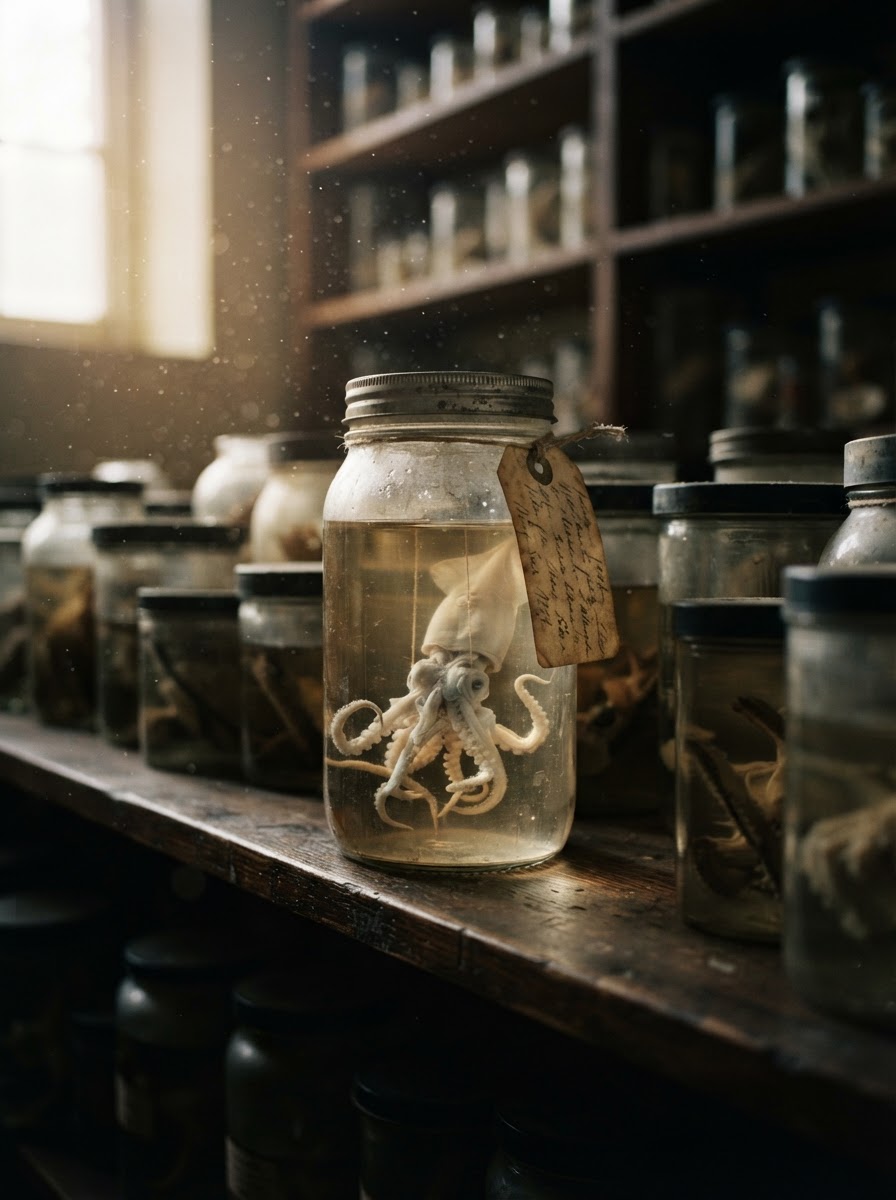
This is Mobydickia poseidonii. And it is only one of 1,121 new ocean species discovered in a single year.
In 2025, the Nippon Foundation-Nekton Ocean Census — the largest mission ever launched to accelerate the discovery of ocean life — returned from 13 expeditions across the most remote and least explored waters on our planet with a staggering haul: 1,121 species previously unknown to science. That is a 54% jump in annual identifications. From the Coral Sea to the South China Sea, from the volcanic seamounts of Japan to a seafood market in Vietnam, the Census proved what divers have always felt in their bones: we barely know the ocean we claim to love.
The numbers are humbling. Only 240,000 marine species have been formally documented. Scientists estimate up to 90% remain undiscovered. The average time between collecting a specimen and formally describing it? Thirteen and a half years. Some species go extinct before we even name them. The Ocean Census is trying to change that — and in the process, they are handing us a front-row seat to the most extraordinary show on Earth.
Here are the seven strangest new ocean species discovered — the deep sea creatures that stopped us in our tracks.
1. The Darth Vader Isopod (Bathynomus vaderi)
The Sith Lord of the South China Sea
It is 32.5 centimeters of armored, jet-black, otherworldly menace — and the first thing scientists thought when they saw its head was Darth Vader.
Bathynomus vaderi is a supergiant isopod, the first of its genus ever described from Vietnamese waters. Its head bears an uncanny resemblance to the iconic helmet of Star Wars' most famous Sith Lord, complete with a stern, angular brow that looks almost intentionally designed to intimidate. But this is no Hollywood prop. This is a deep-sea scavenger that has been patrolling the dark floor of the South China Sea for millennia, completely unknown to science until 2022 — when researchers from Hanoi University found it not in the abyss, but in a seafood market in Quy Nhơn City.
Yes, you read that correctly. One of the most headline-grabbing marine discoveries of 2025 was made in a fish market.
The specimen was sent to Dr. Peter Ng at Singapore's Lee Kong Chian Natural History Museum, who assembled a tri-national team of scientists from Singapore, Indonesia, and Vietnam. By early 2023, they knew they had something unprecedented. B. vaderi is not just a new species — it is a supergiant, a category of deep-sea isopod that can exceed 30 centimeters and weigh over a kilogram. To put that in perspective: the pill bugs in your garden are its cousins.
In Vietnam, these animals are known as bọ biển — "sea bugs" — and they have become an unlikely culinary phenomenon. Until 2017, fishermen sold them as cheap bycatch. Today, they command premium prices in Hanoi, Ho Chi Minh City, and Đà Nẵng, with some devotees claiming they taste better than lobster. A restaurant in Taipei once served a 14-legged isopod with ramen for $65.
Where to find it: Deep waters off Vietnam, near the Spratly Islands in the South China Sea. The exact depth remains unknown — dealers and fishermen are notoriously protective of their trawling grounds — but other Bathynomus species typically inhabit 200 to 2,000 meters.
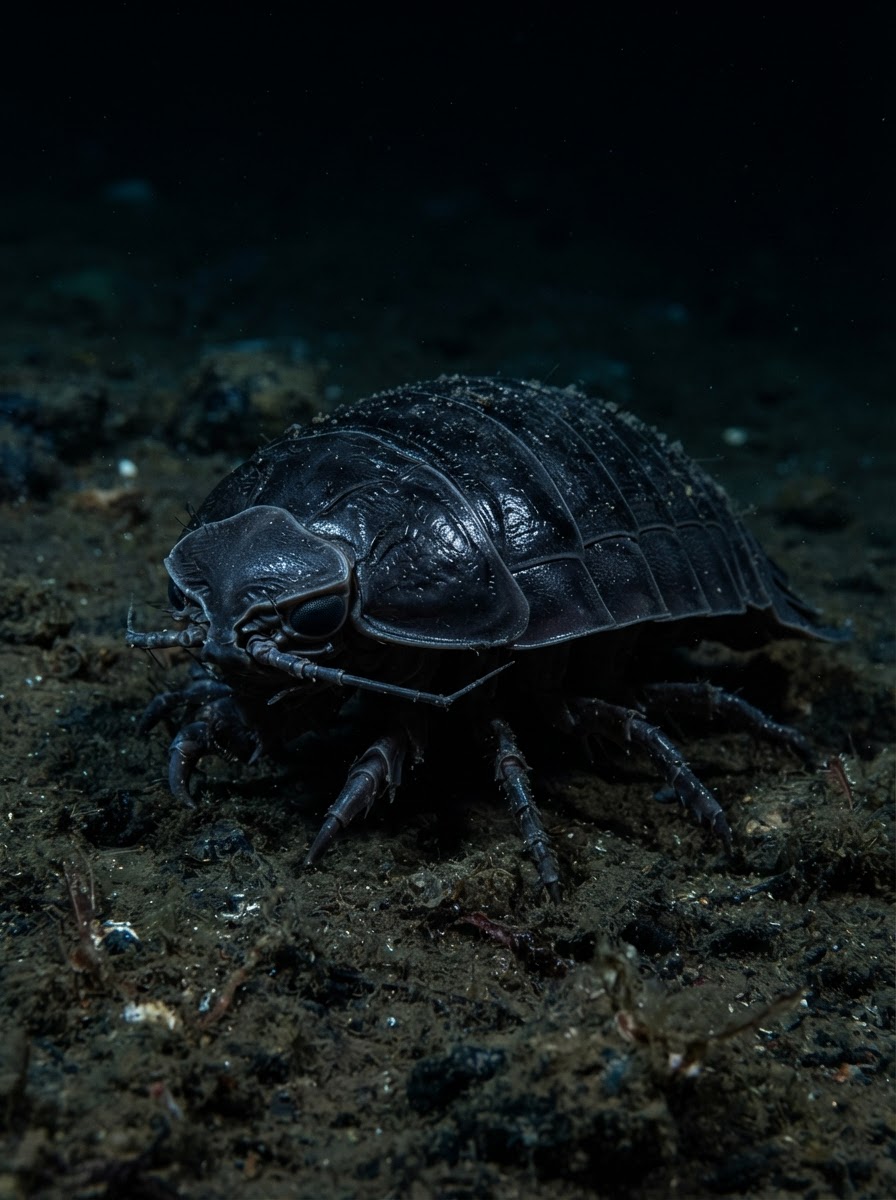
"Luke… am I your dinner?!?" — WoRMS Top Ten Marine Species of 2025 nomination
2. Poseidon's Squid (Mobydickia poseidonii)
A New Squid Family, Hidden in a Whale's Stomach for 70 Years
This is the discovery that should make every museum curator's heart skip a beat.
In the 1950s, a sperm whale was hunted in Antarctic waters. Its stomach contents were preserved and stored at Naturalis Biodiversity Center in the Netherlands, where they sat — catalogued but unexamined — for seven decades. Then, in 2025, while revising a group of deep-sea squids, scientists Samuel Arnold and Fernando Álvarez realized that one of those preserved specimens did not match any known squid family on the planet.
Enter Mobydickia poseidonii — not just a new species, not just a new genus, but an entirely new family: Mobydickidae.
The name is layered with meaning. The genus Mobydickia honors the fictional white sperm whale from Herman Melville's masterpiece, acknowledging the real sperm whale that unknowingly delivered this scientific treasure to shore. The species name poseidonii refers to Poseidon, the Greek god of the sea, whose trident the squid's arm hooks strikingly resemble. On most of its arms, the central hooks feature one large cusp flanked by smaller accessory claws — a trident in miniature.
Unlike many deep-sea squids, Poseidon's Squid lacks bioluminescent light organs. Its body is pale, gelatinous, almost ghostly — a reminder that the deep ocean does not need light to be extraordinary. Sperm whales dive thousands of meters in search of squid prey. In this case, one whale's last meal became science's first glimpse of an entirely unknown branch of the squid family tree.
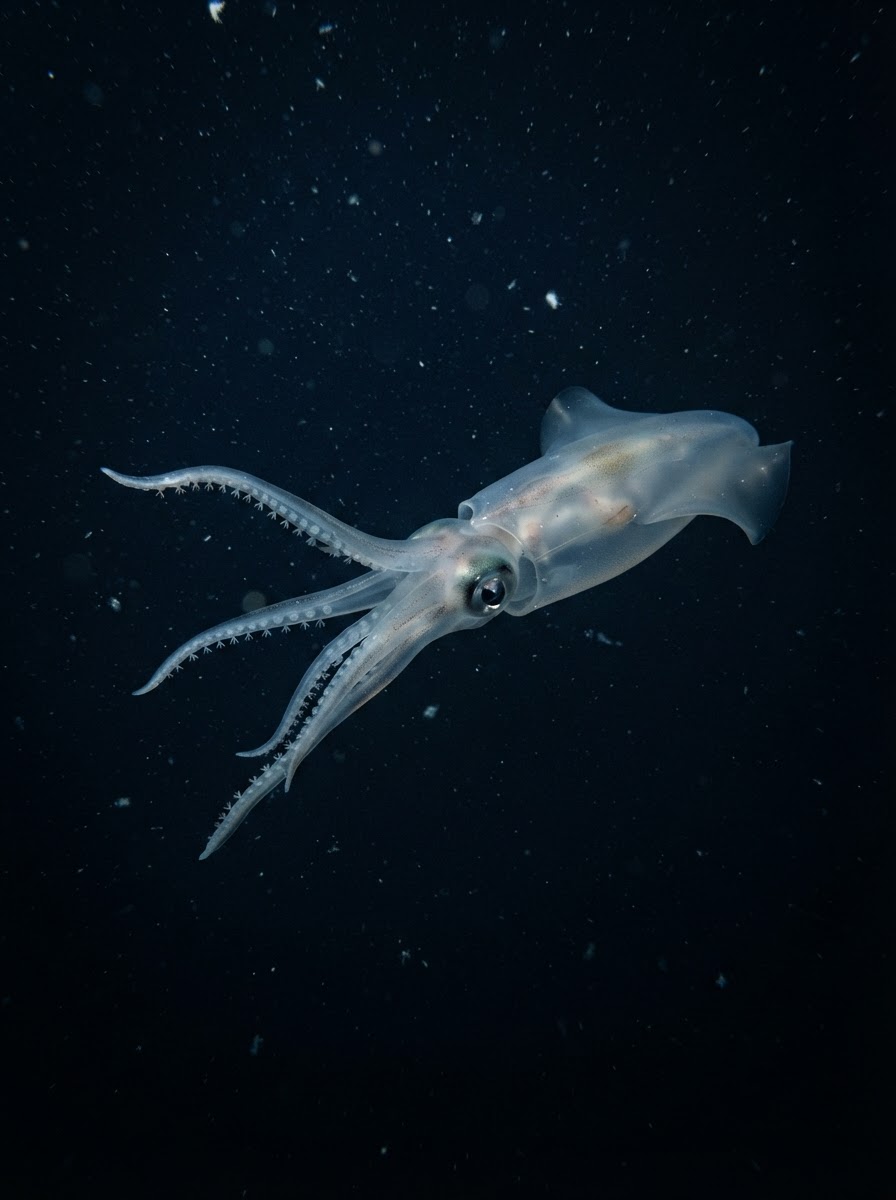
Where to find it: Antarctic waters, exact location unknown. The only specimen ever found came from the stomach of a sperm whale caught in the Southern Ocean. If you are diving in Antarctic waters, you are already having the adventure of a lifetime — but keep your eyes on the whale stomachs.
3. The Glowing Cave Creature (Corallizoanthus aureus)
The Deep-Sea Burglar Alarm
At 400 meters below the surface, near the entrances of steep karst caves off Minamidaito Island in southern Japan, something glows green when disturbed. It is not a rave. It is a burglar alarm.
Corallizoanthus aureus is the first documented deep-sea cave species known to bioluminesce. When researchers from the Japan Agency for Marine-Earth Science and Technology (JAMSTEC) first spotted it during their Deep-sea Archaic Refugia in Karst (D-ARK) project, they were using ROVs to explore a region 360 kilometers west of Okinawa-jima — an area defined by dramatic underwater topography and caverns that have historically limited biological sampling.
The creature itself is deceptively modest: bright yellow polyps, less than a centimeter across, living directly attached to their host coral colonies. You could swim past them a hundred times with the lights on and never notice them. But when the ROV's lights dimmed and a chemical or mechanical disturbance triggered their response, the polyps erupted in 515-nanometer green light — the deep-sea equivalent of a tornado siren.
The hypothesis? Bioluminescence as a "burglar alarm." In the permanent darkness of a cave, glowing when threatened attracts the attention of larger predators, who may then attack whatever is threatening the polyps. It is evolutionary outsourcing at its finest: "You want to eat me? Fine. But my glow just called my bigger friend."
Bioluminescence in hexacorallian lineages is exceptionally rare. This discovery suggests that luminescence may be far more widespread among deep-sea, epibiotic organisms than previously recognized — and that the caves we have barely explored may be twinkling with light we cannot see.
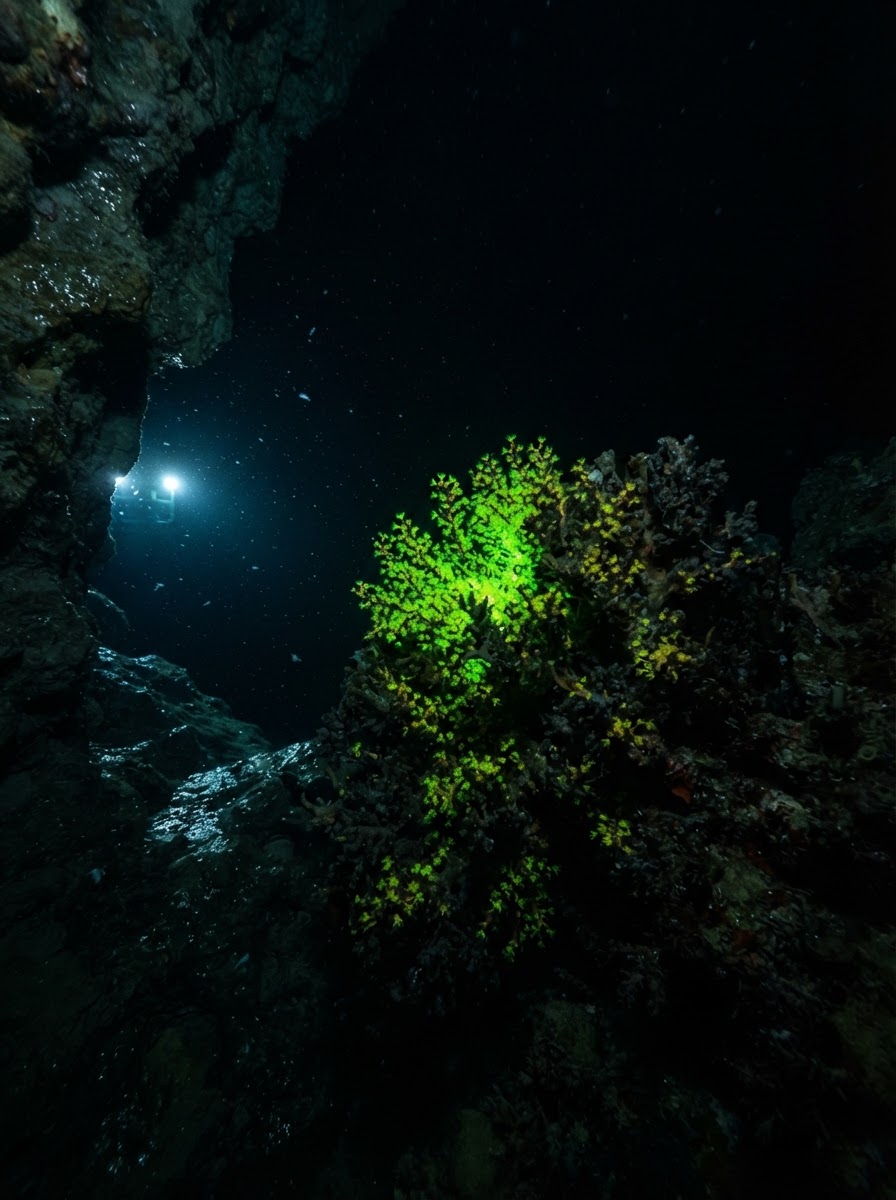
Where to find it: Karst caves near Minamidaito Island, southern Japan, at approximately 400 meters depth. Accessible only by ROV or deep-sea submersible — this is not a recreational dive site, but it is exactly the kind of frontier that fuels the explorer's imagination.
4. The Ghost Shark (Chimaera sp. 1)
A Living Fossil From Before the Dinosaurs
At 802 meters in the Coral Sea Marine Park off Australia's Queensland coast, Dr. William White came face-to-face with a lineage that diverged from sharks and rays nearly 400 million years ago. That is 150 million years before the first dinosaur walked the Earth.
The ghost shark — or chimaera — is one of the most mysterious inhabitants of the deep. Often called "ratfish" or "rabbitfish" by fishermen for their distinctive faces, chimaeras are not sharks at all, but their own ancient lineage. They have a single gill opening, a venomous dorsal spine, and a body plan that has remained almost unchanged since the Devonian period. They are, in every meaningful sense, living fossils.
The new species discovered during a CSIRO expedition adds another layer of urgency to their story: today, a third of all sharks, rays, and chimaeras are vulnerable to extinction. These animals grow slowly, mature late, and reproduce in small numbers — making them exceptionally vulnerable to deep-sea fishing pressure.
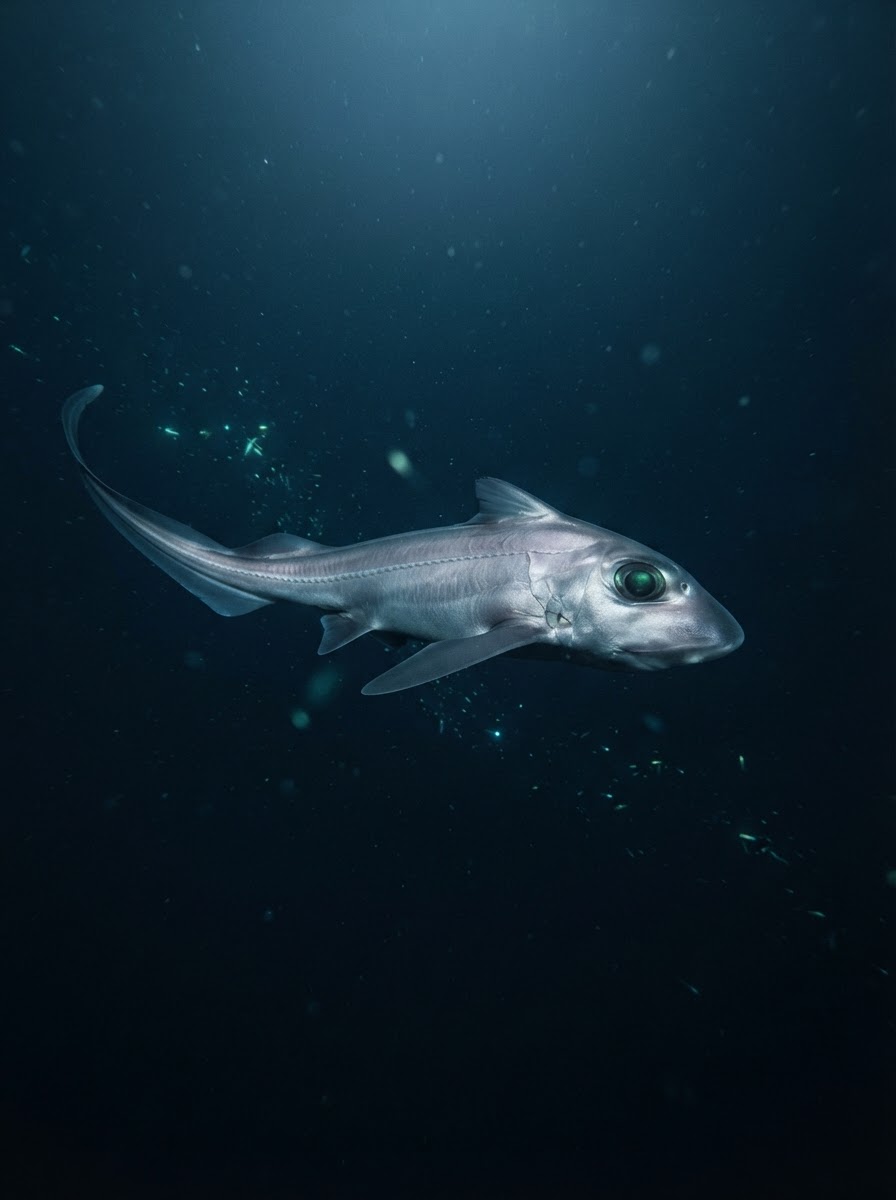
Where to find it: Coral Sea Marine Park, Australia, 802–838 meters. The Coral Sea is one of the most celebrated dive destinations on Earth — it makes our roundup of 13 dive sites that will ruin your land life forever — but its deep walls and seamounts remain largely unexplored. This is a reminder that even in places we think we know, the ocean keeps its secrets.
5. The Creature in the Glass Castle (Dalhousiella yabukii)
A Worm That Lives Inside a Crystal Palace
At 791 meters on a volcanic seamount in the Shichiyo Seamount Chain, Japan, scientists discovered a worm that lives inside a glass sponge — a creature whose skeleton is made of crystalline silica, forming intricate, translucent chambers that look like something from a fairy tale.
Dalhousiella yabukii is a polychaete worm, one of the first ever discovered living symbiotically within a glass sponge. It was found during the 2025 Ocean Census JAMSTEC-Shinkai Japan expedition, collected by the famous Shinkai 6500 manned submersible. Named after the mission's principal investigator, Dr. Akinori Yabuki, this worm does not just inhabit the sponge — it depends on it. The relationship is symbiotic: the worm gains shelter in the sponge's crystalline chambers, and in return, it likely contributes to the sponge's nutrient cycle.
Dr. Michelle Taylor, Head of Science at Ocean Census, described the scene with visible wonder: "Some of those polychaetes also bioluminesce, so I just love the idea that there are these crystalline glass castles of sponges, and they are probably twinkling at each other."
The discovery, published in The Zoological Journal of the Linnean Society, adds a new chapter to our understanding of how life adapts to the deep sea's most extreme environments. Volcanic seamounts are biodiversity hotspots — isolated underwater mountains that rise from the abyssal plain, creating unique ecosystems that are home to species found nowhere else on Earth.
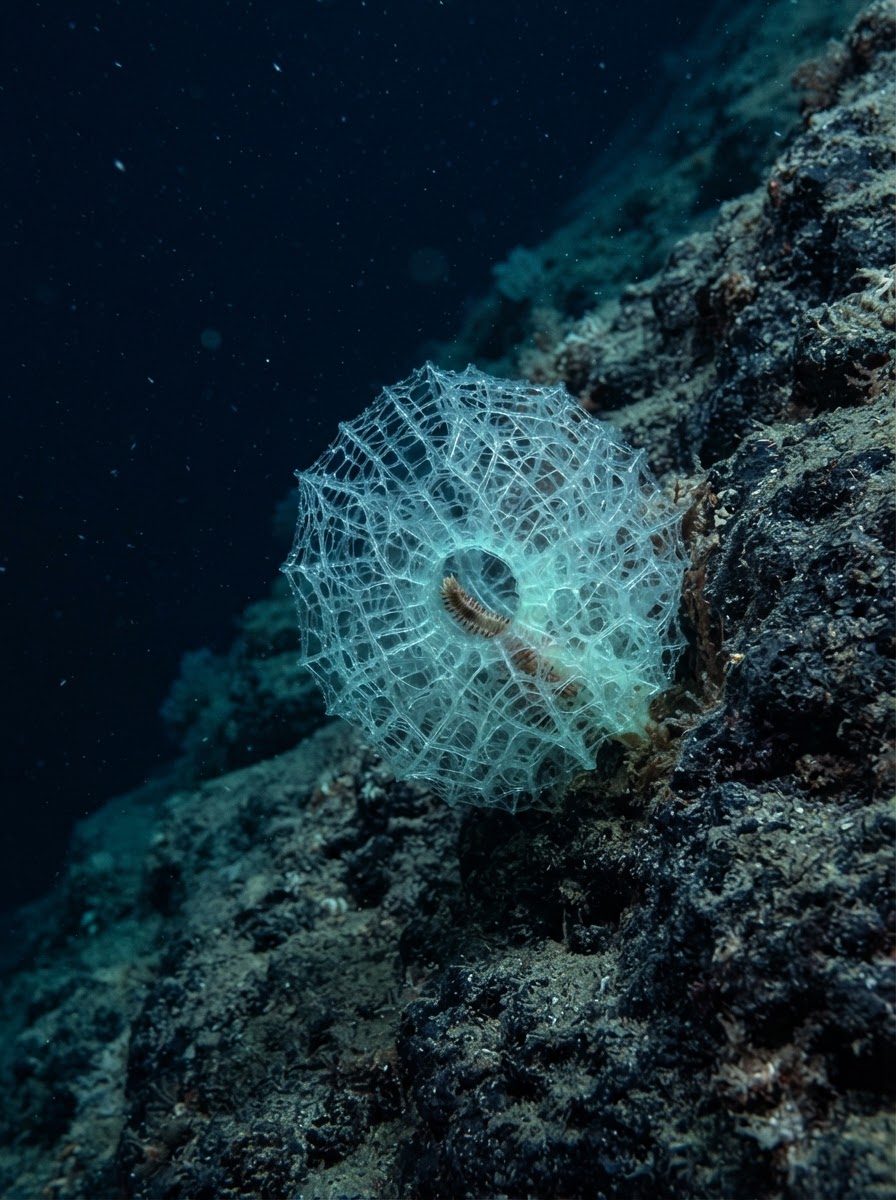
Where to find it: Shichiyo Seamount Chain, Japan, at 791 meters. Accessible only by deep-sea submersible or ROV. Japan's deep-sea research infrastructure, led by JAMSTEC, is among the most advanced in the world — and the Shichiyo Seamounts are proving to be a treasure trove of undiscovered life.
6. Iskra's Glitter Worm (Photinopolynoe iskrae)
The Spark That Lives on Whale Bones
Far below the Pacific Ocean, off the coast of California, something glitters in the permanent darkness. Photinopolynoe iskrae — Iskra's Glitter Worm — is a shimmering, scale-covered polychaete that thrives in some of the most extraordinary ecosystems on Earth: whale falls, wood falls, and methane seeps.
The name "Iskra" means "spark" in several Slavic languages. It was chosen not by a marine biologist, but by Maja Young, a high school student at the American School in Warsaw, who won the 'Inspired by the Deep' competition. She named the species after her childhood dog — a fitting tribute for a creature that glitters so brightly it looks almost unreal.
What makes Iskra's Glitter Worm remarkable is not just its beauty, but its adaptability. Most of its relatives specialize in a single chemosynthetic ecosystem — whale falls, where the body of a sunken whale becomes an entire island of life; wood falls, where drifting trees sink and create their own micro-ecosystems; or methane seeps, where gas leaks from deep in the Earth's crust and feeds bacteria that form the base of the food chain. But P. iskrae seems comfortable in all three. It is a generalist in a world of specialists, and that flexibility may be the key to its survival.
These ecosystems are not built on sunlight. They are built on chemicals — chemosynthetic bacteria that convert methane, hydrogen sulfide, and other compounds into energy. Life here does not need the sun. It needs chemistry, patience, and the occasional dead whale.
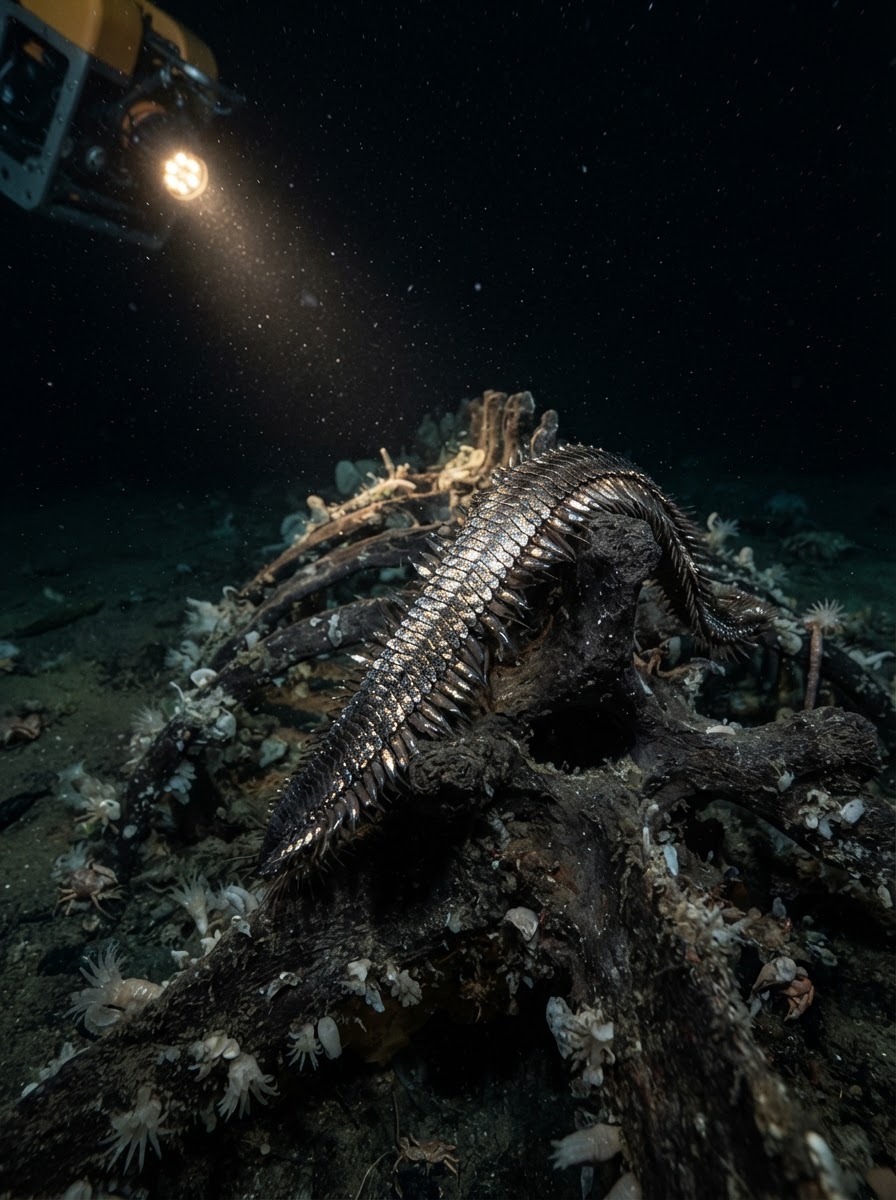
Where to find it: Pacific Ocean, off the coast of California, at whale falls, wood falls, and methane seeps. These are deep-sea environments, typically 1,000 meters or deeper — not accessible to recreational divers, but a reminder of how much life depends on what falls from above.
7. The Guitar Shark (Rhinobatos sp.)
The 38th Member of a Disappearing Family
Along the coasts of Mozambique and Tanzania, at approximately 200 meters depth, scientists discovered a new guitar shark — a creature that looks like someone merged a shark and a ray and could not decide which to keep. It is only the 38th known species of its kind, and that family is in trouble.
The guitar shark family (Rhinobatidae) is among the top 10 most threatened vertebrate groups on Earth. Two-thirds of its species are classified as Threatened. As apex predators, sharks and rays play a critical role in maintaining the balance of marine ecosystems. Their decline ripples through the entire food web.
This discovery matters not just because it is new, but because it reminds us that we are still finding species in families that are already disappearing. It is a race against time — and the Ocean Census is trying to document these animals before they are gone.
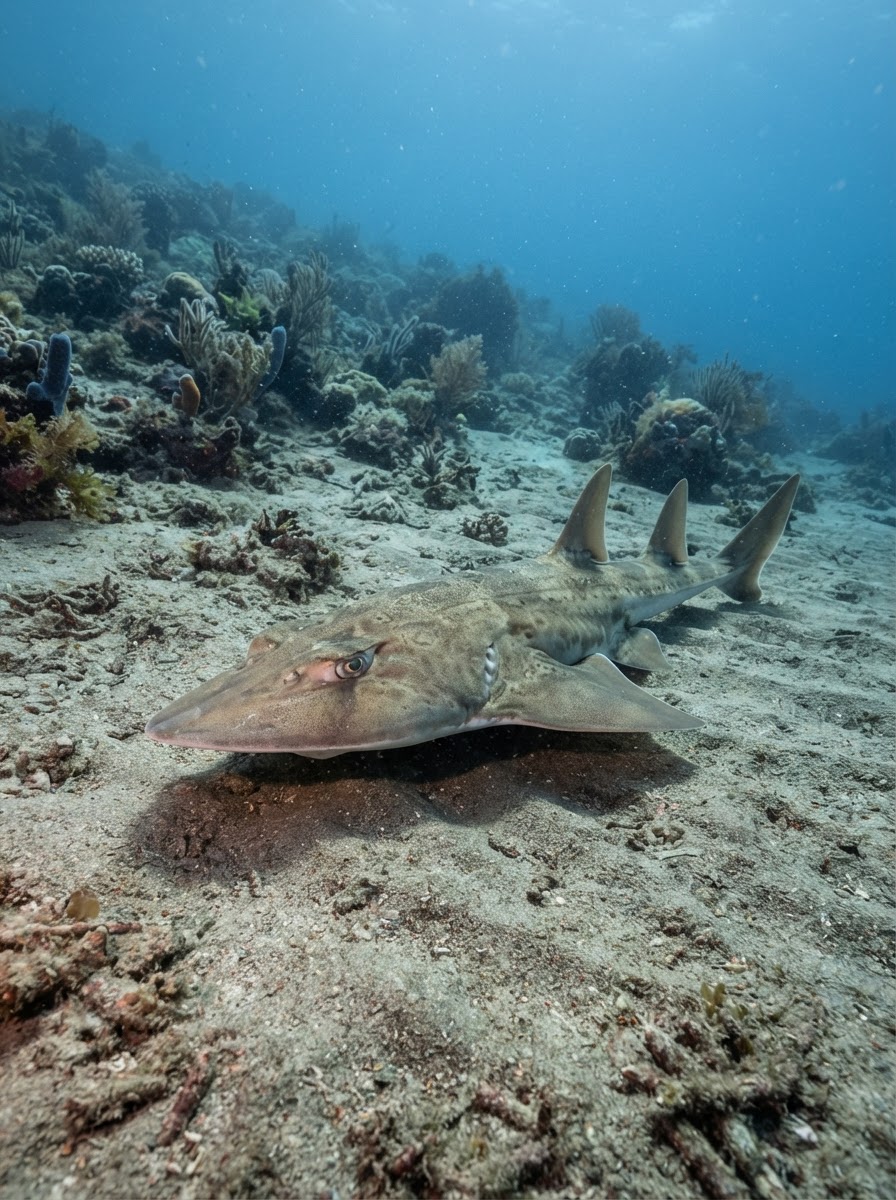
Where to find it: Coastal waters of Mozambique and Tanzania, ~200 meters. The Western Indian Ocean is a region of extraordinary marine biodiversity, and its deeper reefs and slopes remain poorly explored. For advanced technical divers, this region represents one of the last frontiers.
Why These New Ocean Species Discovered in 2025 Matter
The Ocean Census did not just find 1,121 new species. It shattered a bottleneck that has plagued marine science for generations. For too long, thousands of species have sat in jars, drawers, and databases — collected, preserved, and forgotten — because the pace of taxonomic discovery could not keep up with the pace of exploration. The average lag between collection and formal description was 13.5 years. Some specimens waited decades. Some will never be described at all.
The Census is changing that. Through a new open-access platform called NOVA, discoveries can be registered and shared within days, not years. The Science Network now unites over 1,400 taxonomists from 660 institutions in 85 countries. And the goal is audacious: 100,000 new species by 2030.

But there is urgency here. As Oliver Steeds, Director of the Ocean Census, put it: "We spend billions searching for life on Mars or going to the dark side of the moon. Discovering the majority of life on our own planet — in our own ocean — costs a fraction of that. The question is not whether we can afford to do this. It is whether we can afford not to."
Up to 90% of ocean species remain undiscovered. Some will go extinct before we ever name them. The deep sea is not a void. It is a library, and we have only read the first chapter. That sense of vast, unknowable wonder is the same feeling behind the Blue Mind effect — the reason water calms us and pulls us back, again and again.
The Deep-Sea Creature Spotter's Guide
We made something for you.
Every species in this article — and dozens more from the 2025 Ocean Census — has been compiled into The Deep-Sea Creature Spotter's Guide, a free PDF with high-resolution photos, depth ranges, locations, and the stories behind the science. It is designed to be saved on your phone, shared with your buddy, and referenced before your next dive trip.
Because knowing what is down there changes how you feel about going down there.
Subscribe to the Dive Report
Every Friday, we send one creature you never knew existed, one reef story, and one reason to protect what we love. No spam. No noise. Just the deep, delivered to your inbox.
→ Join the tribe. Subscribe to the Dive Report.
Sources & Further Reading
- Ocean Census Press Release — Scientists discover over 1,100 new marine species (May 2026): oceancensus.org
- WoRMS Top Ten Marine Species of 2025 — marinespecies.org
- Ng, P.K.L., Sidabalok, C.M. & Nguyen, T.S. (2025). A new species of supergiant Bathynomus from Vietnam. ZooKeys, 1223: 289–310.
- Arnold, S. & Fernández-Álvarez, F.Á. (2025). Mobydickia poseidonii — a new family of deep-sea squid. ZooKeys.
- Kise, H. et al. (2025). Glow in the D-ARK: a new bioluminescent species of Corallizoanthus from southern Japan. Royal Society Open Science, 12(11): 250890.
- Hiley, A.S., Green, K.R. & Rouse, G.W. (2025). Seven new species of scaleworms from deep-sea chemosynthetic-based ecosystems. Marine Biodiversity, 55(6).
- National Geographic — First ever video shows colossal squid in natural habitat (April 2025)
- Dive Magazine — Ocean Census discovers 1,121 marine species in a single year (May 2026)
DeepBeatDives is building the world's first premium deep-sea scuba + music destination festival in the Maldives. We believe the ocean is not just something to observe — it is something to belong to. If this article made you feel something, you are already part of the tribe.
We only know 10% of the ocean. Want to discover the rest with us?