The first note changes everything.
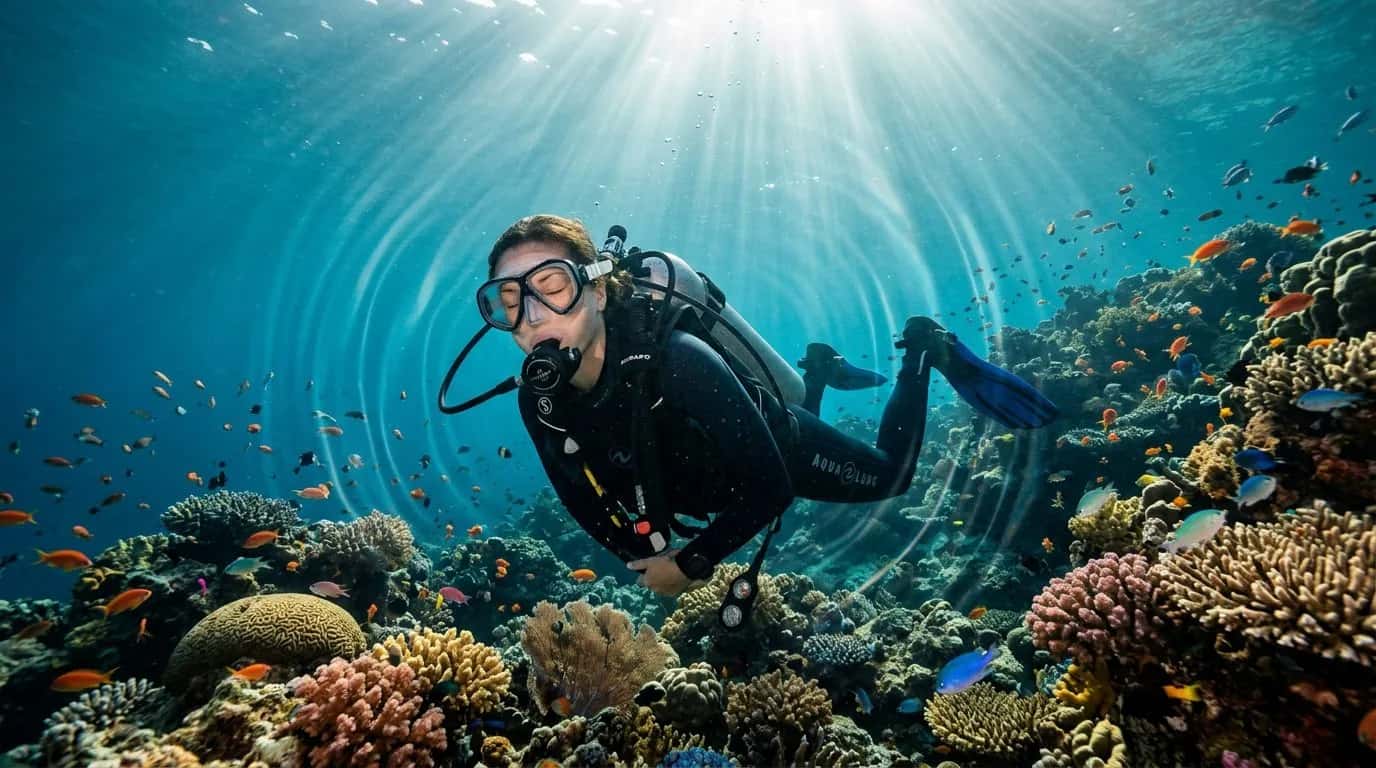
At 20 feet beneath the surface, your body is weightless. Your heart rate has already dropped. The mammalian dive reflex has switched on, and your vagus nerve is humming a quiet song of its own. Then something happens that shouldn't feel possible: music reaches you. Not from above — from around you. Sound traveling 4.3 times faster through water than air wraps around your body like a 360-degree embrace. The boundary between listener and song dissolves. You are not hearing the music. You are inside it.
This is not a dream. This is the experience that has driven a 41-year cultural movement — one that started with a radio news director in the Florida Keys, evolved through Danish innovators building instruments from glass and carbon fiber, and is now culminating in the most ambitious underwater music experience ever conceived: DeepBeatDives.
The story of music beneath the surface is older than most people realize. And it is only getting louder.
The Timeline: Four Decades of Sound Beneath the Surface
1960s — The Whales Teach Us First
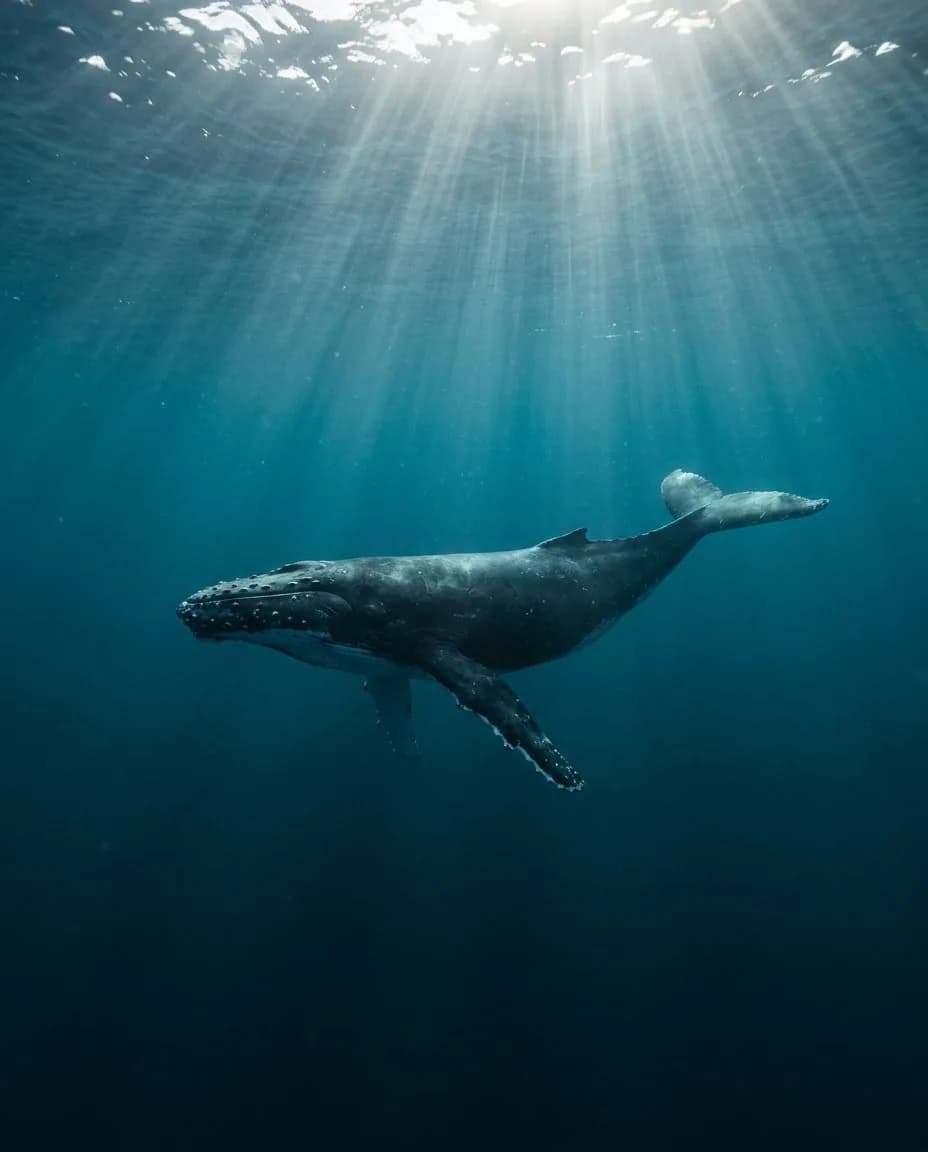
Before humans ever played music underwater, the ocean was already composing symphonies. In the early 1960s, a sound pioneer named Frank Watlington, working at a SOFAR listening station on Bermuda, captured something extraordinary on his hydrophone array. While scanning for Soviet submarines, he heard sounds that defied military classification: long, haunting, structured songs — the vocalizations of humpback whales.
Marine biologist Roger Payne and his colleague Scott McVay analyzed these recordings and discovered something that would reshape both science and culture: the whales weren't just vocalizing. They were singing. Repeating phrases. Building themes. Creating songs that could last for hours and evolve across seasons. In 1970, Payne and the New York Zoological Society released Songs of the Humpback Whale — the best-selling nature recording of all time. It would spend eight weeks on the Billboard 200 and inspire a global conservation movement. But it did something else too: it taught humanity that the ocean was not silent. It was a concert hall, and we had just been listening wrong.
1971 — Max Neuhaus Submerges the Listener
Composer Max Neuhaus didn't want to play music at the water. He wanted to play music in it. His 1971 installation Water Whistle invited participants to physically immerse themselves in pools where sound textures were created by water being forced through whistles. In a 1978 iteration at De Appel in Amsterdam, swimmers experienced what Neuhaus described as an "all-encompassing sensation" — the sound seeming to originate from within the body itself, transmitted through the forehead and skull in ways impossible on land. The ocean was no longer just a venue. It was becoming an instrument.
1984 — The Lower Keys Underwater Music Festival Is Born
The first true underwater music festival began with a simple, radical idea: what if people could experience the reef while simultaneously experiencing music designed for it?
Bill Becker, then news director of Florida Keys radio station WWUS 104.1 FM, co-founded what would become the Lower Keys Underwater Music Festival in 1984 alongside Dr. Fred Troxel, then president of the Lower Keys Chamber of Commerce. Their goal was not entertainment alone — it was conservation through communion. Becker believed that if people could experience the beauty of Looe Key Reef in a way that engaged their emotions, they would be more likely to protect it.
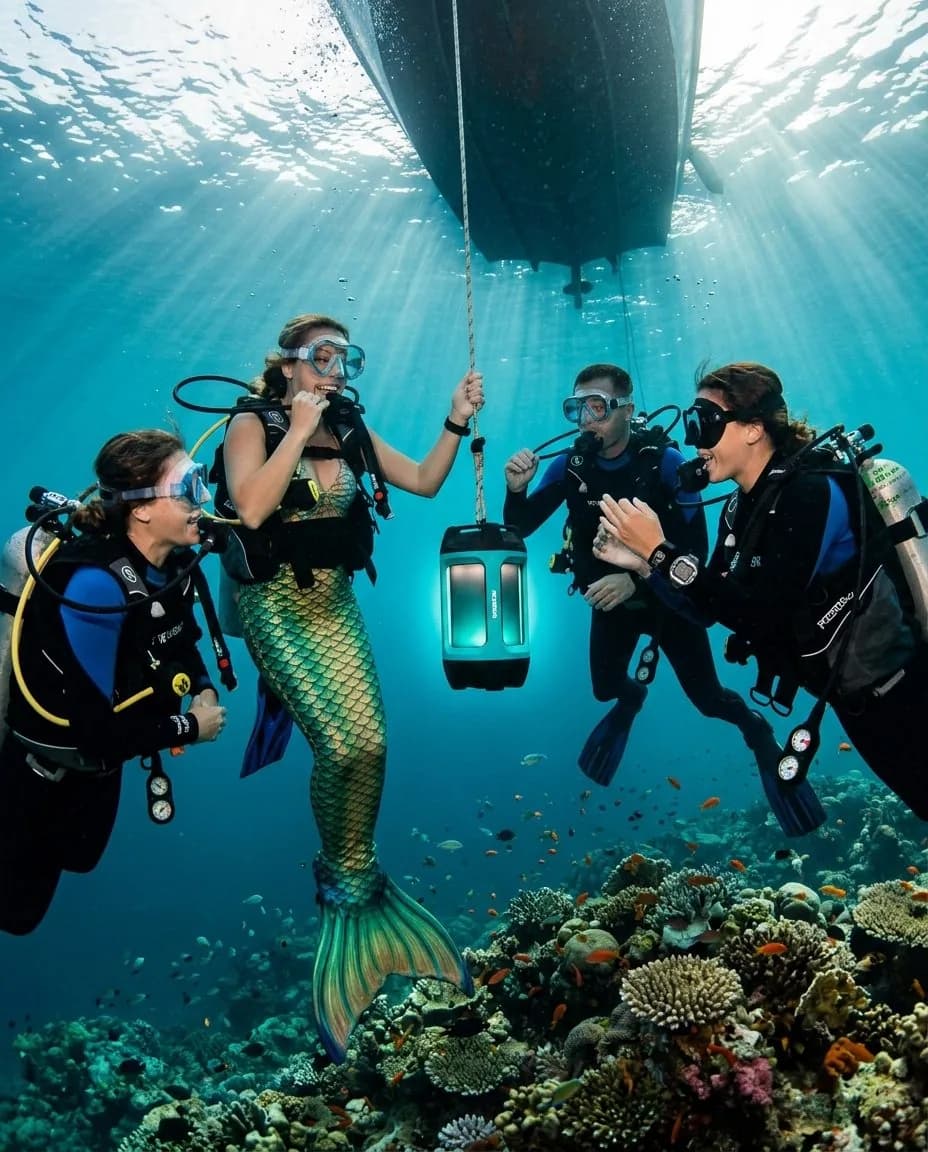
The format was ingenious in its simplicity. Lubell Laboratory waterproof speakers were suspended beneath boats anchored above Looe Key Reef, part of the Florida Keys National Marine Sanctuary. A specially curated playlist of ocean-themed music was broadcast underwater while simultaneously airing on WWUS 104.1 FM. Divers and snorkelers would descend to find themselves surrounded by sound — and by local artist August Powers' whimsical underwater instrument sculptures, including the "trom-bonefish," the "sea-phan flute," the "Fluke-a-Lele," and the "sax-eel-phone." Musicians in wetsuits and mermaid costumes mimed playing these creations while the real music pulsed through the reef.
The playlist was deliberate, almost mythological in its selection: The Beatles' "Yellow Submarine" and "Octopus's Garden." The Little Mermaid theme. Jimmy Buffett's "Fins." The Jaws theme. The Flipper theme. Each song an invocation, each melody a bridge between human culture and marine ecology. Between tracks, public service announcements reminded divers about reef-safe practices — the first known fusion of festival culture and environmental education.
The festival was intended as a one-time event. Instead, it became an annual tradition. After 41 years (with a brief pause in 2015 due to funding), the Lower Keys Underwater Music Festival has drawn hundreds of participants annually to the only living coral barrier reef in North America. Becker's observation became legendary: because sound reaches both ears almost simultaneously underwater, the experience creates a surround-sound quality that no land-based concert can replicate. Some observers have even reported fish swaying to the music — a claim that sounds like folklore until you remember that sound is vibration, and vibration is felt before it is heard.
1984 — Michel Redolfi's Sonic Waters
The same year Becker launched his festival in Florida, French composer Michel Redolfi was pioneering a different path. His album Sonic Waters combined natural ocean recordings with electronic ambience, creating soundscapes specifically designed for underwater broadcast. Working with music engineer Daniel Harris, Redolfi developed instruments for submerged performance, including the SOSNO underwater percussion instrument and the DUCS (Digital Underwater Controller System). His 1992 opera Chrysalis even featured a soprano submerged in a 2-ton plastic bubble. Where Becker's festival was communal and celebratory, Redolfi's work was avant-garde and introspective — two complementary poles of the same movement.
2002 — Laila Skovmand Dips Her Face in a Bowl of Water
The next evolution began with a bowl. Danish composer and vocalist Laila Skovmand was experimenting with extended vocal techniques when she decided to submerge her face completely in water and sing. The sound that emerged was muffled, strange, and utterly captivating. What began as a solitary experiment would consume the next decade of her life and redefine what music could be.
Skovmand, together with her partner Robert Karlsson, founded Between Music and embarked on a 12-year odyssey to build the world's first fully submerged band. They weren't just adapting existing instruments for water. They were inventing new ones from scratch, collaborating with deep-sea divers, physicists, instrument makers, and neuroscientists to understand what sound does in a medium 800 times denser than air.
2016 — AquaSonic Emerges from the Depths
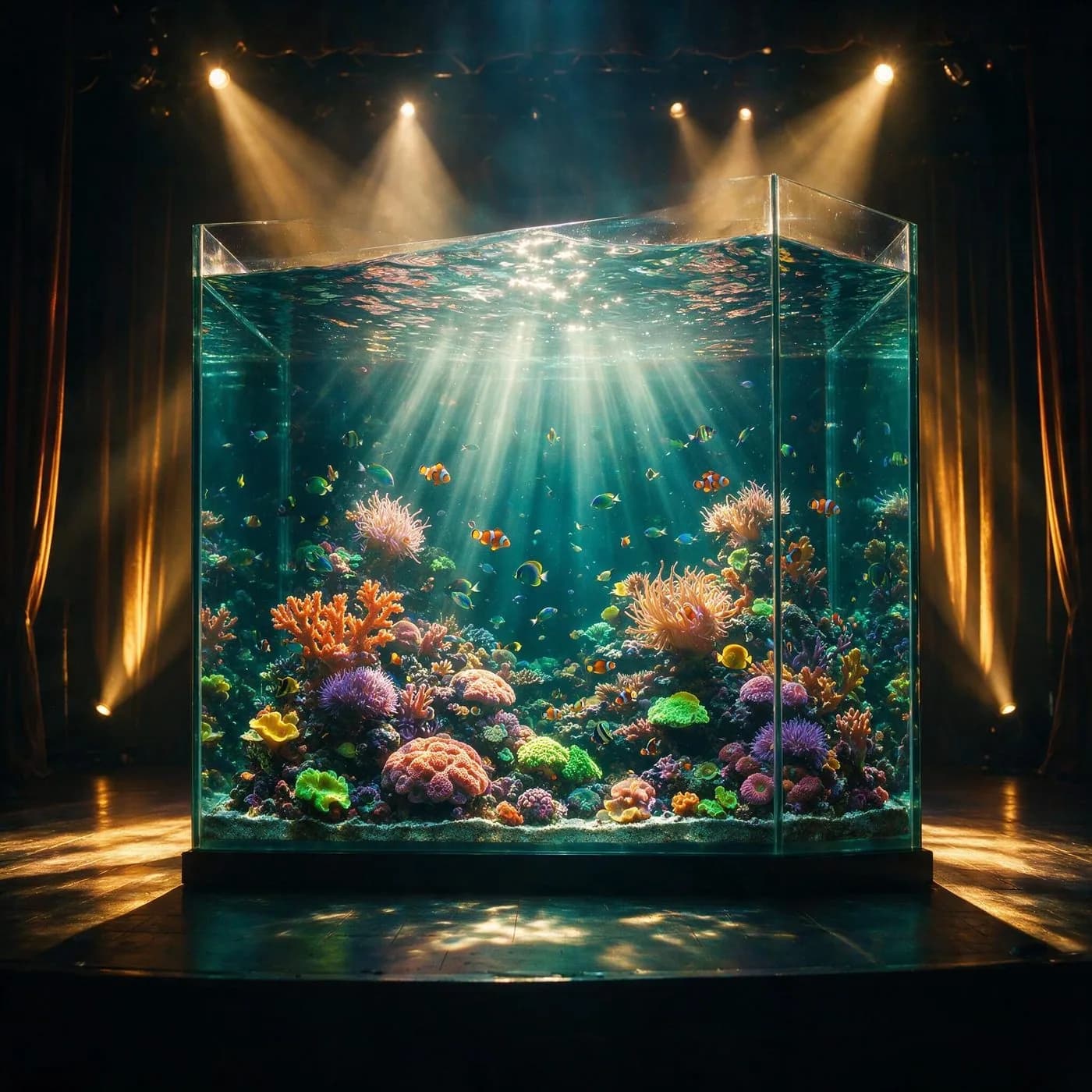
In 2016, Between Music premiered AquaSonic at the Operadagen festival in Rotterdam. The world had never seen anything like it. Five performers submerged in glass water tanks — some holding their breath for extended passages, others surfacing in choreographed breathing breaks — played custom-built instruments and sang entirely underwater.
The instrumentarium reads like a Jules Verne inventory: the hydraulophone, an underwater organ that uses water instead of air to produce sound; the crystallophone, a reimagining of Benjamin Franklin's glass harmonica that emits ethereal, shimmering tones when rotating glass vessels are played underwater; the rotacorda, a hurdy-gurdy-like instrument whose wheel sweeps across strings to produce sounds reminiscent of a submerged violin; a carbon-fiber violin designed by German company Mezzo-Forte that could withstand water's corrosive effects; and percussion instruments tuned to frequencies that cut through water's density.
The vocal technique was perhaps the most revolutionary. Singing underwater is not merely difficult — it is physically dangerous. The human reflex to inhale when submerging, the impossibility of sustained phonation, the way water absorbs high frequencies: all presented challenges that took years to solve. The singers developed a distinctive technique that used smaller air bubbles, controlled exhalation, and breath management that made the gasping, surfacing moments part of the composition itself. The result was a sound world that one critic described as "eerily melodic and powerfully resonant" — music that sounded like it came from another planet because, in a sense, it did.
2018–2022 — AquaSonic Conquers the World Stage
Between Music's AquaSonic became a global phenomenon. After its Rotterdam premiere, the production toured to Sydney Festival (2018), where reviewers described the experience as "a strange and fantastic performance unlike any other." The Sydney Morning Herald noted how the tanks themselves became resonating chambers, extensions of the instruments they contained. From there, AquaSonic traveled to Hong Kong, Sha Tin, Paris, Norway, Germany, Scotland, Lithuania, and Denmark — each performance selling out and generating viral social media coverage that introduced millions to the concept of underwater music.
Sound engineer Roma Komar, who worked with Teledyne Marine hydrophones to capture AquaSonic's performances, described the revelation of hearing underwater music with professional-grade equipment: "You can hear the small particles, small details so clearly... it just keeps the picture full." For Robert Karlsson, the breakthrough was in the high frequencies: "When we were singing, there was a lot of this mumble, but when we had the Teledyne hydrophone, it was like we could hear all these sparkling high frequencies, and that was quite amazing."
Laila Skovmand's artistic vision expanded beyond performance. She borrowed whale recordings to study their vocal techniques, trained her singers to emulate the range and control of marine mammals, and spoke of water as a universal language that transcends culture and religion. "Water is a substance that unites us all," she said. "This makes this work speak to a wide audience — not only regular visitors to the theater or concert."
2011 — Underwater Opera Finds Its Voice
While Between Music was building its instruments, other artists were exploring the operatic possibilities of submersion. German swimmer-turned-opera-singer Claudia Herr debuted her underwater opera AquAria Palaoa in Berlin in 2011, combining operatic vocals with synchronized swimming in a public pool. American soprano Juliana Snapper had already premiered You Who Will Emerge from the Flood in a Manchester swimming pool in 2009, developing a "mouth-to-water" singing technique that required, as she described it, "hours submerged in my bathtub and borrowed pools." These experiments proved that the human voice — arguably the most intimate instrument — could be coaxed into producing beauty even in a medium fundamentally hostile to breath.
2020s — The Sound Art Renaissance
The 2020s have seen an explosion of underwater sound art. Projects like the Computer Signals Archive, led by Swiss artist Hannes Rickli at Zurich University of the Arts, have accumulated over 50,000 hours of hydrophone recordings from underwater observatories off Spitsbergen and Helgoland. Musicians like Ben Kaczor, Dianita, Lb Honne, and Hatarii have created compositions from these recordings, blending natural marine soundscapes with electronic music. The See Signals Sea Noise project invites artists worldwide to compose using the archive, creating a global community of underwater sound artists connected through the hashtag #seesignals.
Environmental sound artists have also turned to the ocean as a medium of political expression. Calder Harben's installation Bodies of Water uses barely audible, low-frequency hydrophone recordings to force listeners to strain toward the sounds of a changing ocean — making the difficulty of listening itself a metaphor for our collective failure to hear the ocean's distress. David Monacchi's Eco-acoustic Theatre brings live hydrophone feeds into gallery spaces, collapsing the distance between the concert hall and the coral reef.
The Science That Makes It Possible — And Magical
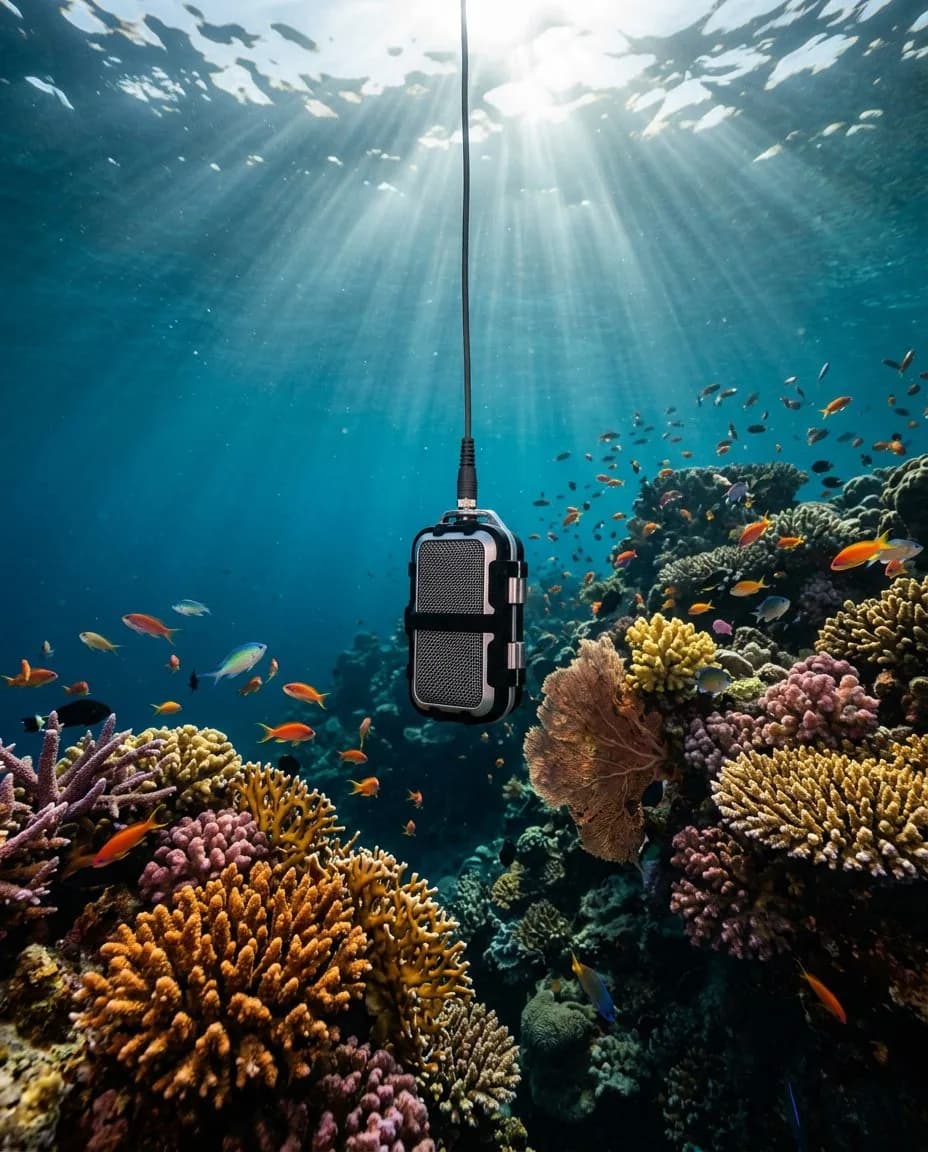
Understanding why underwater music feels so different requires understanding the physics. Sound travels approximately 4.3 times faster through water than through air, and because the density of water is roughly 800 times that of air, the transmission is more efficient. In air, sound arrives at each ear at slightly different times, allowing the brain to locate its source. In water, sound arrives at both ears almost simultaneously, making directional location nearly impossible. The result is not stereo or surround sound — it is a true omnidirectional experience, as if the listener is floating at the center of the sound itself.
But water also absorbs high frequencies more readily than low frequencies. This is why underwater music tends to favor deep, resonant tones, and why instruments like the crystallophone (which produces piercing, high-frequency shimmer) are so remarkable in the AquaSonic context. The musicians of Between Music spent years calculating the exact positioning of instruments within their tanks to achieve consistent, predictable sound — a feat that involved acoustic specialists and precision engineering more commonly associated with aerospace than the arts.
For the listener, this physics translates to a phenomenological experience unlike any other. The boundary between self and sound dissolves. The music doesn't come from "over there" — it comes from everywhere and nowhere. Your entire body becomes a resonating chamber. This is why divers at the Lower Keys festival describe the experience as "ethereal," "surround-sound," and "like being inside the song." It is not hyperbole. It is physics.
The Artist's Perspective: Voices from the Deep
We asked the founders and pioneers of underwater music to reflect on what this movement means. Their responses reveal a philosophy that transcends entertainment and enters the realm of transformation.
Laila Skovmand, Artistic Director of Between Music and creator of AquaSonic:
"I was looking for new ways to express myself. At first, I put my face close to the water. Then, I decided to try singing with my face in the water. It didn't sound so good at first, but I was intrigued and fascinated by this new element in terms of music. After twelve years of experiments, we had created something entirely new. What I hope is that people question their limitations and capabilities. I want to turn the world upside down, so that we see it from a new angle. Water is the one thing we are all connected to, regardless of religion or culture."
Robert Karlsson, Innovation Director of Between Music:
"It's very difficult to play live music underwater. This complexity also creates a huge closeness of the performers. You can't just think about something else. And I think that's exactly what the audience can feel. Water is a substance that unites us all. When we finally got the Teledyne hydrophones and heard the sparkling high frequencies, we were like WOW, WOW, WOW. One of our musicians, who is a sound nerd, immediately said: 'I need one of these!' The quality was so much higher."
Bill Becker, Founder of the Lower Keys Underwater Music Festival:
"The underwater music festival is a way to celebrate the coral reef. We celebrate it by looking for a balance between protection of the reef and public enjoyment. The more people realize what's down there and enjoy it, the more likely they are to protect it. Because sound reaches both ears almost instantaneously underwater, it gives the music very much of a surrounding sound. We have the largest living coral reef in the Northern Hemisphere, and we want to bring attention to it and some of the stresses that it faces."
Roma Komar, Sound Engineer for AquaSonic:
"For our first attempt at recording underwater, we used our normal hydrophone. We could hear something interesting, and that was good. And then we put the Teledyne hydrophone on, and everything opened suddenly. The precision of the sound is on a completely different level. You can hear the small particles, small details. So clearly, and it just keeps the picture full. You understand better what is going on. You hear more. You hear it louder."
DeepBeatDives: The Next Evolution
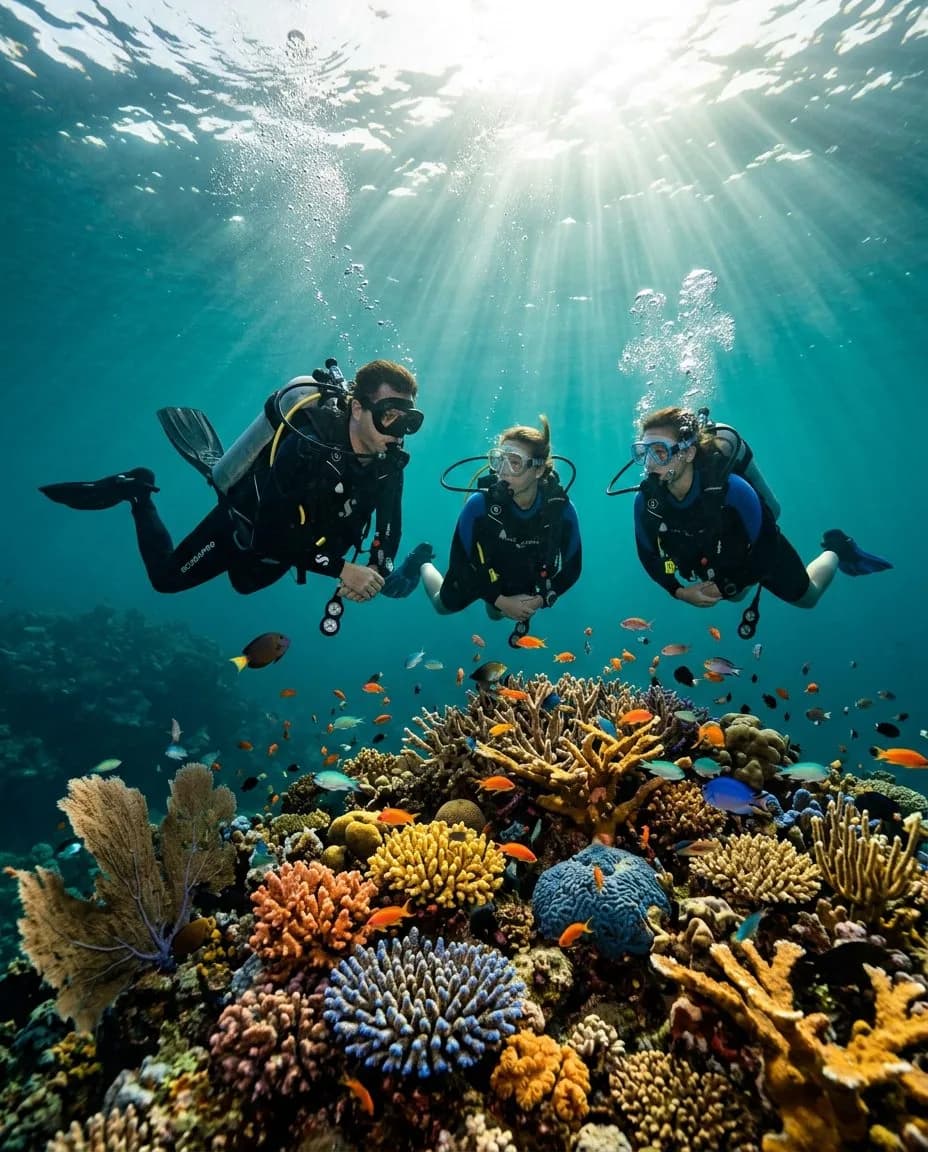
The 41-year arc from Bill Becker's first underwater broadcast to Laila Skovmand's glass tanks to the 50,000-hour hydrophone archives of the Computer Signals Archive leads to a single, inevitable conclusion: humanity is just beginning to understand what music means in the ocean.
DeepBeatDives stands at the convergence of this entire history. We are not simply "adding music to diving" or "bringing a festival underwater." We are building what the last four decades of experimentation have been preparing the world for: a fully immersive, purpose-driven experience where the ocean is not a backdrop but a co-creator.
Where the Lower Keys festival used music to raise awareness for coral preservation, and AquaSonic used submersion to push the boundaries of artistic possibility, DeepBeatDives fuses both impulses into something larger: a community built around the idea that the deepest human experiences happen in the deepest water. Our sound system is not suspended from boats — it is designed around the physics of the Maldives atoll itself. Our music is not broadcast from above; it is composed for the specific acoustic properties of 20 meters of clear Indian Ocean water. Our artists are not performing at divers; they are creating in collaboration with the reef, the current, and the creatures who have been making music in this water for millennia — the same collaboration photographers, musicians, and marine artists have been chasing underwater for years.
The Lower Keys festival taught us that music can be a tool for conservation. AquaSonic taught us that the human body can become an instrument in water. The whale songs of the 1960s taught us that the ocean was never silent. DeepBeatDives teaches us that all of these revelations were leading to something: a tribe of people who believe that the best music, the best community, and the best version of ourselves exist beneath the surface.
The Video Embed Concepts: What This Looks Like
Featured Video: AquaSonic — Live at Sydney Festival (Teaser: 90 seconds) A montage of the five Between Music performers submerged in their glass tanks, crystallophone spinning, rotacorda moaning, vocalist surfacing for a breath before descending again. The tagline: "This is what 12 years of obsession sounds like."
Embedded Clip: Lower Keys Underwater Music Festival — 40th Anniversary (60 seconds) Aerial footage of boats clustered above Looe Key Reef, divers in mermaid costumes descending, the moment a diver hears the first underwater note and visibly pauses, suspended in the water column, eyes widening behind the mask. The tagline: "41 years. The original underwater concert."
Ambient Loop: Hydrophone Recording — Healthy Maldives Reef (Seamless audio embed) A 3-minute hydrophone recording from a healthy reef in the Maldives, featuring the clicking of pistol shrimp, the grazing of parrotfish, and the distant low-frequency pulse of a passing whale. The tagline: "This is the soundscape we compose within."
Documentary Segment: The Making of AquaSonic (2-minute excerpt) Behind-the-scenes footage of instrument construction, vocal training in bathtubs, the first successful underwater note, and the faces of the audience at the Rotterdam premiere. The tagline: "They told them it was impossible. They built it anyway."
The Invitation: Where We Go From Here
The cultural history of underwater music is not a straight line. It is a spiral, circling deeper with each revolution. From the accidental discovery of whale songs in a Cold War listening station, to a radio director's conservation idea in the Florida Keys, to a Danish composer's face in a bowl of water, to a global archive of 50,000 hours of ocean sound — each layer has built upon the last, and each has asked the same question: what happens when we stop listening at the ocean and start listening with it?
The answer is emerging. It is a global movement of divers, musicians, sound engineers, marine biologists, and dreamers who have all arrived at the same realization: the most profound music experiences are not on stages. They are not in arenas. They are not on festival grounds. They are in the water, where the physics of sound and the physiology of the human body converge in a way that transforms both.
The Lower Keys Underwater Music Festival will continue its 41-year tradition. Between Music will continue touring AquaSonic to cities that didn't know they needed underwater music until they heard it. The Computer Signals Archive will continue growing. And DeepBeatDives will continue building the tribe that believes the best frequency is the one you find at depth.
Because the music isn't above the surface. It's below it. And the world is finally learning to listen.
The Dive Deck: The Sound of the Deep, Delivered
Every month, we curate one ocean-inspired playlist and one interview with an artist who is redefining what music means underwater. From hydrophone recordings of healthy reefs to the latest experimental compositions from submerged sound artists, The Dive Deck is the only music newsletter that sounds better at depth.
The next issue drops soon. Subscribe to hear what others miss.
Join the tribe to subscribe to The Dive Deck.
Download: The History of Underwater Music — A Timeline + Playlist
We've compiled the complete history of underwater music into a downloadable timeline and curated Spotify playlist. From the 1970 whale songs that changed conservation to the AquaSonic compositions that redefined performance art to the DeepBeatDives originals composed for the Maldives — this is the definitive guide to the sound beneath the surface.
Join the tribe to get the Timeline + Playlist — a free PDF and Spotify playlist for subscribers.
DeepBeatDives is building the world's first premium deep-sea scuba + music destination festival in the Maldives. We don't sell tickets. We extend invitations. The tribe is forming. The surface is full of noise. The deep is where you find yourself.