
There is a moment that every creative diver knows. It happens somewhere between the surface and the thermocline, when the light fractures into cathedral beams and the only sound is your own breathing. In that suspended silence, the boundaries between observer and artist dissolve. The ocean doesn't just give you subjects — it rewires the way you see, hear, and create.
Most people think of scuba diving as sport. Adventure. Travel. But beneath the surface, another current runs through our tribe. It's the current of creation — the photographers who paint with light at depth, the musicians who build symphonies from whale song, the artists who translate reef memory into canvas and glass. They are not visitors to the underwater world. They are interpreters of it.
This is the Creative Current. And it flows through every one of us who has ever surfaced with something new burning in our chest.
The Photographer: Painting With Photons at 30 Meters
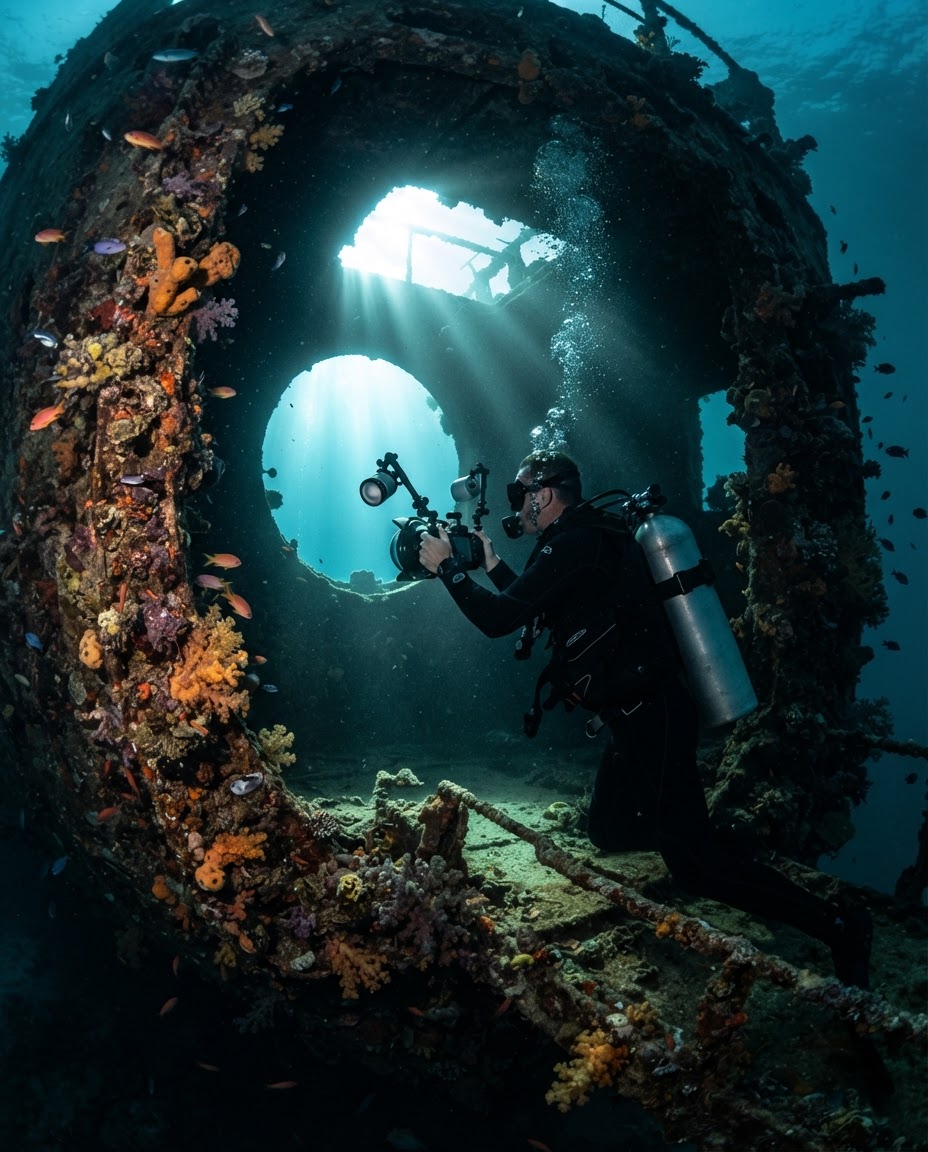
Meet the tribe's light-chasers. They are the ones who descend not just to witness, but to capture — and in capturing, to transform.
The underwater photography community is unlike any other creative ecosystem on Earth. At the 2025 Underwater Photographer of the Year competition, judges sifted through 6,750 images from every corner of the globe. The winning photograph — Alvaro Herrero's Radiant Bond — showed a mother humpback whale and her newborn calf in French Polynesia, a moment of such intimacy that it stopped three veteran photographers in their tracks. But what makes this community extraordinary isn't the hardware. It's the hunger.
Consider the discipline these artists practice. Wide-angle specialists like Alex Dawson descend to 104 meters to frame a shipwreck wedged between reef walls, executing 25-minute bottom times followed by two and a half hours of decompression — all for a single frame. Macro photographers like Paolo Bondaschi spend entire dives motionless, waiting for a hairy shrimp the size of a grain of rice to turn into perfect profile. Korean photographer Ruruka travels 24 hours by plane to Cancun's cenotes, chasing light that only exists for a few minutes when rain-season clouds part above submerged caves.
Their portfolios read like love letters to a world most will never see. Catherine Holmes's Kaleidoscope of Colour — winner of the Coral Reefs category at UPY 2025 — doesn't just document Raja Ampat's Gorgonian Passage. It argues for its survival. Every frame is a plea. Every saturation curve is an act of devotion.
But here's what the judges don't score: the creative transformation that happens to the photographer underwater. When Enric Gener freedives with bottlenose dolphins in the Red Sea, waiting for the precise moment when four males chase a female in a mating ritual that lasts only seconds, he isn't just taking a picture. He's entering a choreography older than human art itself. The black-and-white conversion isn't an aesthetic choice. It's an ethical one — stripping away color to expose the architecture of instinct.
Francesca Page, the UK-based dive professional and artist, captured it perfectly in an interview about her National Geographic Traveller-winning eagle ray photograph: "The ocean's forever magic has enchanted my spirit and is my mission in life." She learned to dive at 13. By 22, she was a divemaster carrying a camera. Now her work spans photography, painting, digital illustration, and writing — because one medium was never enough to hold what the ocean gives her.
The portfolio that defines this tribe: Dramatic wreck penetrations where natural light becomes a character. Macro worlds that reveal nudibranchs as alien sculptures. Split-shots where surface and depth exist in the same breath. Blackwater dives that turn the open ocean into a cosmos of bioluminescent constellations. Every image is proof of the same truth: the camera doesn't steal the soul of the ocean. It gives the ocean a voice on land.
The Musician: When Whale Song Becomes the Setlist
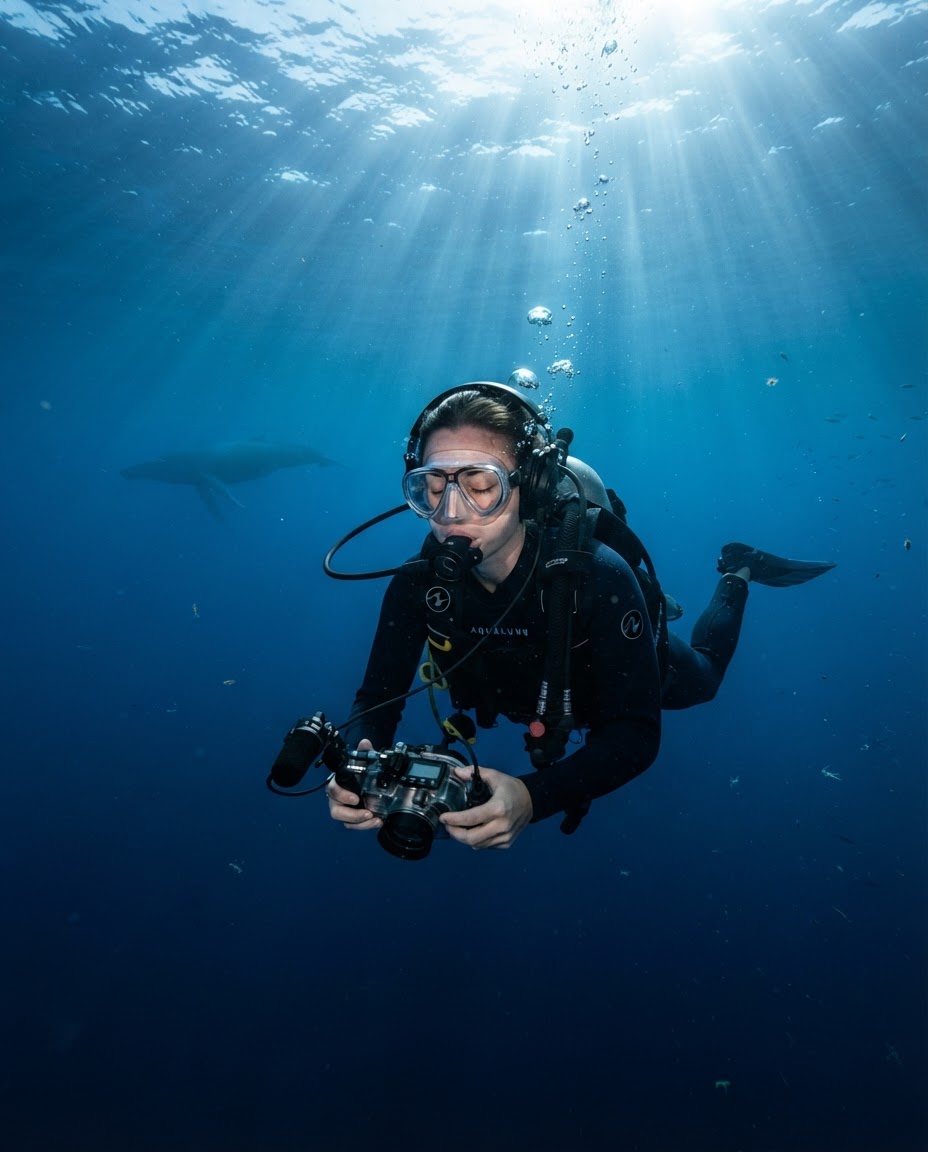
Now descend deeper. Past the photic zone. Into the realm where light ends and sound begins.
Sound travels roughly five times faster underwater than through air. But speed is only half the story. Underwater, sound becomes three-dimensional — it wraps around you, penetrates you, locates you in space in ways no land-based concert speaker can replicate. For the musicians of the Creative Current, this isn't physics. It's invitation.
Enter the world of marine bioacoustics — where composers don't write melodies. They listen for them.
British musician Cosmo Sheldrake composed an entire EP, Wild Wet World, using nothing but recordings of marine life. Killer whales from Scotland's West Coast Community. Humpback whale songs from breeding grounds in the Pacific. Sperm whale clicks. Weddell seals courting. Coral reefs spluttering with life. Parrotfish crunching coral. Shrimp snapping in choruses. Oyster toadfish grunting. Blue whales lamenting across ocean basins. Haddock drumming their swim bladders like underwater timpani.
The result isn't "nature music" in the New Age sense. It's composition. Sheldrake treats these recordings as source material — sampling, layering, building rhythmic structures from biological imperatives. The humpback whale's song, which can last for hours and evolve seasonally across entire ocean populations, becomes a bass line. The pistol shrimp's snap — so loud it momentarily reaches temperatures comparable to the sun's surface — becomes percussion. The reef itself becomes a living orchestra.
But some musicians go further. They don't just sample the ocean. They try to speak back to it.
In 2018, off the coast of La Réunion Island in the Indian Ocean, a team of musician-researchers deployed an extraordinary device called GUiWHi — the Gestural Underwater interactive Whale–Human interface. Wearing wrist-mounted sensors and diving with underwater speakers and hydrophones, musicians attempted real-time acoustic dialogue with humpback whale singers. Not playback. Not mimicry. Genuine interaction — where the human musician listens to the whale's phrases, selects sound elements that harmonize with the whale's acoustic features, and responds in real time.
The protocol was strict: boats stopped 300 meters from singers, engines off, no swimmers in the water, marine mammal observers watching for any sign of distress. Sessions lasted only 15 minutes. Each whale was engaged just once. The goal wasn't to trick the whale. It was to signify: We are here. We are listening. We are trying to meet you in your medium.
Tom Mustill, filmmaker and author of How To Speak Whale, created an immersive audio installation called Whale Song Sound Bath — a narrated journey beneath the waves composed of hydrophone recordings: common dolphins, bottlenose dolphins, Risso's dolphins, the snap of shrimp, the drone of distant shipping. His work asks a question that haunts the Creative Current: What if we've been listening to the ocean all wrong? What if the sounds we call "noise" are actually language — not human language, but something older, stranger, more beautiful?
The musician-diver doesn't just hear the ocean. They learn its grammar. The 20-Hz pulse of a fin whale can travel across entire ocean basins. The clicking sequences of sperm whales may be encoded with individual identity — names, passed through matrilineal lines for millions of years. The choruses of fish that erupt at dusk and dawn follow lunar calendars older than human agriculture — the same living soundscape that lets researchers tell whether a reef is thriving or dying just by listening.
For these artists, every dive is a recording session. Every descent is a collaboration with a composer who has been refining their craft for 50 million years.
The Marine Artist: Translating Reef Memory Into Form
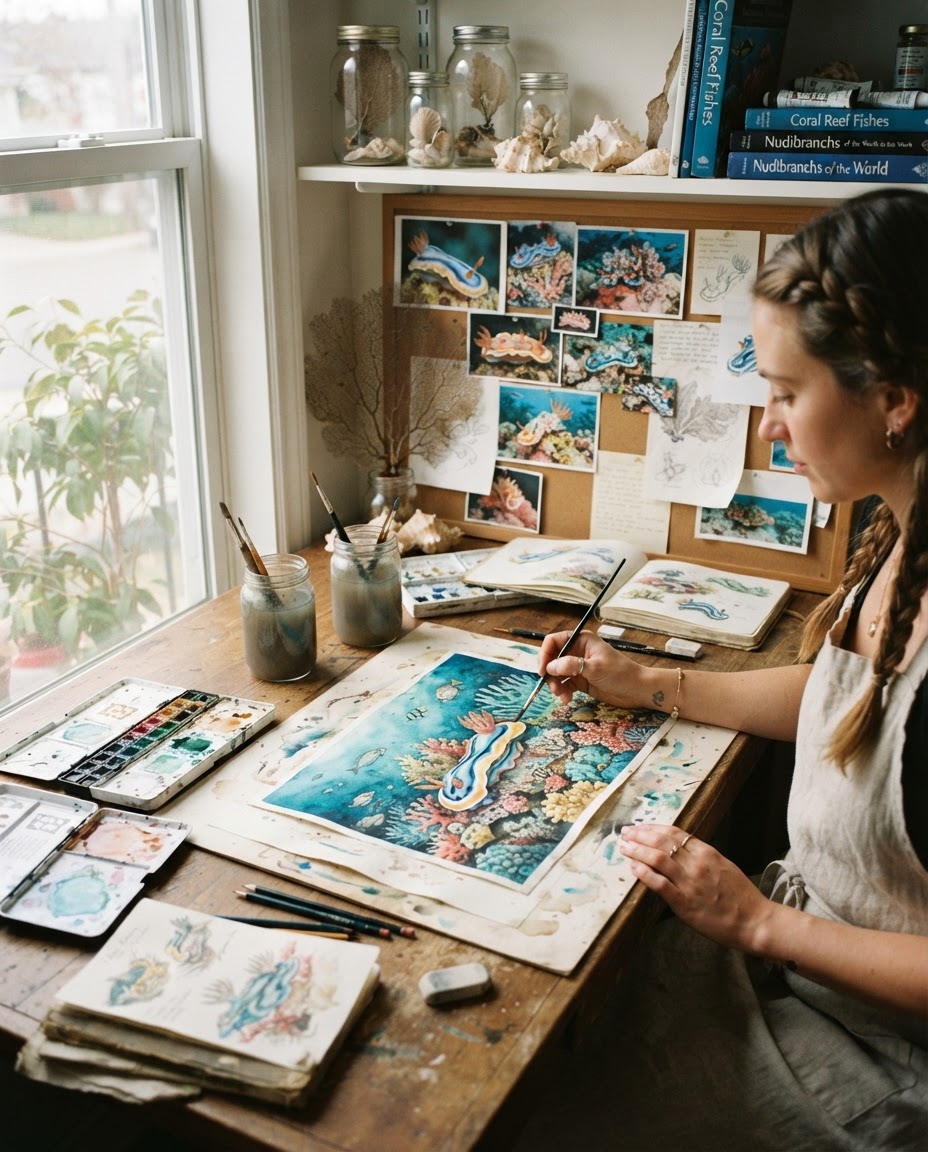
Surface now. Dry off. But the ocean doesn't let go.
For the marine artists of our tribe, the dive doesn't end at the safety stop. It continues in the studio, in the workshop, in the hours between midnight and dawn when coral formations replay behind closed eyes and the color of anthias schools haunts the palette like a melody you can't shake.
Francesca Page — dive professional, National Geographic Traveller competition winner, and illustrator — describes her creative mission with piercing clarity: "I want my art to capture the magic of the ocean and hopefully ignite a fire in others to want to protect it. I believe art has the power to not only connect others to the wonders found in our ocean but also help in the fight against climate change."
She's not alone in this conviction. Across the globe, a generation of marine artists is emerging from the dive community with a shared obsession: translating the untranslatable experience of being underwater into forms that can live on land. Call it underwater art, call it reef memory made physical — either way, it's a discipline built entirely from time spent below the surface.
Kolin Hansen, a cold-water diver from Vancouver Island, uses 3D animation and digital painting to spotlight the overlooked marine life of the Pacific Northwest — wolf eels, rockfish, giant Pacific octopuses. His work is anchored in field observation: he contributes to glass sponge reef research in Howe Sound, then translates that scientific intimacy into portraits that make viewers care about creatures they'd never heard of. The giant Pacific octopus, with its three hearts and blue copper-based blood, becomes a character in his digital canvases — not cute, not anthropomorphized, but seen.
Andrea Dingeldein, a science illustrator in California's Monterey Bay, works at the intersection of rigorous observation and artistic interpretation. Her process begins with precise field sketches — notes on the way a kelp frond moves in surge, the exact color gradient of a nudibranch's rhinophores — then transforms through watercolor, colored pencil, and digital media into pieces that support real conservation programs: the White Abalone Captive Breeding Program, the Puget Sound Partnership. Her art doesn't just depict. It advocates.
Then there's Dimitri Sirenko in Vancouver, whose oil paintings capture seascapes with the emotional density of memories rather than landscapes. A 2018 National Champion of the competitive live painting event Art Battle, Sirenko works fast and works wet — his canvases carrying the urgency of someone who knows the reef he's painting may not look the same when he dives it again.
But perhaps the most striking work comes from artists who use the ocean's own materials as medium. Mason Parker, an Oregon-based artist working in stained and fused glass since 1990, creates five-foot-wide octopus chandeliers and jellyfish lamps that hang in homes like fragments of captured reef. The Washed Ashore project builds massive sculptures — up to 15 feet long — entirely from plastic pollution recovered from the Pacific Ocean. Their pieces are stunning and horrifying: a great white shark built from discarded toothbrushes, an octopus constructed of flip-flops. The art doesn't just depict the ocean's crisis. It embodies it.
For these artists, every dive is a sketching expedition. Every surface interval is color-matching in memory. And every finished piece is an argument: This world exists. It is stranger and more beautiful than anything we could invent. And it is worth every breath we take to save it.
The Creative Current: Why Divers Make the Best Artists
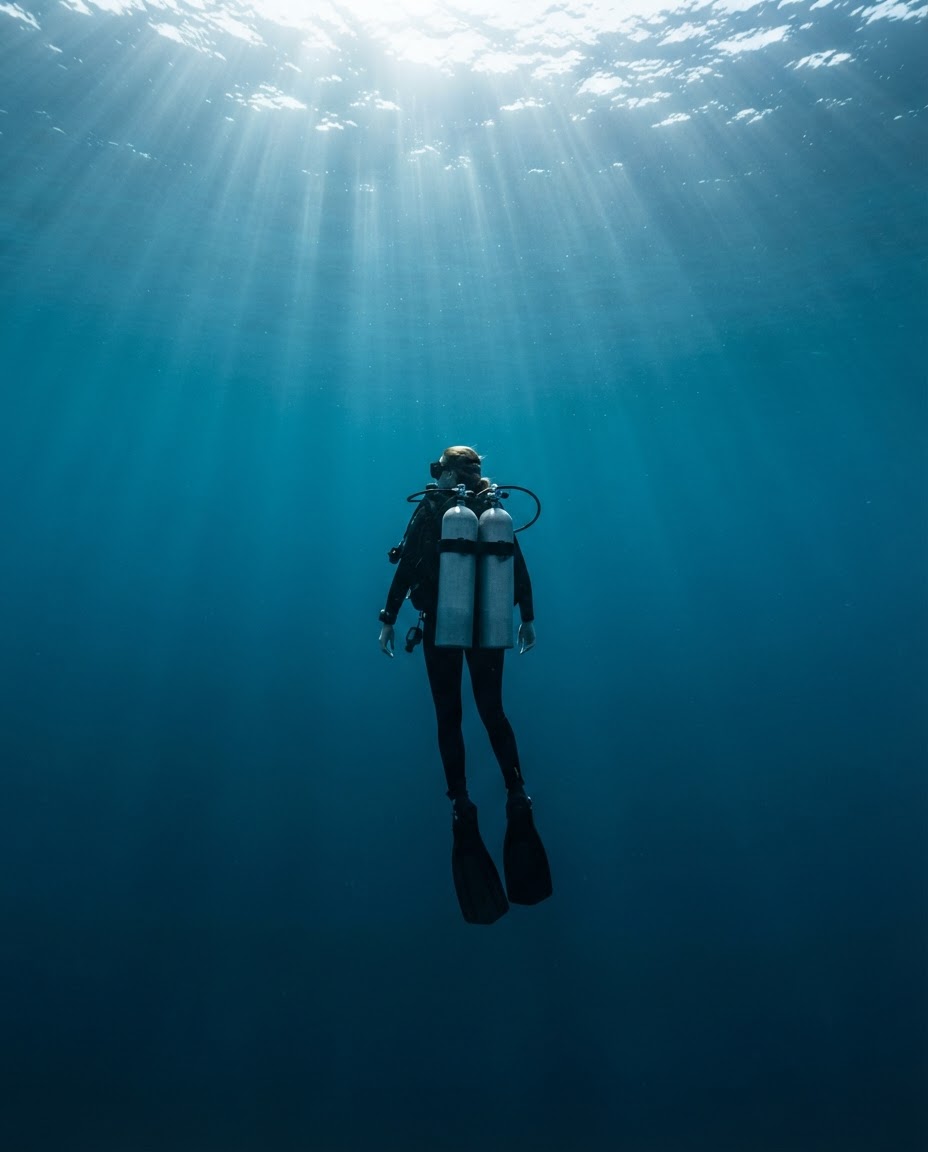
Here's what connects these three disciplines — photography, music, marine art — into a single creative current. It's not subject matter. Plenty of non-divers paint the ocean and sample whale sounds.
It's the condition of diving itself.
Scuba diving imposes a set of creative constraints that paradoxically unlock extraordinary art. You have limited time — governed by gas supply and decompression obligations. You have limited mobility — every movement must be deliberate, every fin stroke calculated against impact on the environment. You have limited communication — the hand signal vocabulary forces a kind of visual thinking that transfers directly into composition. You have limited light — the ocean absorbs color progressively with depth, so by 30 meters you're working in a blue-dark world where flash and torch become your paint.
Most importantly, you have forced presence. No phone. No notifications. No multitasking. Just breath, buoyancy, and the absolute now. That kind of sustained attention — what psychologists call "deep work" — is the rarest creative resource in the modern world. And divers get it delivered with every descent.
The result? A tribe of creators who don't just visit the ocean for inspiration. They return transformed. The photographer who surfaces seeing light differently for days. The musician who dreams in hydrophone frequencies. The painter whose palette shifts permanently toward the aquamarines and indigos of the deep.
Your Invitation to the Creative Current
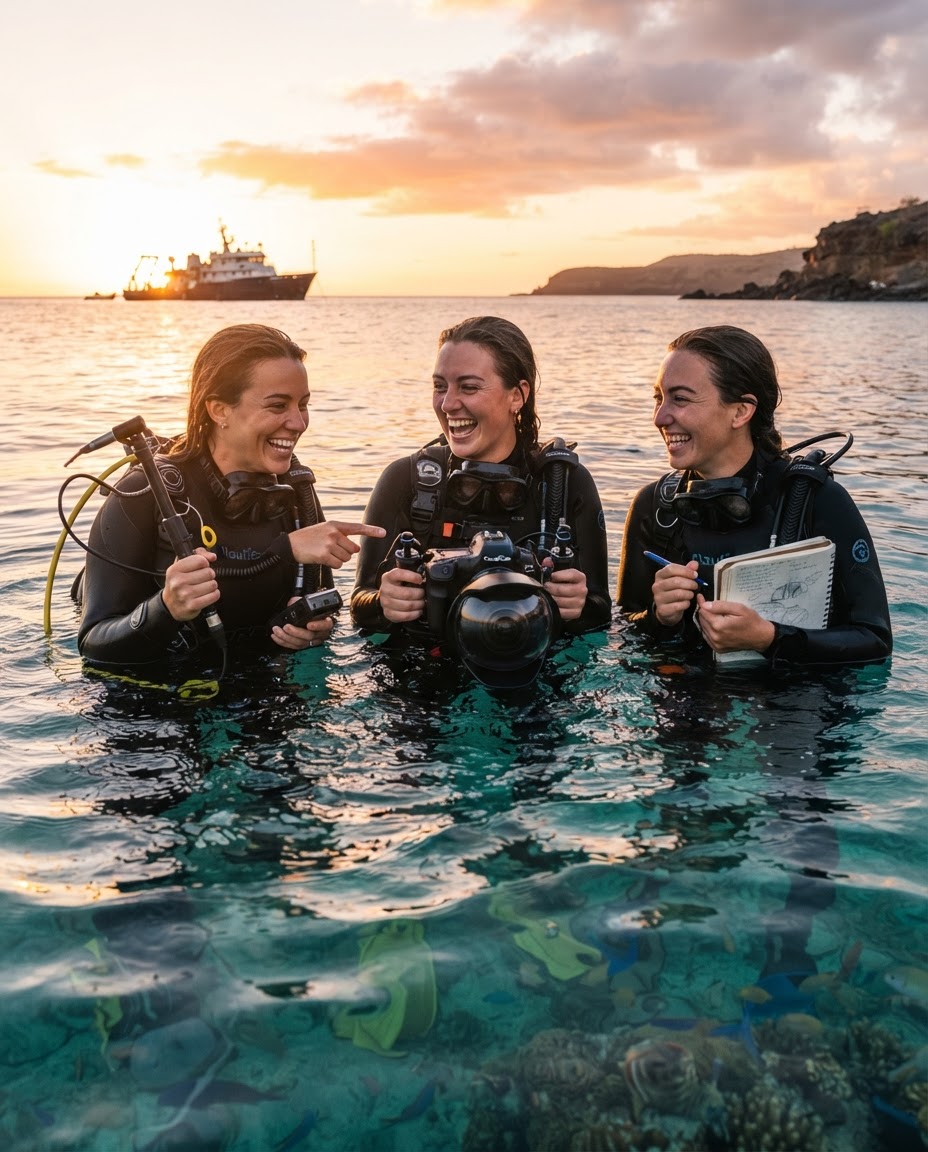
If you've ever surfaced from a dive with your mind racing — not with narcosis, but with ideas — you're already part of this current. If you've ever tried to describe a manta encounter to a non-diver and found language failing, only to reach for a camera, a sketchpad, or a MIDI controller instead, you know exactly what we're talking about.
The dive community has always been more than a sport. It's a lens. A medium. A way of seeing that produces art the surface world cannot make.
Are you a creative diver? We want to feature you.
Submit your photography, your music, your art, your writing. The Creative Current doesn't discriminate by medium. It only asks one question: Did the ocean make this?
📬 Get the Creator Current
Every month, we spotlight one underwater artist, musician, or photographer from the tribe — their process, their portfolio, and the dive that changed everything. These are the stories we don't post on the blog. These are the voices from the deep.
Join the tribe to subscribe to The DeepBeat Dispatch and get one creative spotlight delivered to your inbox every month — plus the resources, communities, and inspiration that turn dive dreams into art.
🎁 Free Lead Magnet: Download The Creative Diver's Toolkit — our curated collection of underwater photography resources, hydrophone recording guides, marine art communities, and inspiration for divers who create. [Subscribe below to get your copy.]
The ocean doesn't just have creatures. It has composers, painters, and storytellers. Some of them wear wetsuits. Some of them wear fins. All of them carry the current.
See you in the water. 🌊
DeepBeatDives is building the world's first premium deep-sea scuba + music destination festival in the Maldives. Want to dive, discover, and dance with the tribe? [Join the waitlist.]