The Dive That Changed Everything
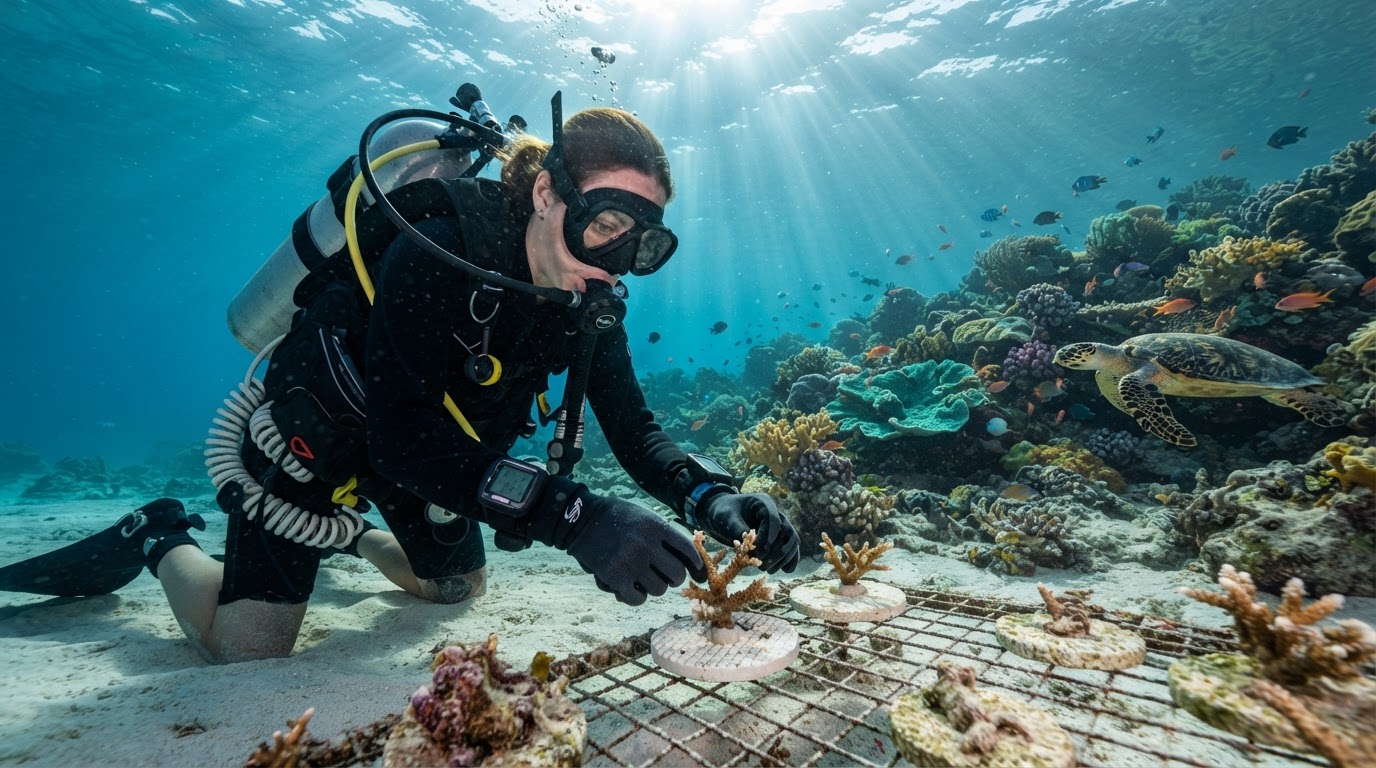
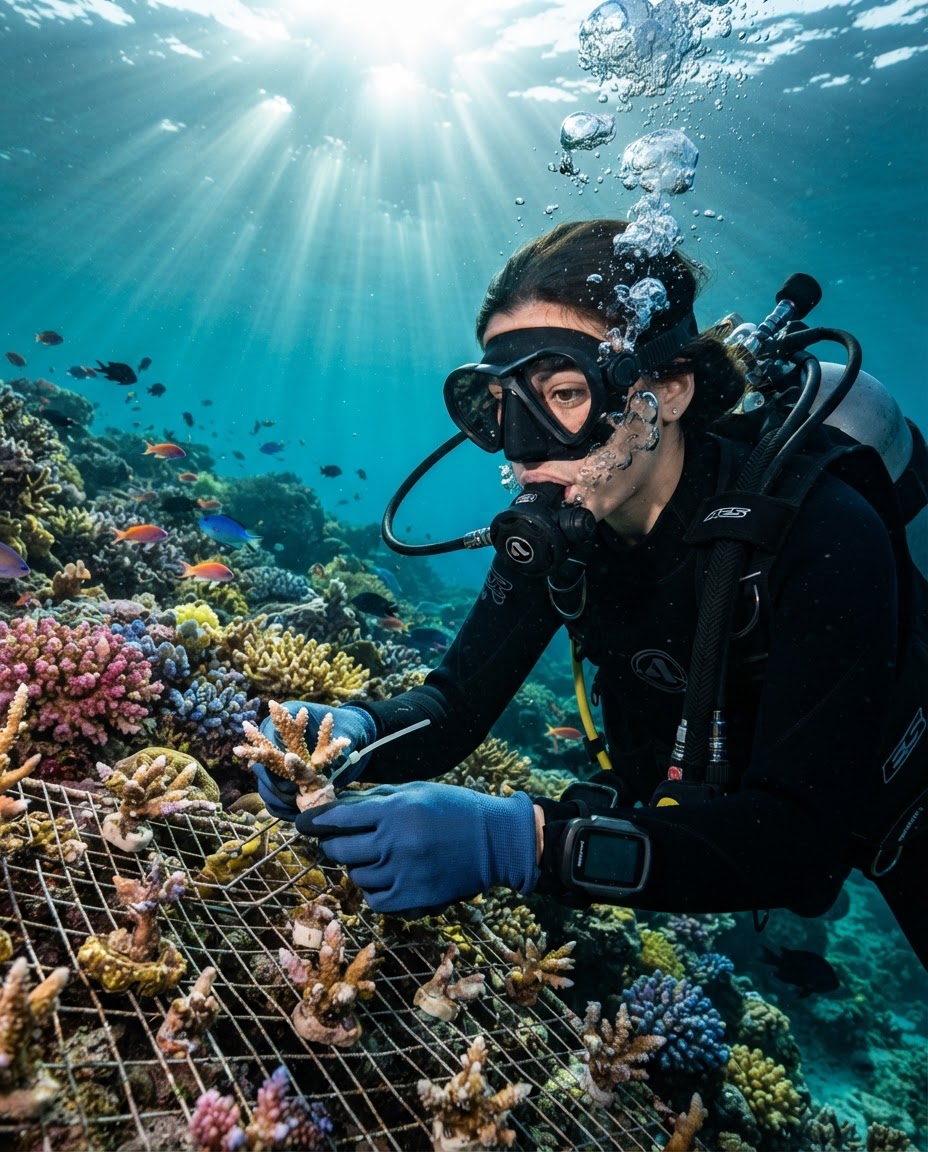
There is a moment every diver knows — the one where you roll off the boat, feel the saltwater seal your mask, and descend through the blue into a world that does not care about your job title, your inbox, or your deadlines. But in the Maldives, there is a second moment that is changing the way we think about diving itself. It happens when you kneel on the sandy bottom at eight meters, hold a fragment of living coral no larger than a thumbnail, and attach it to a ceramic disk with a dab of marine-safe epoxy. You look up. A parrotfish darts past in a flash of emerald. A hawksbill turtle cruises the reef wall. And you realize: you did not just observe this ecosystem today. You rebuilt a piece of it.
This is regenerative travel. This is the Maldives coral restoration revolution. And this is why DeepBeatDives chose these waters.
The Maldives has always been a paradox — 1,192 islands scattered across 26 natural atolls, built atop some of the most biodiverse coral reefs on Earth, yet hauntingly vulnerable to the very oceans that define them. The numbers tell a sobering story. Before the catastrophic bleaching event of 1998, Maldivian reefs boasted coral cover of 46.5%. After the combined toll of the 1998, 2010, and 2016 mass bleaching events — plus the relentless pressures of coastal development, land reclamation, and warming seas — that figure plummeted to less than 10% in some areas by 2024. For a nation where tourism and fisheries drive the economy, where the very land beneath your feet is coral skeleton accumulated over millennia, those percentages are not abstract statistics. They are an existential countdown.
But beneath the surface, something extraordinary is happening. And divers are not just witnesses to it. We are the architects.
The Science of Microfragmentation: 40 Times Faster, One Tiny Cut at a Time
To understand why the Maldives coral restoration movement matters, you need to understand a technique that sounds more like science fiction than marine biology. It is called microfragmentation. And it is rewriting the timeline of reef recovery from centuries to years.
The story begins not in the Maldives, but in a land-based coral nursery in Florida, where Dr. David Vaughan at Mote Marine Laboratory was experimenting with ways to accelerate the growth of massive corals — the slow-growing brain corals, boulder corals, and star corals that form the backbone of reef structure. These species grow at a glacial pace in the wild, sometimes just 0.2 to 1 centimeter per year. A single colony might take 50 to 100 years to reach reproductive size. Conventional restoration could not scale fast enough to outrun the losses.
Then Dr. Vaughan made an accidental discovery that would change everything.
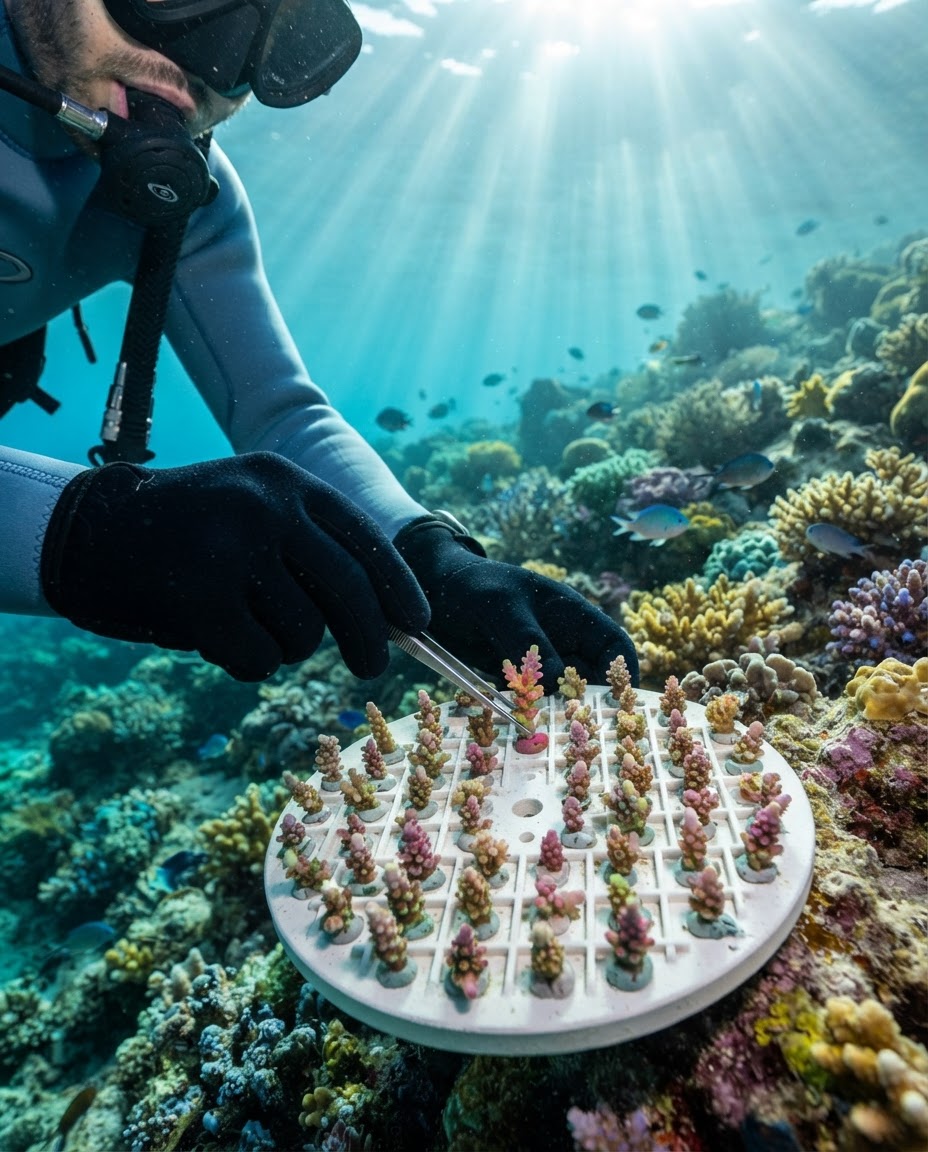
While working with coral fragments in controlled tanks, he noticed something counterintuitive: when you cut a coral colony into tiny pieces — fragments as small as 1 to 2 square centimeters, barely the size of a fingernail clipping — the coral does not die. It panics. And in its panic, it triggers a healing response so aggressive that it begins growing tissue up to 40 times faster than it would under natural conditions. A baseball-sized piece of coral, fragmented and arranged in a grid pattern, can fuse into a basketball-sized colony in four to six months. What would normally take 75 years in the wild now happens in two.
The mechanism is elegant in its simplicity. Corals are clonal animals. When you cut them into microfragments, the increased surface-area-to-edge ratio triggers rapid cell division as the coral races to heal its wounds. Each tiny fragment deploys all available energy into tissue expansion rather than the slow, conservative growth strategy it uses in nature. Place those fragments close enough together — an inch or two apart — and as they grow, their edges meet and fuse, forming genetically identical colonies that behave as a single organism. The result is a "reskinning" effect that can bring 100-year-old dead coral skeletons back to life.
Dr. Vaughan calls it the "Coral Lazarus Effect." We call it hope, measured in millimeters per month.
From Florida to the Atolls: How the Maldives Is Scaling Restoration
The Maldives did not wait for permission to adopt microfragmentation. It adapted it. Combined it. And built something uniquely Maldivian.
The archipelago's coral restoration efforts have evolved from passive approaches — protecting areas and hoping nature heals itself — to an increasingly sophisticated, multi-technique arsenal that involves marine biologists, resort operators, local island communities, and yes, the divers who come to explore these waters. The National Coral Reef Monitoring Program, one of the oldest in the world, has tracked reef health at 50+ permanent monitoring sites since 1998, giving Maldivian scientists an unmatched longitudinal dataset to guide their restoration decisions.
Today, three primary restoration techniques dominate the Maldives approach:
Coral Transplantation involves moving healthy coral fragments directly from donor colonies to degraded reef areas. It is the fastest method visually — guests see immediate results — but survival rates hover around just 10%, making it better for optics than ecology.
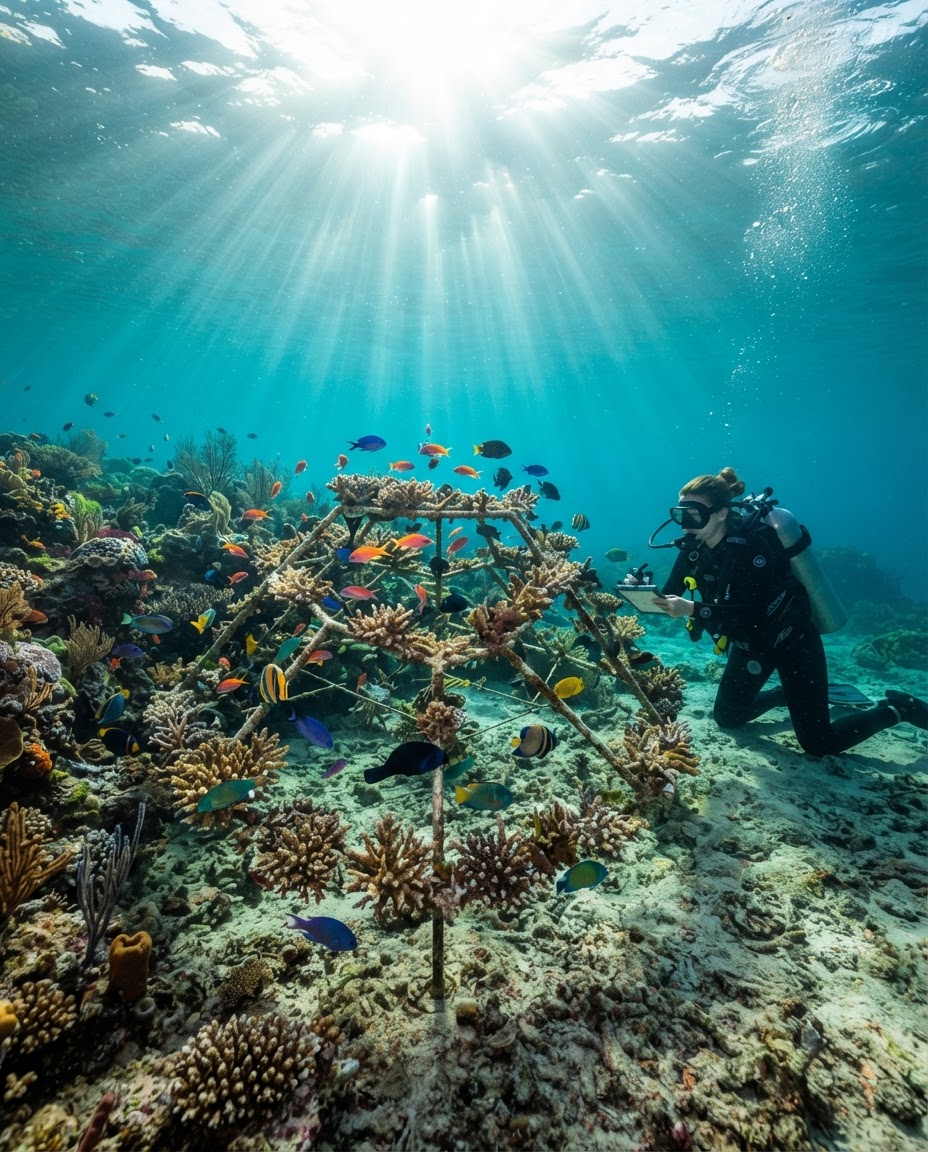
Modular Coral Frames — the iconic underwater structures you have seen on Instagram, where fragments are tied to metal frames and lowered onto the reef — achieve far better survival rates of roughly 68%. Resorts across the Maldives, from Anantara to Baros to Conrad Rangali, have planted thousands of these frames, transforming house reefs into living coral gardens. The frames themselves become substrate, eventually overgrown and absorbed into the reef structure.
Coral Gardening — the most successful technique to date — achieves survival rates exceeding 85%. Fragments are first nurtured in underwater nurseries, often suspended on rope lines or coral trees that maximize water flow and light exposure, before being transplanted to restoration sites once they have grown large and resilient enough to survive. A study conducted in Faafu Atoll and Alif Dhaal Atoll demonstrated that fragments of Acropora, Pocillopora, and Porites corals not only survived at rates above 90% in nursery habitats but grew fast enough to reach transplant size within months, not years.
But the Maldives is not stopping at fragmentation. In 2025, a breakthrough collaboration between the Maldives Marine Research Institute (MMRI) and the Australian Institute of Marine Science (AIMS) deployed ReefSeed — a portable, containerized coral aquaculture system capable of rearing millions of coral larvae in remote locations. For the first time, local Maldivian biologists independently operated the system, successfully rearing over three million larvae and deploying more than 10,000 juvenile corals across nine reef locations. This is larval-based restoration — sexual reproduction, not cloning — and it matters because genetic diversity is the ultimate insurance policy against future bleaching events.
The Maldives is also pioneering "super coral" selection. Marine biologists are identifying heat-resistant coral genotypes — species like Montipora digitata and Porites cylindrica that have demonstrated greater resilience to thermal stress — and prioritizing them in restoration programs. These are not just random fragments being planted. They are the survivors of the 2016 bleaching, the corals that refused to die, and they are being given the chance to repopulate the reefs of tomorrow.
Citizen Science: When Every Dive Becomes Data
Here is where the revolution gets personal. Because the most powerful tool in the Maldives restoration toolkit is not a diamond-bladed saw or a containerized larval pool. It is you.
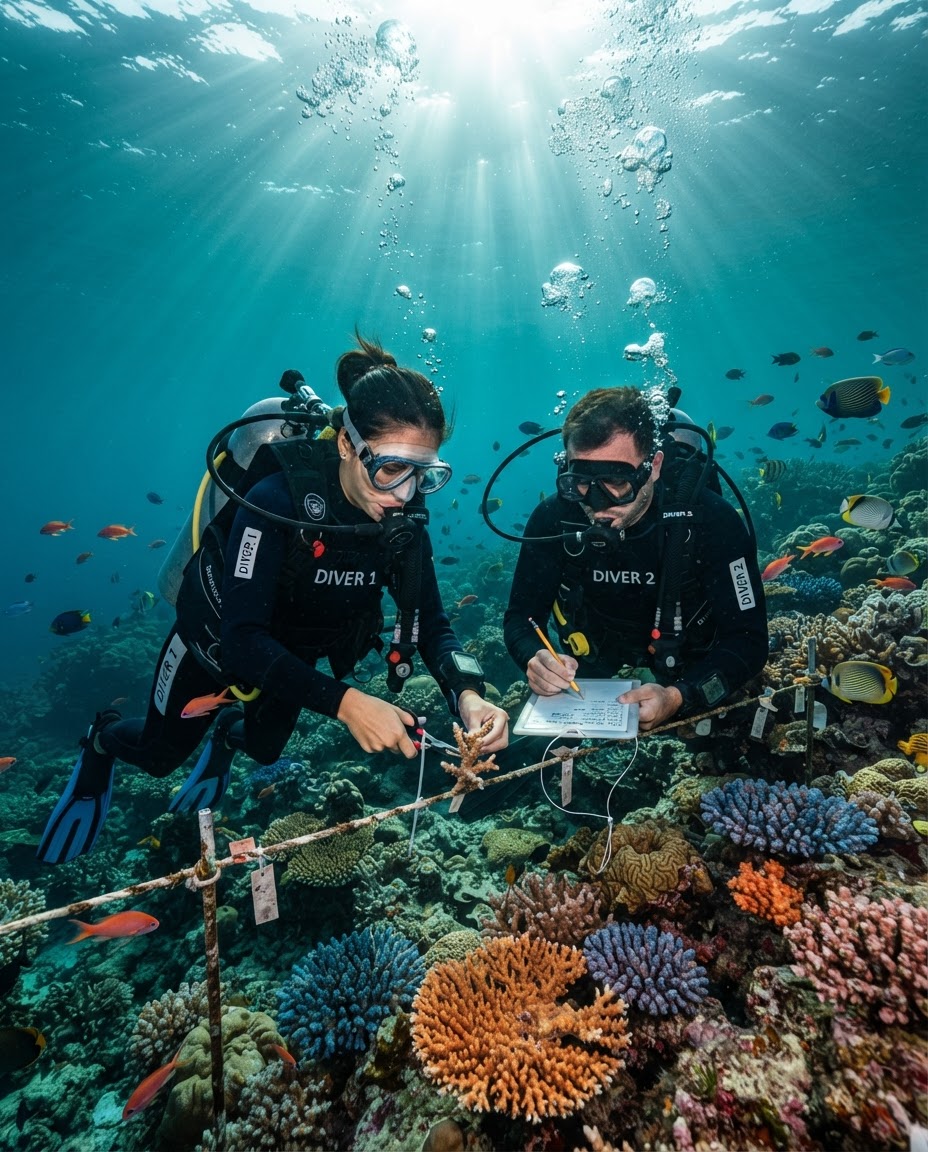
Citizen science — the practice of engaging non-scientists in data collection, monitoring, and active restoration — has become the secret force multiplier of Maldivian reef recovery. Resorts across the atolls now invite guests to participate in coral planting programs, where divers and snorkelers attach fragments to frames, monitor growth, and contribute to datasets that would be impossible for a handful of marine biologists to collect alone.
The model is brilliantly simple. A guest arrives at a resort like Constance Moofushi or Bandos Maldives. They attend a briefing with the resident marine biologist — the same kind of briefing that teaches you to read a reef like a marine biologist. They learn to identify coral species, recognize signs of bleaching, and understand the fragile mechanics of the ecosystem they are about to enter. Then they descend — not just as tourists, but as stewards. They plant a fragment. They record its location. And months later, they receive an update: a photo of the coral they planted, now visibly larger, perhaps fused with its neighbors, perhaps hosting its first tiny Trapezia guard crab.
This is not voluntourism. This is data. The Maldives Coral Institute's community-led restoration program, launched in 2024, trained 27 representatives from 16 organizations across five Maldivian regions in coral spawning surveys, larval culture techniques, and monitoring protocols. Local island councils. Resort eco-centers. Schoolchildren in Fulhadhoo and Baa Atoll learning reef ecology through snorkeling trips and ocean art. Divers who return year after year to check on "their" corals. Together, they form a distributed intelligence network — thousands of eyes and hands working in parallel across 2,691 to 4,510 square kilometers of reef.
The World Bank's 2024 assessment of Maldivian reef management explicitly recommends scaling citizen science as a core strategy, noting that "engaging citizen science as part of the data collection needs that support resilience-based management of the reef" is essential to long-term success. The divers who collect photographic surveys, the snorkelers who report bleaching events, the tourists who fund restoration through frame adoption programs — they are not replacing scientists. They are extending them.
And the psychological impact runs deeper than the data. Studies on conservation psychology consistently show that people who participate in hands-on environmental restoration develop stronger pro-environmental identities, higher willingness to pay for conservation, and greater advocacy for protective policies. When you plant a coral fragment, you do not just change the reef. You change yourself. You become the kind of person who speaks up for marine protected areas, who chooses reef-safe sunscreen, who signs petitions against coastal dredging. The Maldives has figured out something profound: the best way to protect a reef is to make people fall in love with it. And the fastest way to make them fall in love is to let them build it.
The Sound of a Reef Being Reborn
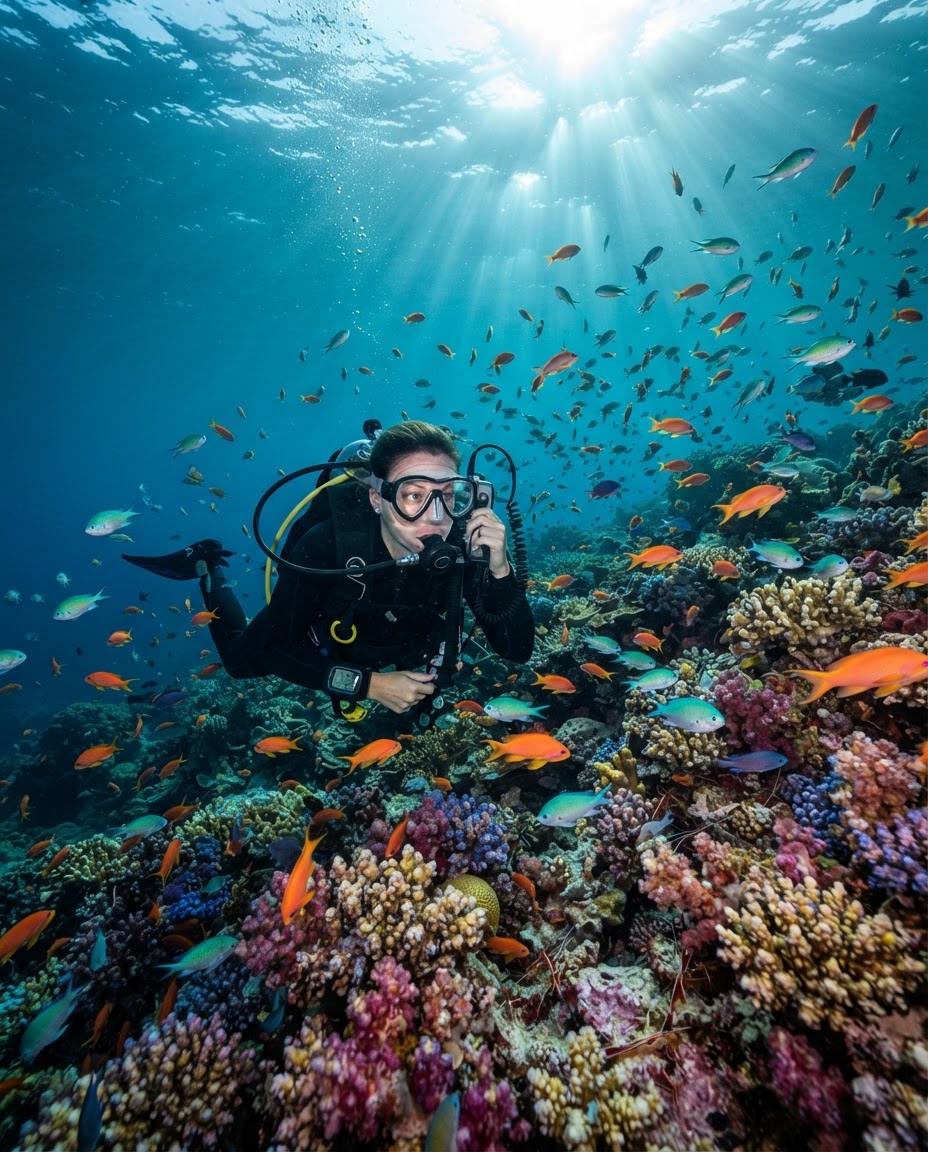
There is a detail about coral restoration that almost nobody talks about, but it is the detail that connects most deeply to who we are at DeepBeatDives. It is the sound.
Healthy reefs are noisy — and you can hear a reef dying before you can see it. Crackling, popping, clicking — a symphony of shrimp snapping their claws, parrotfish scraping algae, damselfish defending territory. Hydrophone recordings from thriving Maldivian reefs capture a soundscape so dense it resembles frying bacon at full volume. Degraded reefs, by contrast, are eerily silent. The structural complexity that creates acoustic niches has collapsed. The fish have left. What remains is the underwater equivalent of an empty concert hall.
Microfragmentation does not just rebuild coral cover. It rebuilds acoustics. As fragments fuse and grow, as they create new crevices and overhangs, fish return. Shrimp return. The soundscape regenerates. A reef that was silent five years ago can be crackling with life five years later — not because someone dumped concrete on it, but because someone planted a fragment the size of a coin and let nature do what nature does best.
This is why the intersection of diving and music is not a gimmick for us. It is a metaphor made literal. A healthy reef is an orchestra. A restored reef is a comeback tour. And every diver who plants a fragment is buying a ticket to the show.
DeepBeatDives and the Maldives: Why We Are Not Just Visiting
We did not choose the Maldives for our launch because it is beautiful. We chose it because it is becoming — a reef system in active recovery, a conservation story still being written, a place where the dive you take tomorrow can leave the ocean better than it was yesterday.
DeepBeatDives is not a festival that happens to be near a reef. We are a tribe that exists because reefs exist. And we believe that the most premium experience we can offer is not the deepest dive, the rarest creature, or the most exclusive afterparty. It is the moment you surface knowing that your presence mattered.
When you join us in the Maldives, you will not just dive these restored reefs. You will help build them. Our conservation partnerships with local marine research stations will give every DeepBeat tribe member the opportunity to participate in active restoration — from fragment planting to growth monitoring to citizen science data collection. You will descend with a purpose. You will ascend with a story that does not end when the boat returns to shore.
And because we believe in radical transparency, every tribe member who participates in our coral restoration program will receive a Coral Adoption Certificate — a digital record of the fragment you planted, its GPS coordinates, and progress updates as it grows. Six months later, you will receive a photo of your coral, now larger, perhaps fused with its neighbors, alive in the reef you helped rebuild. This is not a souvenir. It is proof that you were here, that you gave more than you took, and that the ocean remembers.
The Math That Matters
Let us close with the numbers — not because numbers are what move us, but because they are what move decision-makers, funders, and the skeptics who say restoration is too little, too late.
- 46.5% — Maldivian coral cover before the 1998 bleaching event.
- <10% — Coral cover in some areas before 2024.
- 40x — The growth acceleration achieved through microfragmentation.
- 85%+ — Survival rates for coral gardening techniques in Maldivian nurseries.
- 3 million+ — Coral larvae reared through the ReefSeed program in 2025.
- 10,000+ — Juvenile corals deployed across nine Maldivian reef locations.
- 14,000+ — Coral fragments propagated by Ventive Hospitality resorts alone.
- 27 — Local stakeholders trained in the Maldives Coral Institute's 2024 capacity-building program.
- 1 — The number of fragments you can plant on your first dive that will outlive every Instagram post you have ever made.
The Maldives is not saved. No reef on Earth is saved while global temperatures continue to rise and oceans continue to acidify. But the Maldives is fighting with a toolkit that did not exist a decade ago, a coalition of scientists and citizens that grows stronger every year, and a technique — microfragmentation — that compresses geological time into human time.
A century-old reef structure, "reskinned" and brought back to life in two years. A dead reef, silent and grey, crackling with shrimp and parrotfish five years after the first fragments were planted. A diver, kneeling in eight meters of turquoise water, attaching a fragment to a ceramic disk and looking up at a turtle passing by.
This is the revolution. And it is happening one fragment at a time.
The Invitation
The Maldives coral restoration revolution is not a spectator sport. It is a participation event. And the diving community — our tribe — has a role to play that no other group can fill. We are the ones who see these reefs up close, who document their changes, who fund their recovery through our tourism dollars, and who carry their stories back to the surface world.
Every subscriber to the DeepBeat Dispatch helps us fund one additional coral fragment through our restoration partnerships. Join 10,000+ ocean lovers and see the reef you are helping rebuild. You will receive updates from our marine science partners, photos of the fragments your subscription supports, and the knowledge that your curiosity is converting into coral cover.
This is not a newsletter. It is an invitation to the blue — with a fragment of reef attached.
Join the tribe to subscribe to the DeepBeat Dispatch, plant your coral fragment, and receive your Coral Adoption Certificate.
Protect what we celebrate. Become a reef guardian.
DeepBeatDives is the world's first premium deep-sea scuba + music destination festival, launching in the Maldives. We do not just dive. We restore. We do not just listen. We protect. Join the tribe.
SEO Keywords: Maldives coral restoration, coral reef restoration diving, citizen science coral reef, regenerative travel diving, eco diving Maldives, microfragmentation coral growth, coral adoption program, Maldives marine conservation
Sources & Further Reading:
- Mote Marine Laboratory — Coral Reef Restoration & Microfragmentation Research
- Maldives Marine Research Centre — Coral Reef Research Programme
- Oceanographic Magazine — "Maldives Coral Reef Restoration Takes Pioneering Step Forwards" (2025)
- The Biologist — "Divide and Conquer: Microfragmentation Explained" (Forsman et al.)
- World Bank — Roadmap for Fostering Coral Reef Resilience in the Maldives (2024)
- Maldives Coral Institute — Community-Led Coral Reef Restoration Program
- PBS NewsHour — "Scientists Try to Regrow Dying Coral Reefs 25 Times Faster Than Nature" (David Vaughan interview)