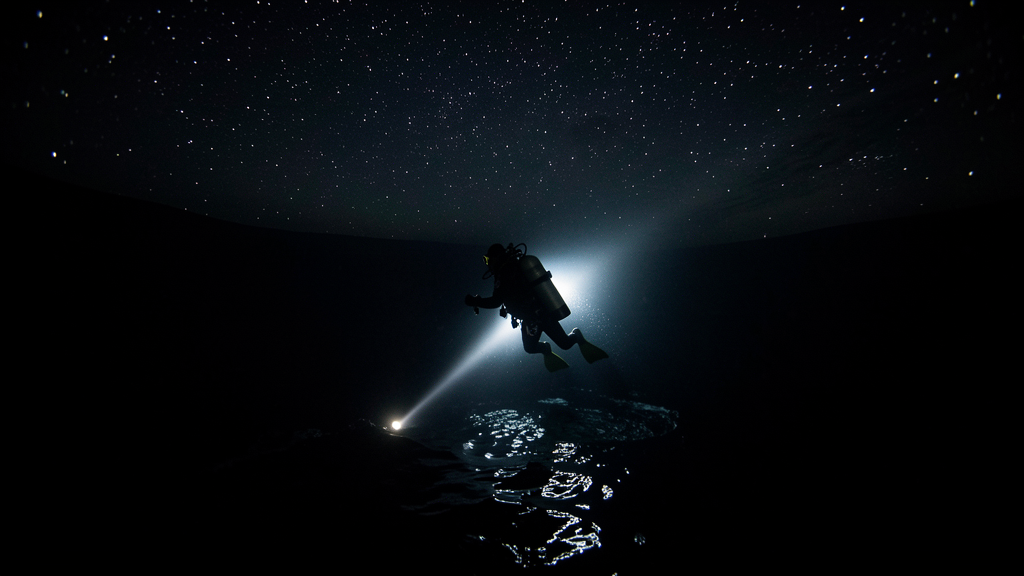
There is a moment, just before the backroll, when the ocean stops being a place and becomes a question. Every night diving experience begins here — at the threshold between the lit world and the one that wakes after dark.
It is not the question you asked on your first open-water dive — Can I do this? — because you already know the answer. You are certified. You have hours. You have descended into blue so deep it felt like falling through sky. This question is older. It lives in the part of your brain that still remembers being prey.
The boat rocks. The surface is oil-black, swallowing the stars. Your primary light is charged, your backup light is clipped, your tank is full. You have checked everything twice because that is what the tribe does. But no checklist in the world can prepare you for what happens when you let go of the gunwale and fall backward into a darkness so complete it feels like being born.
This is the threshold. And on the other side of it waits a secret society whose only membership requirement is the courage to enter.
The Descent
The entry is always the hardest part.
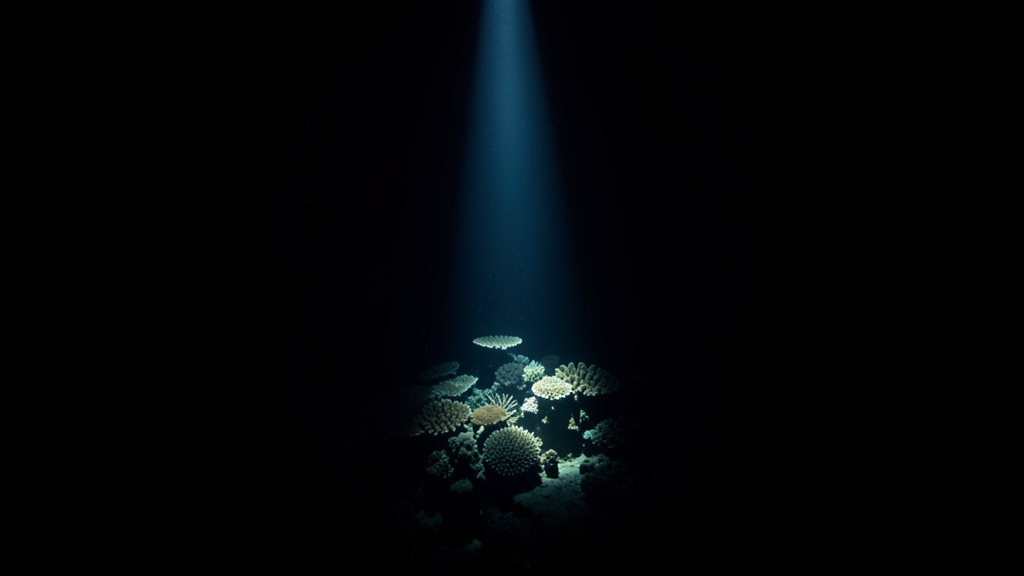
Not physically — the backroll is muscle memory now. But psychologically. On a day dive, you can see the bottom. You can read the reef. The sun gives you bearings, and the surface is a bright promise you can always look up to. At night, that promise is gone. What remains is a cone of light, maybe two meters across, carving a small cathedral of visibility out of an infinite blackness.
You equalize. You descend. And somewhere around six meters, something shifts.
Your peripheral vision — already narrowed by the mask — contracts further. Psychologists call this perceptual narrowing: the brain's response to stress, funneling attention into a laser beam of focus. During the day, this is a liability. At night, it becomes a gift. The reef outside your light beam ceases to exist. The surface ceases to exist. There is only the beam, your breath, and the slow metronome of your fins.
You are not swimming through water anymore. You are swimming through consciousness itself.
The Silence That Isn't
They tell you the night ocean is silent. They are wrong.
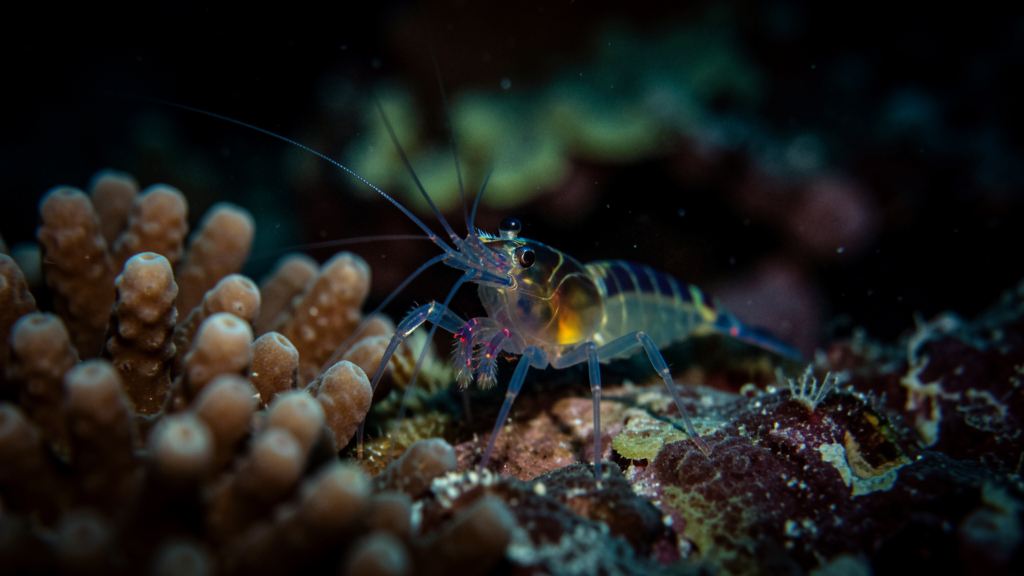
What they mean is that the daytime racket — the boat engines, the surface chop, the chatter of other divers — has vanished. In its place arises a soundscape so intricate it feels orchestrated. The reef crackles. Literally. What you are hearing is the snapping shrimp, thousands of them, their tiny claws creating a constant sizzle of white noise that marine biologists have measured at nearly 90 decibels in some healthy reefs. It is the sound of a living reef breathing. A dying reef is quiet. You will never forget the difference once you have heard it. The same physics that makes sound travel 5x faster underwater makes the night reef's crackle feel close enough to touch.
Between the crackles, other sounds emerge. The whoosh of a parrotfish passing close, its scales catching your beam like shattered glass. The hollow knock of a triggerfish nosing coral. And sometimes — if you hold perfectly still, if you suspend your breath for just a moment — the distant, low-frequency pulse of something large moving through the channel beyond your light.
Your ears, deprived of visual information, become sharper than you knew they could be. This is the mammalian dive reflex at work, an ancient neural pathway that rewires your senses for submersion. Your heart rate drops. Your metabolism quiets. You become, for this hour, more animal than human — and the animal in you knows exactly what to do with the dark.
The Hunter in the Dark
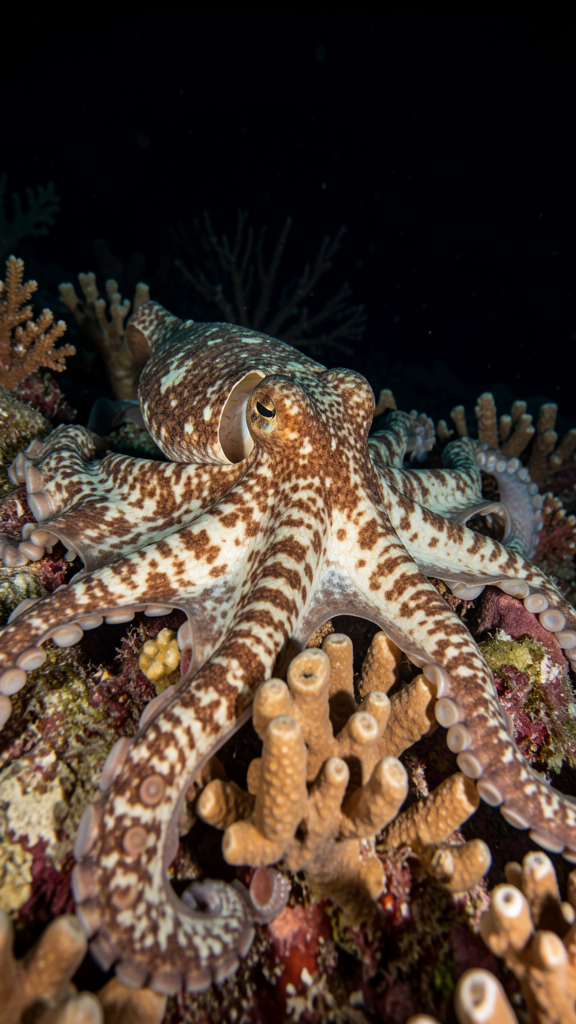
We found her at fourteen meters, tucked into a coral overhang that would have been invisible in daylight.
She was a common octopus — Octopus vulgaris — though there is nothing common about watching a cephalopod hunt. By day, these creatures are masters of stillness, compressed into crevices, color-matched to rock, waiting out the sun. But night belongs to them. At night, they emerge from their dens like ghosts materializing from walls, and they become something else entirely.
We killed our lights.
Not all the way — never all the way — but we dimmed them to the lowest setting, and in that reduced glow, we watched her work. She was hunting. Her arms — lined with two hundred million touch receptors, each one tasting the reef as she moved — extended in a slow, hypnotic ripple across the coral. Her skin changed color in waves: mottled brown to pale sand to a sudden, startling flash of white as she spotted something in a crack. An octopus does not see with its eyes alone. It sees with its entire body.
She found a crab. The encounter lasted perhaps four seconds. One arm shot forward with a speed that seemed to violate physics, the suckers latched, and then she was wrapped around her prey in a mantle of flesh so complete it looked like the crab had simply ceased to exist. No struggle. No sound. Just the ocean swallowing another small death, as it has for four billion years.
We turned our lights back on, and she was gone. Dissolved into the rock like she had never been there at all.
That is the thing about night diving. You do not visit the reef. You are permitted to witness it. The difference is everything.
The Light You Cannot See Yet
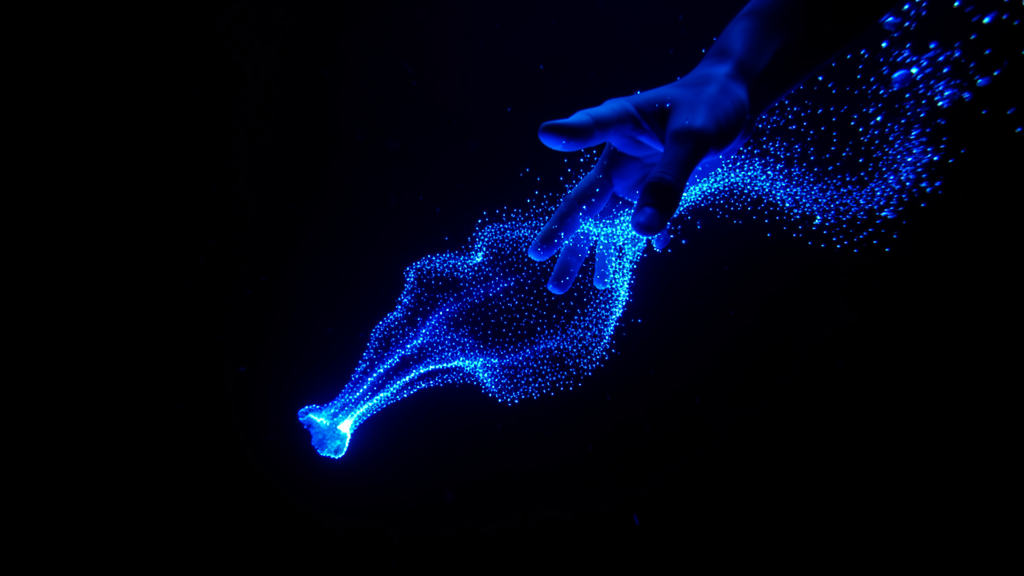
The bioluminescence diving experience came halfway through the safety stop.
We were at five meters, hovering in the dark, when our guide — a Maldivian divemaster who had done this thousands of times and still smiled every single time — gave us the signal. Lights off.
Three beams died. Blackness rushed in.
For a moment, there was nothing. Just the sound of three regulators, the pressure in your ears, and the old mammalian fear that lives at the base of every spine. Then someone moved. A hand. A fin. And the water erupted in blue.
It is impossible to describe accurately, but I will try.
Imagine that every molecule of water around you contains a star, and that the slightest disturbance — the sweep of a hand, the flick of a fin, even the exhale of bubbles — is enough to ignite them. Millions of dinoflagellates, each one a single-celled organism no larger than a speck of dust, responding to mechanical stimulation with a chemical reaction so fast it completes in twenty milliseconds. Luciferin. Luciferase. Oxygen. Light. The same biochemistry that powers fireflies, evolved independently in the ocean depths, where approximately 76 percent of all life forms can produce their own illumination.
The light is blue — not the blue of the sky, but the blue of deep space, of gas giants, of computer screens in unlit rooms. It peaks at 476 nanometers, the wavelength that travels farthest through seawater, and when it flashes in response to your own movement, you do not feel like you are swimming. You feel like you are flying through a galaxy you created simply by being alive in it.
Our guide waved his arm in a slow arc, and a trail of cobalt fire followed it like a lightsaber drawn through ink. A reef squid shot past, leaving a bioluminescent contrail that hung in the water for half a second before dissolving. We laughed into our regulators — that strange, muffled sound divers make when joy becomes too large for silence — and for those three minutes at five meters, nobody was afraid of anything.
This is the secret the night divers know, the one we do not post on Instagram, the one that does not translate to GoPro footage or cocktail-party anecdotes:
The darkness is not empty. It is full of light that waits for you to move.
Where Fear Becomes Flow
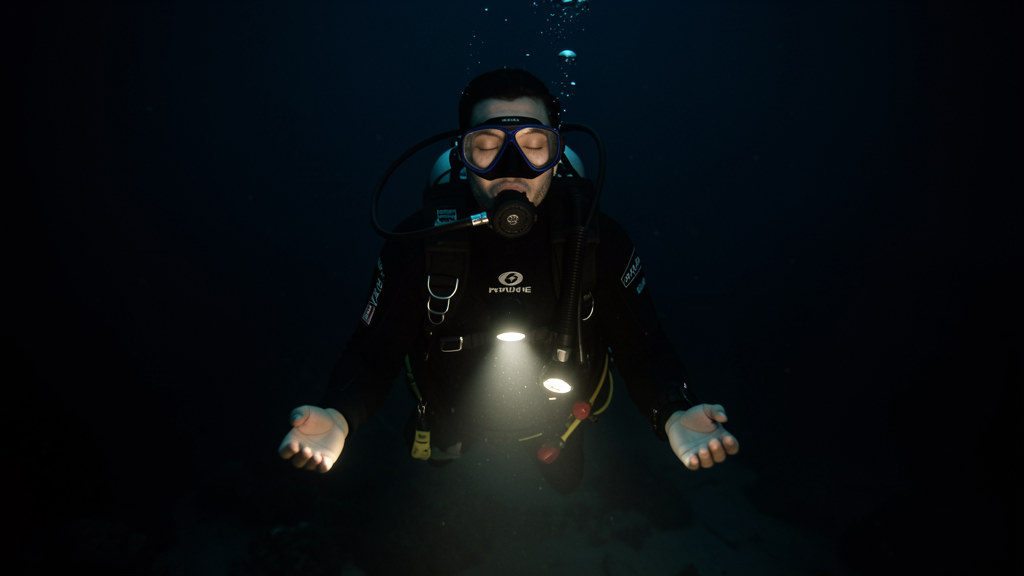
Psychologists who study extreme sports talk about the flow state — that rare condition where challenge and skill align so perfectly that the self dissolves into the task. Time warps. Decisions arrive without deliberation. Fear, if it was present, transforms into something else entirely: a kind of hyper-presence that feels, paradoxically, like freedom. Research on flow in extreme sports has shown that the state is most reliably triggered when environmental demands push the brain to its processing limits — exactly what the dark does.
Night diving is a direct pipeline to flow. The conditions demand it. If you want night diving tips, the best one is this: trust the darkness.
During the day, your brain processes thousands of visual inputs per second — color, depth, movement, contrast, the position of your buddy, the state of your gauges. At night, that torrent becomes a trickle. Your beam shows you one thing at a time. A coral head. A sleeping turtle, its shell fuzzed with algae. The eyeshine of a lobster, reflecting your light back in twin orange pinpricks. Each frame is a photograph. Each moment is a world.
With less to process, your mind quiets. The default mode network — the brain's background chatter of worry, planning, rumination — goes offline. What remains is pure sensation. The cold against your cheeks. The tug of current on your fins. The rise and fall of your chest, controlled now, slower than it would be on land, sedated by the pressure and the reflex and the dark.
This is why night divers keep coming back. Not for the creatures, though the creatures are extraordinary. Not for the bioluminescence, though it is the closest most of us will come to magic. We come back because for one hour, the noise stops. The surface world — the deadlines, the notifications, the endless scroll — ceases to exist. There is only this beam, this breath, this black water that holds you like a secret.
The Return
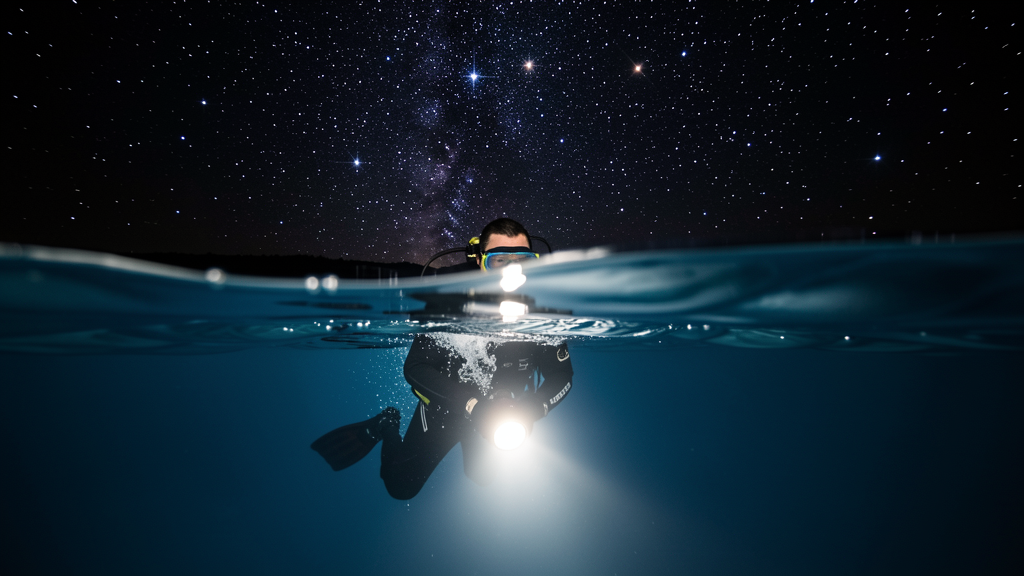
Surfacing from a night dive is disorienting in the best way.
Your light hits the underside of the surface, and for a moment, the boundary between worlds is visible — a silver membrane trembling above your head. You break through. The air is warm. The stars, which seemed so dim on the boat, now blaze with a violence that makes you wince. Someone hands you a line. You kick to the ladder, pass up your fins, haul yourself out.
And then you sit.
There is a ritual to this part, unspoken but universal among the tribe. You do not talk immediately. You wrap yourself in a towel, accept the thermos of tea that appears from somewhere, and you stare at the water you just emerged from. It looks the same as it did before — black, indifferent, unremarkable. But you are not the same. You have seen what lives in it. You have moved through a galaxy of living light. You have watched a consciousness without bones solve problems faster than you can blink.
You are now a member of a society with no dues, no meetings, no badges. Only this: you have been in the dark, and you did not run. You stayed. You looked. And the ocean, in return, showed you what it hides from the sun.
Your Invitation to the Dark
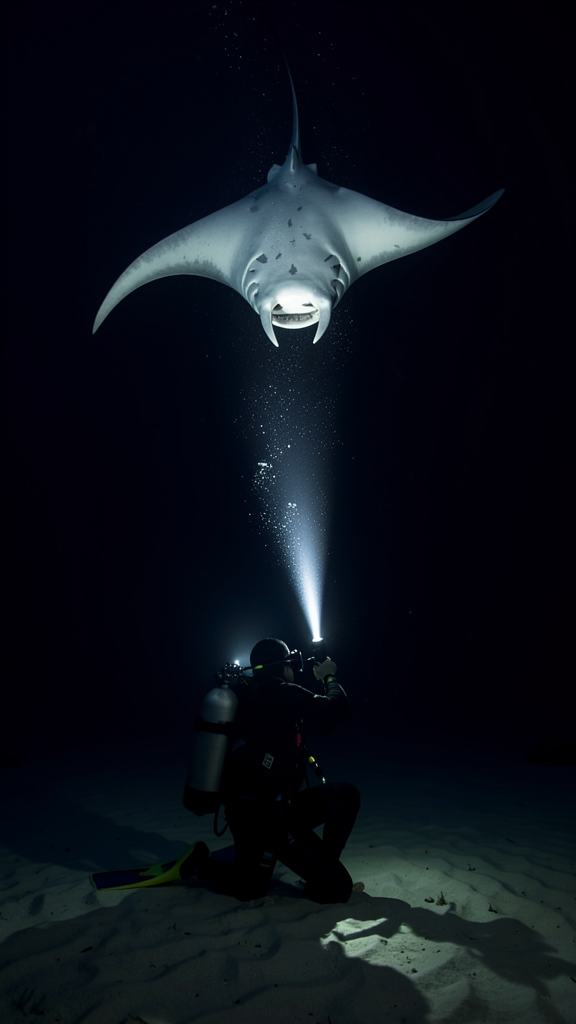
Not every diver is ready for scuba diving at night. That is precisely why it matters. If you are wondering what to expect night diving, the honest answer is: transformation.
At DeepBeatDives, we believe the dives that change you are never the easy ones. The easy dives give you stories. The hard dives give you transformation. Night diving is both — a story you will tell for decades, and a transformation you will feel in your nervous system every time you see darkness afterward and think: I know what lives in there. And it is not what I feared.
The Maldives, where we gather this November, offers some of the most spectacular night diving Maldives has to offer — on the planet. Check our Maldives dive calendar for the best months. Maaya Thila, where white-tip reef sharks patrol the reef like silent sentinels. Alimatha, where nurse sharks and stingrays gather in numbers that feel prehistoric. And in the southern atolls, the manta night dives — where you kneel on the bottom, aim your light at the surface, and watch three-meter wingspans materialize from the black to feed on plankton drawn to your beam.
But this essay is not about the Maldives. It is about the part of you that knows — has always known — that the most extraordinary experiences live just beyond the edge of your comfort zone, in the places where the light does not reach.
📥 Download the Night Diver's Checklist: What to Pack, What to Expect, What to Feel → — our field-tested guide to your first (or fiftieth) night dive.
💌 Subscribe to The DeepBeat Dispatch → for the night dive tales that only come out after dark.
The darkness isn't empty. It's full of light you can't see yet. Subscribe for more night stories.