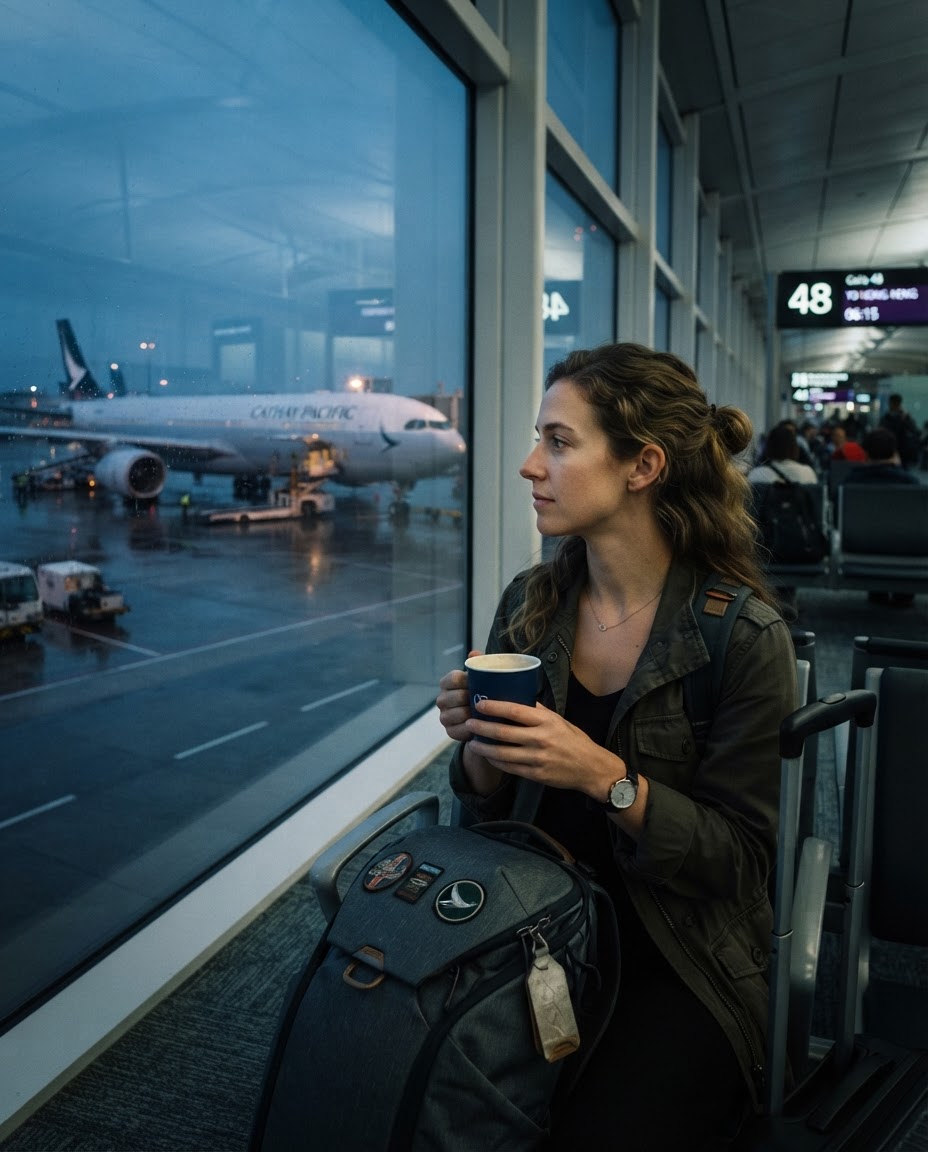
I almost didn't get on the flight.
Sitting in the departure lounge at Heathrow, passport in one hand and a coffee I wasn't drinking in the other, I kept asking myself the same question: What am I doing? I was about to board a 14-hour flight for a solo liveaboard diving trip in the Maldives liveaboard waters, transfer to a domestic seaplane, then climb onto a liveaboard boat where I would share a cabin with someone I'd never met and spend seven days diving with complete strangers.
I'd booked the trip three months earlier during a 2 AM spiral. The corporate job was eating me alive. My last relationship had ended with the kind of quiet disappointment that leaves no closure, only exhaustion. My friends had heard me talk about getting my Open Water certification for years, and one of them finally called my bluff: "Either book the trip or stop talking about it."
So I booked it. Alone. A liveaboard in the Central Atolls with a company I'd found through a Reddit thread. No dive buddy. No friend to share the nerves with. Just me, a new wetsuit, and the kind of terror that masquerades as bravery.
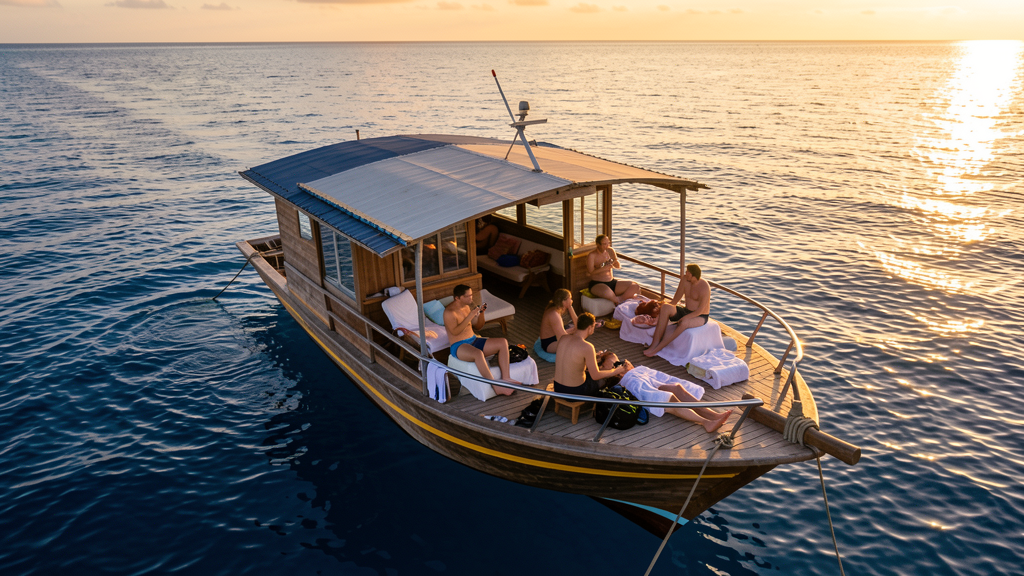
The seaplane landed on the water with a soft slap that made my stomach drop. When the liveaboard came into view — a wooden-hulled beauty called The Ocean Drifter — I almost turned around. But then I saw the dive deck. Gear lined up like soldiers. Tanks being filled with the rhythmic hiss of compressed air. And people. Laughing people. Sunburned people. People who looked like they'd already found something I was still searching for.
"You must be Lila."
The cruise director, a weathered Australian named Marcus who looked like he'd been carved from teak and salt, extended a hand. "Solo traveler, cabin three. Your bunkmate's already onboard — Tanya, from Toronto. She's a nurse. You'll get along." He said it like a fact, not a prediction. Like he already knew.
And then he said the words that would define my entire week: "Nobody dives alone here. Not because it's not allowed. Because it's not possible. The ocean doesn't let you."
The Buddy Check That Changed Everything
The first morning came too early. The bell — an actual hand-held bell that Marcus rang outside cabin doors at 5:45 AM — cut through my jet-lagged sleep like a knife. I'd barely met Tanya the night before. We'd exchanged polite hellos, stowed our gear, and fallen into exhausted silence. Now I was supposed to trust her with my life underwater.
On the dive deck, the ritual began. Marcus paired us up: Tanya and me. A retired firefighter from Berlin named Klaus and a college student from São Paulo named Diego. A newlywed couple from Mumbai who never stopped holding hands. A photographer from Reykjavik who looked like she'd stepped out of a Norse myth. Twelve strangers in total. Twelve lives that would intersect in ways none of us expected.
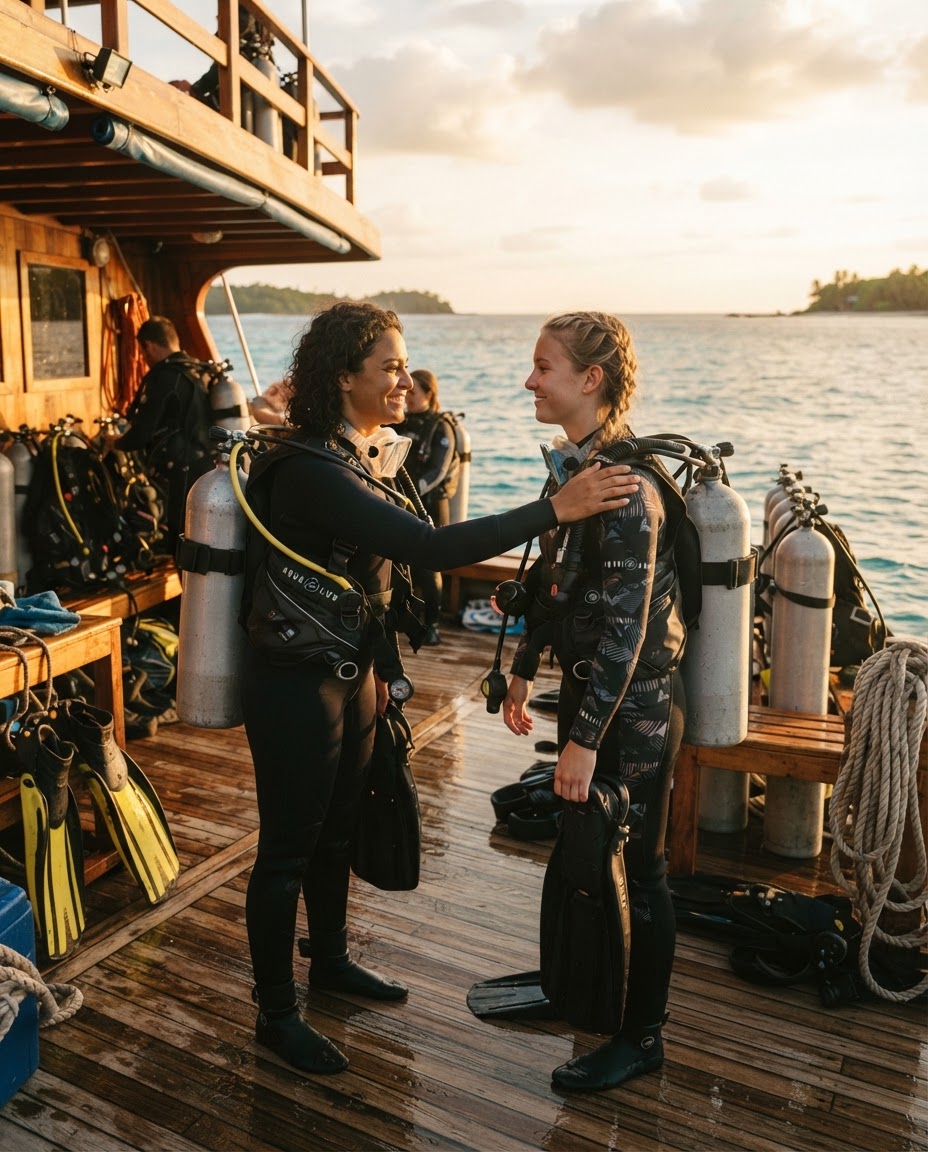
"Buddy check," Marcus called out, and suddenly everyone was moving in sync. Tanks secured. BCDs inflated. Regulators tested with two sharp breaths. Masks defogged. Weights checked. And then the moment that still makes my chest tighten with emotion: Tanya turned to me, looked me directly in the eyes, and asked, "How are you feeling?"
Not "Ready?" Not "Let's go." But "How are you feeling?"
I told her the truth. "Terrified."
She smiled. "Good. That means you're paying attention. I've got you." And she reached out and squeezed my shoulder — the first human touch I'd had in weeks that didn't feel transactional, that wasn't trying to get something from me. Just: I've got you.
The giant stride off the dive platform felt like falling and flying at the same time. The water closed over my head, and everything went quiet. Not silent — the ocean is never silent — but quiet in the way that matters. The noise of my life dissolved. The emails, the deadlines, the should-haves and what-ifs. Gone. Replaced by the sound of my own breathing, rhythmic and meditative, and the knowledge that 30 feet above me, a stranger from Toronto was watching my bubbles.
When we surfaced 45 minutes later, I was crying behind my mask. Tanya saw it immediately. She didn't ask why. She just treaded water beside me until I was ready, then said, "First dive of many, Lila. Welcome to the tribe."
The Dinner Table That Never Emptied
By day three, I'd stopped wearing my watch. Time on a liveaboard doesn't work the way it does on land. You wake when the bell rings. You dive when the current is right. You eat when you're hungry, which is always. You sleep when your body finally gives in. The most stressful decision I made all week was "Nitrox or air?" and I cannot describe how liberating that felt.
But the real magic happened between dives. During surface intervals, when the boat rocked gently at anchor and the sun turned everyone's skin the color of warm honey. We'd sprawl across the sundeck — some napping, some editing photos, some arguing about whether that was a giant trevally or a jack we'd seen on the morning dive. The photographer from Reykjavik, whose name was Sigrid, taught me how to identify a mantis shrimp by its eyestalks. Klaus showed us scars from fires he'd walked into, then laughed about how the ocean scared him more. Diego played his guitar at sunset — bad pop songs that somehow sounded profound when the sky was bleeding orange and pink.
And then there was dinner.
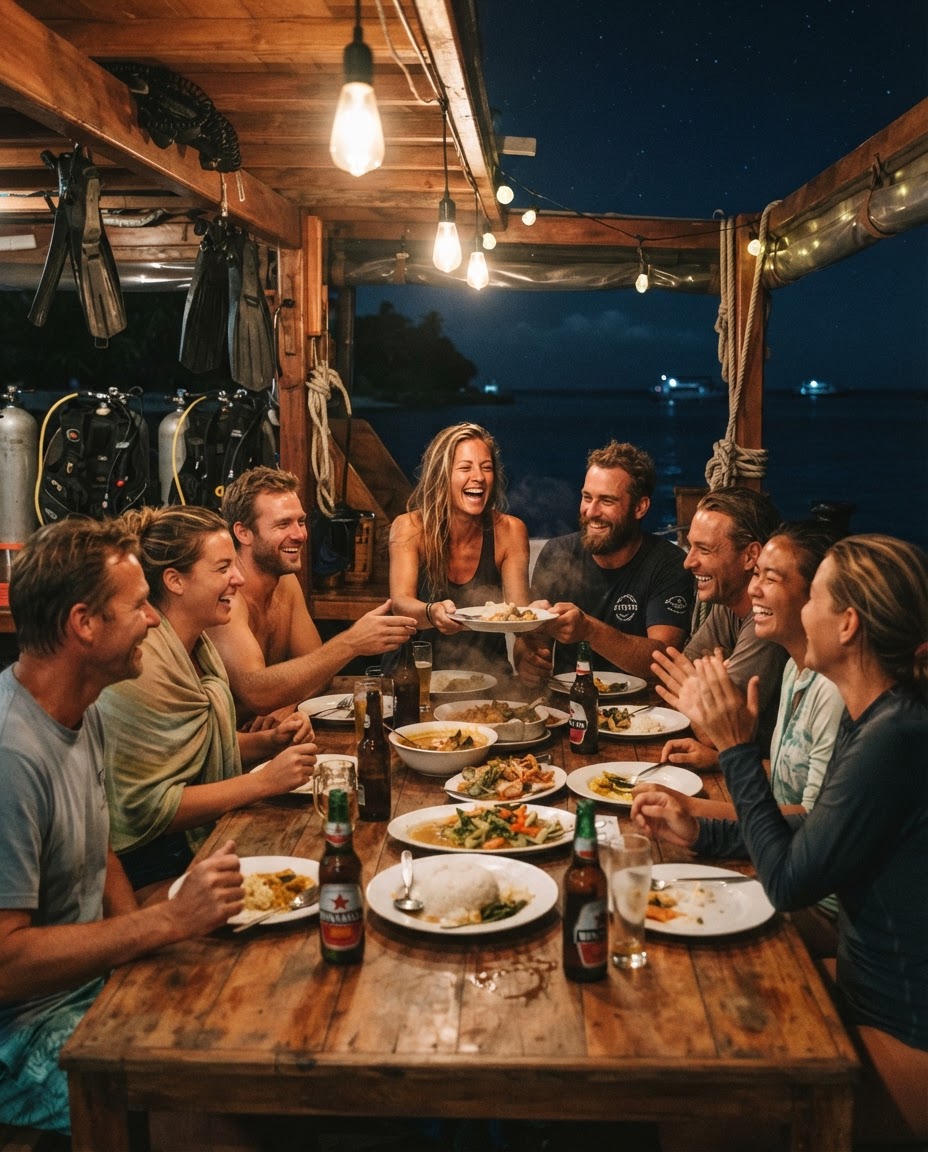
On a liveaboard, there are no private tables. No booths for two. Just one long banquet table where everyone squeezes in together, passing curries and rice and stories in equal measure. The ocean strips away the hierarchies of land. Nobody cares what car you drive or what title is on your business card. On the boat, the only currency that matters is what you've seen underwater.
"What's the best dive you've ever done?" became our opening question every night. Klaus described a night dive in Raja Ampat where bioluminescence turned his exhaust bubbles into columns of blue fire. The Mumbai couple, Priya and Arjun, told us about their first dive together — a manta cleaning station in Komodo where a 12-foot wingspan passed so close they could see the parasites being picked from its gills. Sigrid described diving under ice in Greenland, the silence so complete she could hear her own heartbeat echoing through her chest.
And me? By night four, I had my own story. The sunrise dive that morning — the one where I'd rolled out of bed while the sky was still bruise-colored, coffee in a thermos, barely awake — had delivered a whale shark. Not from a distance. Not a shadow in the blue. But a 30-foot gentle giant that swam directly over our group, its spotted back close enough to touch (we didn't), its slow tail sweep stirring the water like a metronome. I surfaced screaming with joy through my regulator. When I got back on the boat, Marcus handed me a towel and said, "Now you're one of us."
The dinners went late. Some nights, we were still at the table past midnight, trading stories over ginger tea and the occasional beer. Nobody checked their phones. The boat had spotty signal, but by day two, nobody cared. We were too busy being present. Too busy being together.
The Sunrise Dive I Didn't Know I Needed
Day five was the one that broke me open and put me back together.
I'd started waking before the bell. There was something about the pre-dawn darkness on the water — the way the sky transitioned from ink to indigo to gold, the way the ocean held its breath before the sun touched it — that felt sacred. I'd sit on the dive deck with my thermos, wrapped in a salt-crusted towel, and watch the crew prepare the boat in near-silence. They moved like dancers who'd done this a thousand times. And maybe they had.
That morning, Marcus announced a "secret site." He wouldn't tell us the name. Only that the current was perfect, the visibility was pushing 40 meters, and if we were very lucky, we might see something that "doesn't show up for everyone."
The buddy check with Tanya had become routine by then. We didn't even need to speak. A glance. A nod. A double-tap on the shoulder that meant I'm here. I'm with you. We'd rotated buddies throughout the week — paired with Klaus for a drift dive, with Sigrid for a macro hunt, with Diego for a reef wall — but Tanya and I kept coming back to each other. There was a shorthand between us now. A trust.
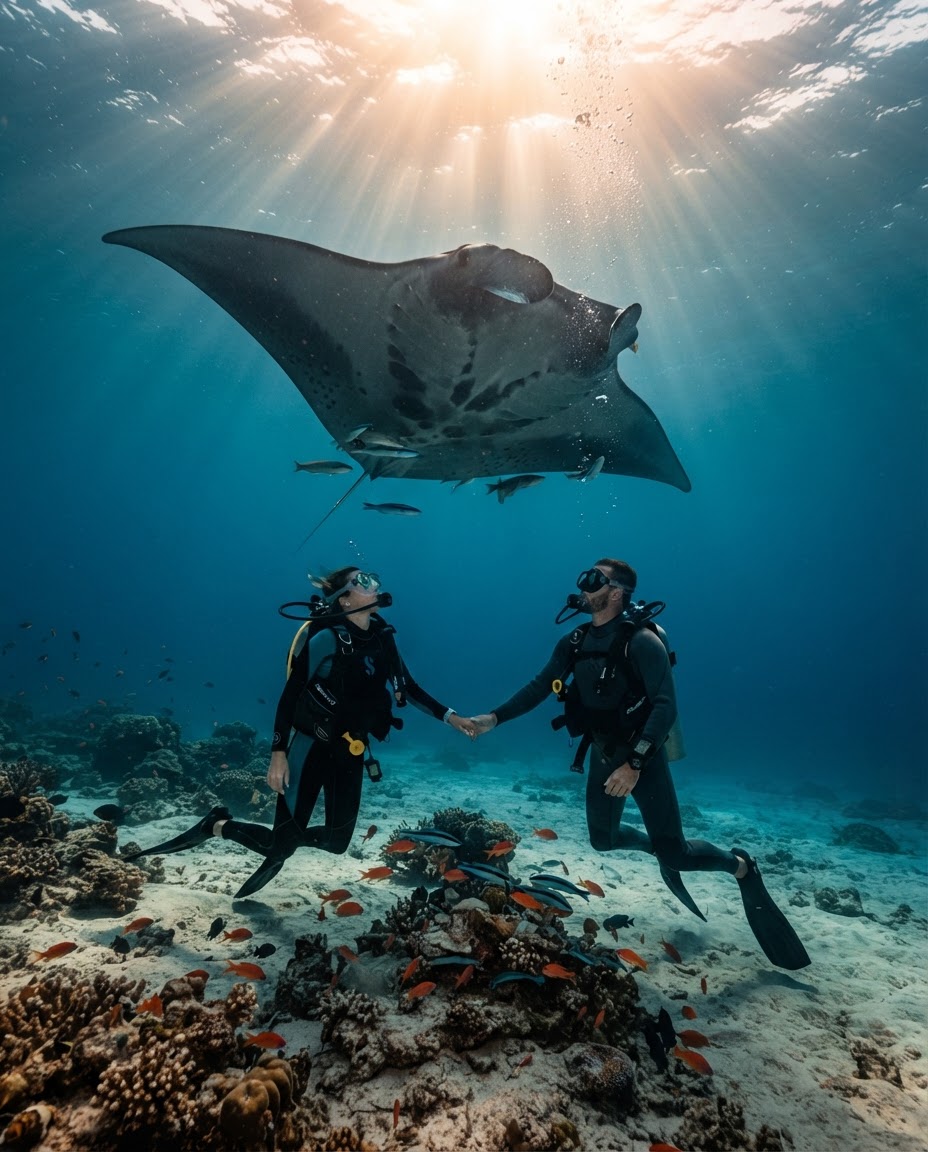
The descent was through a thermocline so sharp it felt like passing through a membrane into another world. And then, at 28 meters, the reef opened up into a sandy channel where six manta rays were circling a cleaning station. Not one. Not two. Six. Their wingbeats were hypnotic — slow, powerful, utterly unhurried. They moved like they had nowhere else to be, which I suppose they didn't.
I felt Tanya grip my hand. I gripped back. We hovered there for 20 minutes, barely breathing, watching these ancient creatures submit to the ministrations of cleaner wrasse with a patience that seemed impossible. A manta ray can have a wingspan of 20 feet and weigh 3,000 pounds, and yet it will hold perfectly still while a fish the size of my thumb picks parasites from its gills. There was a metaphor there, I thought. About surrender. About trust. About letting something smaller than you care for you.
When we surfaced, I didn't cry this time. I laughed. A full, loud, unselfconscious laugh that echoed across the water. Tanya joined in. Then Klaus, who'd surfaced nearby. Then everyone. We floated in a circle, still in our gear, laughing like children at something none of us could explain.
The Hardest Goodbye
On the last night, Marcus broke out a bottle of rum he'd been saving. We sat on the upper deck under a sky so thick with stars it looked fake — like someone had gone overboard with the special effects. The boat rocked in a gentle rhythm that had become as familiar as my own heartbeat.
Diego played one last song. Sigrid passed around her camera, showing us the photos she'd taken of each of us underwater — unguarded moments of wonder that we'd never seen ourselves. Priya and Arjun produced a notebook they'd been secretly keeping: a log of every inside joke, every embarrassing moment, every "you had to be there" story from the week. They called it The Chronicles of the Drifter.
And then Tanya turned to me. "You know what the craziest part is?" she said. "A week ago, you were a stranger. Now I know you better than people I've worked with for five years."
She was right. I knew that Klaus slept with a photo of his grandchildren under his pillow. I knew that Diego was terrified of failure and diving was the one place he felt competent. I knew that Sigrid had left a fiancé who didn't understand why she kept "wasting money on trips to look at fish." I knew that Priya and Arjun had delayed their honeymoon for two years because of family pressure, and this liveaboard was their rebellion.
And they knew me. They knew about the job I'd quit before the trip. The relationship that had hollowed me out. The reason I'd booked a ticket to sleep on a boat with strangers at 2 AM while crying into my laptop. They knew it all. And they were still here. Still squeezing my shoulder. Still saying I've got you.
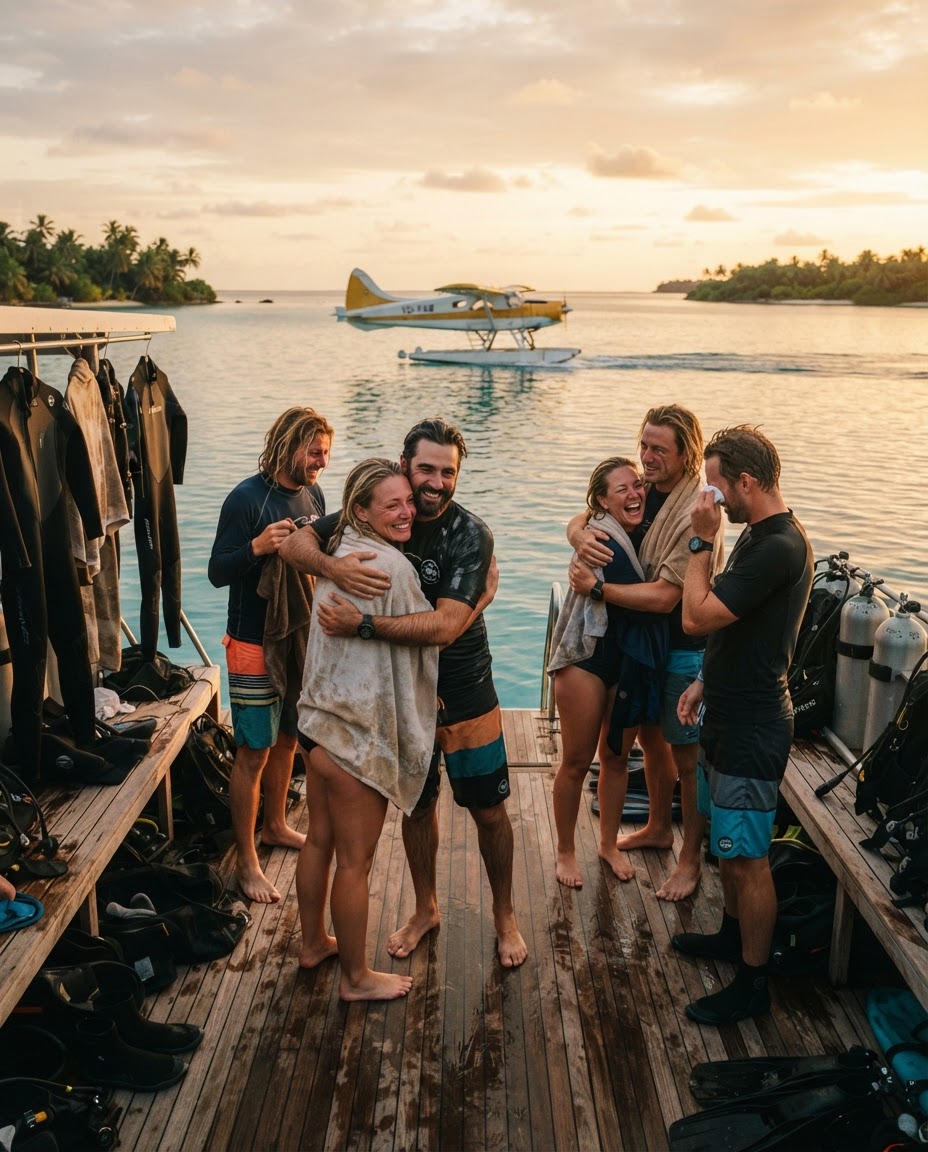
When the seaplane came to take us back to the airport, nobody wanted to get off the boat. We stood on the dive deck in a loose circle, exchanging emails and Instagram handles and promises to "dive together again soon" that we all knew might never happen. But it didn't matter. The tribe isn't a place. It's a moment. It's the space between a giant stride and a surface. It's the dinner table that never empties. It's the buddy who sees your terror and says, "Good. That means you're paying attention."
Marcus was the last to hug me. "You came here alone," he said. "You leave with twelve people who would notice if you were gone. That's the math of a liveaboard. That's the tribe."
Why We Tell These Stories
I flew 4,000 miles to sleep on a boat with strangers. I spent seven days eating, diving, laughing, and breathing with people whose full names I sometimes forgot but whose stories I'll carry forever. I learned that scuba diving community isn't something you find. It's something you build, one buddy check at a time, one midnight dinner conversation at a time, one shared silence with a whale shark at a time.
The liveaboard experience isn't about the boat. It's about what happens when you remove everything that keeps people apart — the job titles, the social media, the schedules, the armor — and replace it with salt water, shared awe, and the fundamental truth that nobody survives the deep alone.
If you're considering solo diver travel for the first time, terrified of what you'll find on that dive deck, let me tell you: the tribe is waiting for you. We've been where you are. We've sat in that departure lounge, questioning everything. And we've all learned the same secret: the ocean doesn't just give you fish and coral. It gives you family.
That's the heart of every dive tribe story — the realization that you didn't just find a hobby. You found your people.
🌊 Your Invitation to the Deep
Tribe Tales are exclusive to subscribers. These are the stories we don't publish on the blog — the raw, unfiltered, underwater moments that define what it means to belong to something bigger than yourself. Join the tribe. Get the stories that never make it to the feed.
📬 Subscribe to The DeepBeat Dispatch →
🎁 Free for Subscribers: The Solo Diver's Playbook
Traveling alone doesn't mean diving alone. Our Solo Diver's Playbook is the complete guide to finding your buddy, choosing your liveaboard, and walking onto that dive deck with confidence — even if your knees are shaking.
Inside:
- How to pick a liveaboard that welcomes solo travelers (not just tolerates them)
- The pre-trip conversation that guarantees you'll find your people
- Buddy rotation etiquette: how to dive with everyone without offending anyone
- The 5 items that turn strangers into friends on a boat
- Safety protocols every solo diver needs to know
👉 Download The Solo Diver's Playbook — Free for Dispatch Subscribers
Have a Tribe Tale? We Want to Hear It.
This community runs on real stories from real divers. If you've experienced the moment when strangers became family on a dive boat — whether it was a sunrise dive that changed everything, a dinner conversation that lasted until midnight, or a buddy check that meant more than words — we want to share it.
Submit your Tribe Tale → [email protected]
The world needs to hear why you dive. And the tribe needs to know you're out there.
Lila is a marketing strategist turned dive enthusiast based in London. She completed her Open Water certification in 2025 and has since logged dives in the Maldives, Komodo, and the Red Sea. She is currently planning her next liveaboard — and already checking the cabin assignments.
Related Reads:
- The 7 Types of People You'll Meet on a Dive Boat — Which One Are You?
- From Panic to Presence: How Scuba Diving Is Quietly Becoming the New Therapy
- Your Brain on Scuba: The Neurochemistry of Diving
DeepBeatDives is building the world's most exclusive community at the intersection of ocean exploration, underground music, and immersive travel. This is not a festival. It's an invitation. And only 1,500 people will receive it.