Editorial Note
At DeepBeatDives, we believe the best stories don't come from marketing decks. They come from the tribe — the divers who decided on a scuba diving career change, walked away from spreadsheets, and found themselves staring into the eye of a parrotfish at 18 meters. This is one of those stories. Names and details have been changed at the diver's request, but the diving lifestyle transformation? That's real. And if you're reading this at 11 PM with your inbox still open, an ocean lifestyle escape might be yours too.
The Surface
I remember the exact moment I knew I was drowning.
Not in water. In fluorescent light. It was a Tuesday — or maybe a Wednesday, the days had blurred together — and I was sitting in my car in the underground parking garage of a glass tower in Gurgaon. My title sounded important: Senior Vice President, Revenue Operations. My salary had more commas than my parents ever saw in a decade. And my heart was trying to escape my chest.
The panic attack didn't announce itself. It simply arrived, like a deadline that jumps from Friday to Wednesday while you're asleep. One minute I was reviewing a forecast model in Excel, the next I was gripping the steering wheel so hard my knuckles turned the color of the whiteboard in Conference Room 4B — the one where I'd spent 847 hours of my life, according to my calendar analytics. Yes, I had analytics for my meeting hours. That should have been the first sign.
According to the Gallup State of the Global Workplace report, over 59% of corporate employees experienced burnout in 2024. I wasn't a statistic. I was the statistic's overachieving cousin.
My week had become a ritual of diminishing returns. Sixty hours minimum. Mondays started with 7 AM standups. Tuesdays bled into Wednesdays through midnight fire drills. Thursdays were for "alignment sessions" that aligned nothing. Fridays were when the real work began, because everyone else finally stopped scheduling meetings. Weekends were recovery zones where I stared at walls and felt guilty for not checking Slack.

The parking garage had no windows. That was the point. Climate-controlled. Secure. Efficient. I had spent three years parking in the same spot, B-147, without ever noticing that the floor numbers counted down instead of up. Basement 3. Basement 2. Basement 1. Surface. The irony would only hit me later.
When the paramedic asked if I'd had caffeine that day, I laughed. Then I cried. Then I laughed again, because crying in front of a stranger in a parking garage felt like the most honest thing I'd done in three years.
"You're hyperventilating," she said. "Breathe with me. In for four. Hold for four. Out for four."
I couldn't. My body had forgotten how.
The Decision
The doctor's note bought me two weeks. "Stress-induced anxiety. Recommend immediate reduction in workload and evaluation of lifestyle factors." I pinned it to my monitor like a war medal. My manager said all the right things — "health first," "we'll cover you," "take whatever time you need" — while his eyes calculated the project delay in real-time.
That night, I deleted LinkedIn from my phone. Then Instagram. Then everything except Maps and a meditation app I'd downloaded seventeen months ago and opened once. The screen looked naked. Liberating.

I found the brochure in a drawer I'd forgotten existed. "PADI Open Water — Begin Your Underwater Journey." I'd picked it up at a travel expo nine months earlier, folded it into my bag on autopilot, and buried it under charging cables and expired protein bars. The diver on the cover was mid-backroll, entering water so blue it looked digitally enhanced.
I didn't know how to swim well. I'd never camped. My idea of adventure was upgrading to business class. But something in that shade of blue — not the navy of my suits, not the screen-glow of my monitors, but a blue that seemed to emit its own light — made me call the number.
"Open Water starts every Monday," the instructor said. "Pool sessions Wednesday and Friday. Ocean checkout next weekend. You in?"
I was supposed to be in Jakarta for a quarterly review. I said yes.
The First Breath
The pool was chlorinated and cold and exactly what I needed.
My instructor, Ravi, had the calmest hands I've ever seen on a human being. He moved like someone who had never once checked a stock price. When I fumbled my regulator retrieval for the fourth time, he didn't sigh. He demonstrated. Again. And again. Until my fingers remembered what competence felt like.
"Underwater," he said, "there's no email. No Slack. No performance review. Just you, your breath, and your buddy. That's the whole religion."
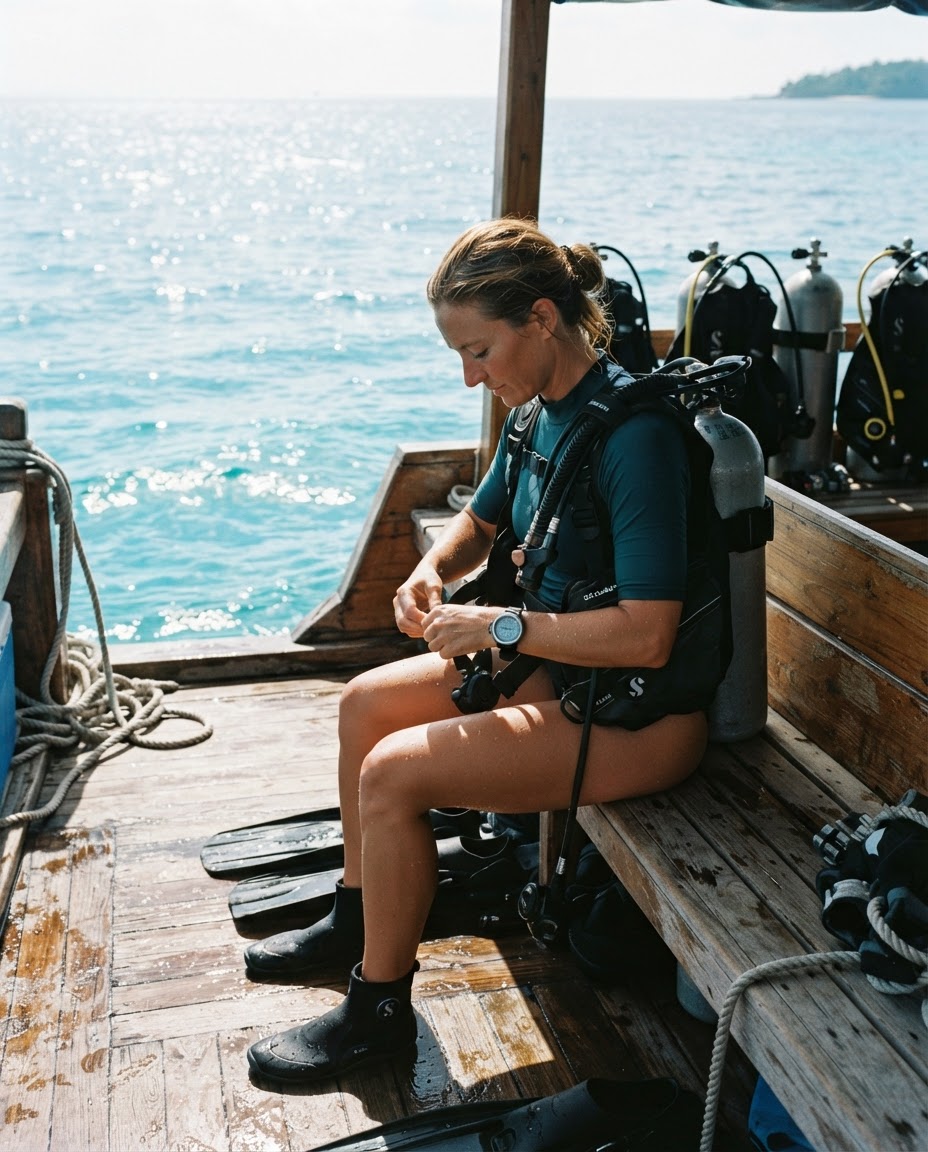
The ocean checkout was in the Andamans. I arrived with a new rash guard, borrowed fins, and a terror so thorough it felt like I'd swallowed a stone. The boat was small. The other students were younger, fitter, already swapping stories about drift dives in Komodo. I sat in the corner and checked my equipment for the seventh time, reciting the acronym Ravi had drilled into us: BWRAF — BCD, Weights, Releases, Air, Final check.
The backroll entry was undignified. I flopped into the water like a seal having a medical episode, surfaced sputtering, and gave Ravi a thumbs-up that was mostly bravado. Then I deflated my BCD.
And descended.
The Descent
The first thing you notice isn't the fish. It's the silence.
Not empty silence. Full silence. The kind that has texture and weight and color. The sound of your own breathing — metallic, rhythmic, ancient — becomes everything. Inhale. The regulator delivers air with a hiss that sounds like a promise. Exhale. Bubbles rise past your mask in silver columns, heading for a surface that suddenly feels very far away.
At three meters, my ears cleared for the first time. The pressure wasn't pain. It was presence. Something was happening to my body that I couldn't control with caffeine or willpower, and the relief of that surrender was indescribable.
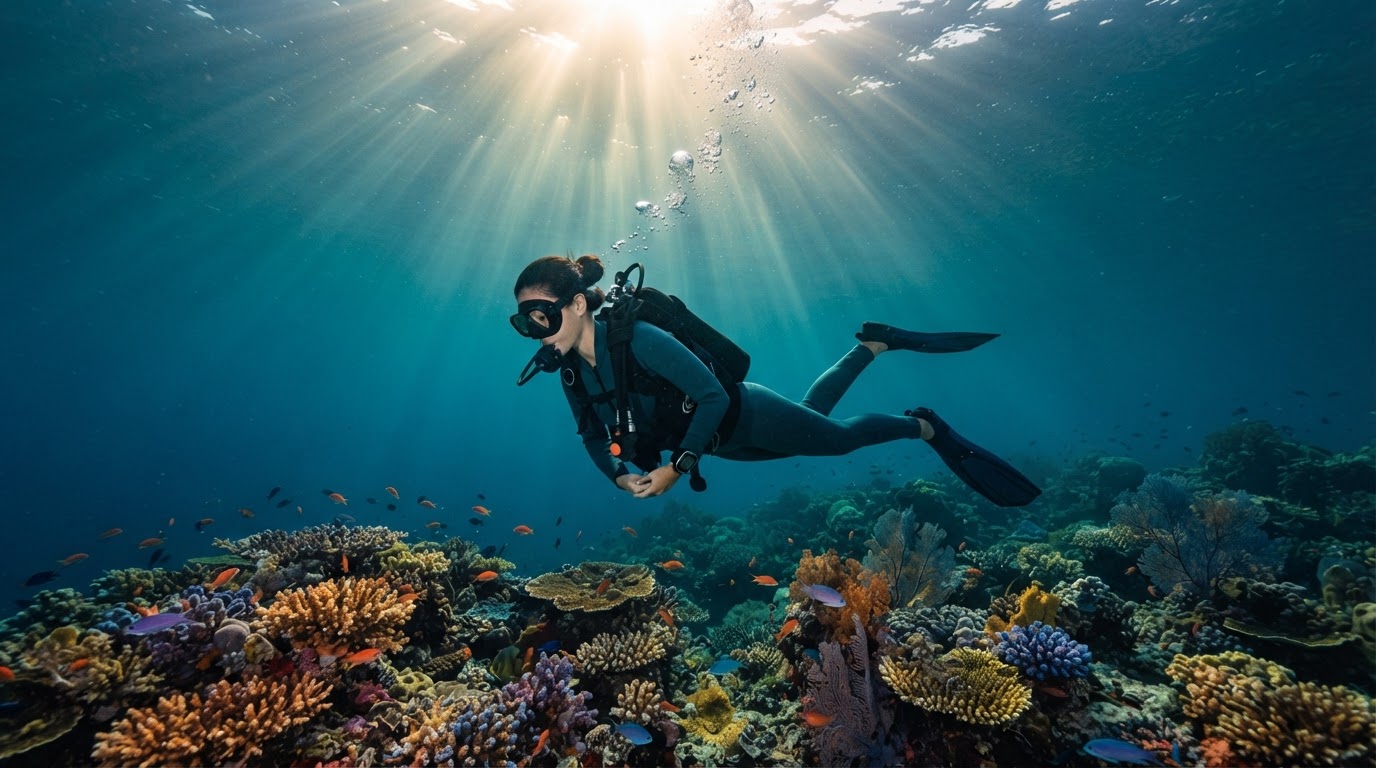
At five meters, the light changed. Colors began their underwater migration — reds and oranges packing their bags and leaving first, yellows lingering awkwardly, blues and violets settling in to dominate the neighborhood. The coral wall beside me shifted from dusty pink to lunar purple. A parrotfish, the size of a football, cruised past with the confidence of a creature that had never heard of a performance review.
At eight meters, I remembered to breathe.
Not the shallow, shoulders-only breathing of boardrooms and panic attacks. Deep, diaphragmatic, ocean breathing. The kind of underwater breathing techniques that fill your lungs from the bottom up, push your belly out, and slow your heart rate without asking permission. I felt it happen — a physical downshift, like a car finding the right gear after years of grinding in third.
Your heart rate drops 10–25% the moment your face submerges — a physiological phenomenon explored in our guide on how your body has an ancient reset button. Scientists call it the mammalian dive reflex. Your body thinks you're returning home. Mine agreed.
At twelve meters, Ravi signaled for me to equalize. I pinched my nose and blew gently, felt the pop in both ears, and suddenly the world opened. Below us, the reef dropped into a slope of staghorn coral so dense it looked like a forest frozen mid-explosion. A school of yellowtail fusiliers streamed past in a single organism of silver and blue, turning as one, no leader, no Slack thread, just collective intelligence written in muscle and scale.
I was weightless.
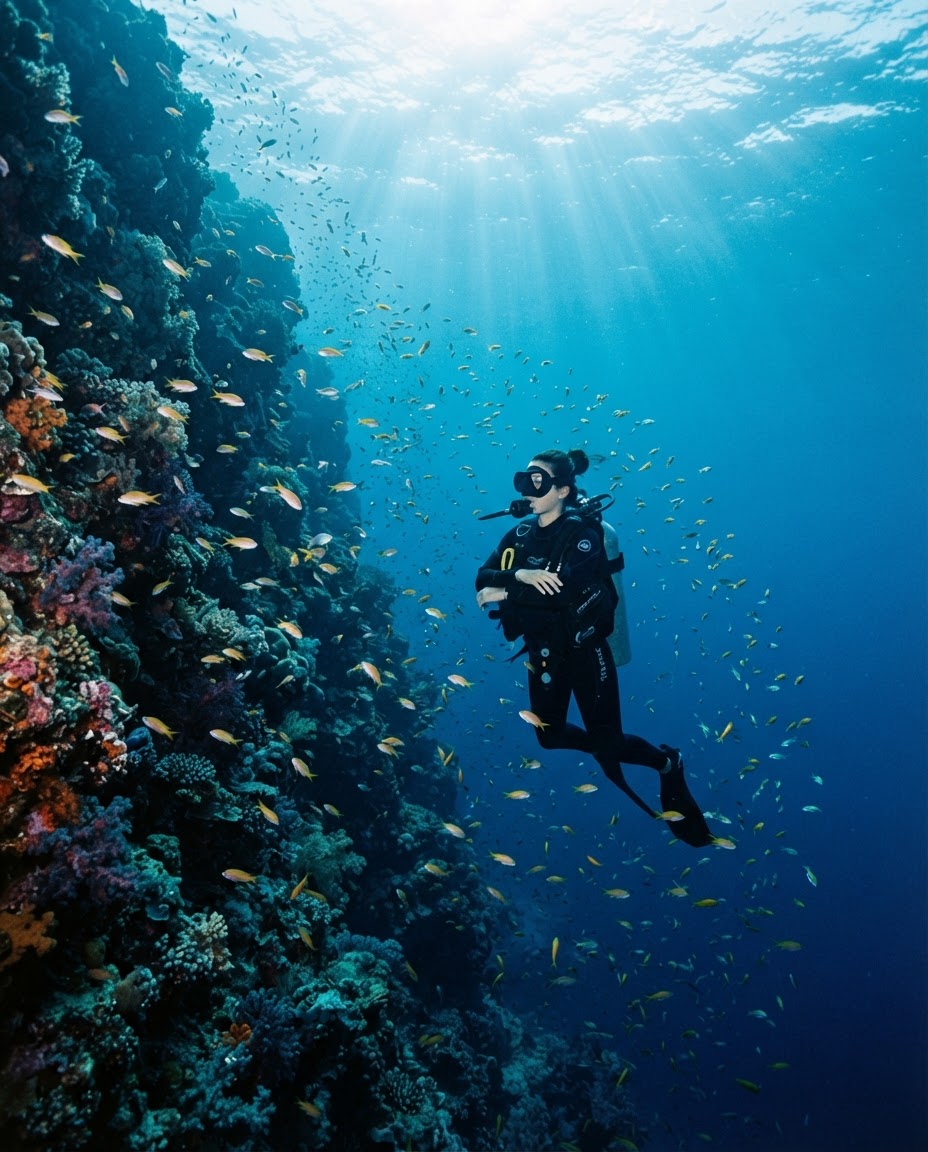
Not metaphorically. Actually weightless. My 78 kilograms of bone and anxiety and ambition had been neutralized by water, by physics, by the simple miracle of buoyancy. I wasn't a VP. I wasn't a diagnosis. I wasn't even a name. I was a breathing thing in a blue place, and that was enough.
The panic didn't vanish. It dissolved. Like sugar in warm water. Like the last reason you had for staying in a job that was eating your soul from the inside.
We stayed down for 42 minutes. I remember checking my air gauge at 20 minutes and being shocked — I'd used almost nothing. My breathing had slowed that much. My body, finally, was cooperating with itself.
When we surfaced, the first thing I heard was Ravi laughing. "You went down a consultant and came up a diver," he said. "Welcome to the tribe."
I didn't have words. I had water in my ears and salt on my lips and something in my chest that felt suspiciously like hope.
Why Scuba Diving for Burnout Is More Than a Vacation
I didn't quit corporate job scuba diving the very next day. That's not how this works. Real transformation isn't cinematic — it's cumulative, like coral building reef one microscopic deposit at a time.
But I did start leaving the office at 6 PM. I did start declining meetings without agendas. I did start staring out windows instead of at refresh rates.
And I dove. Every weekend. Then twice a weekend. I logged 20 dives in two months, then 40, then 60. Each one was a reset button I hadn't known I possessed.
Scientific literature supports this experience: research on recreational diving and mental clarity published in Frontiers in Psychology shows that recreational divers score significantly higher on mental well-being scales, with over 80% reporting regular feelings of joy, relaxation, and cognitive restoration through Blue Mind science. Furthermore, clinical studies on scuba diving for PTSD and anxiety show measurable reductions in depression and nervous system hyperarousal — one study documented a healthcare worker's GAD-7 anxiety score dropping from 16 to 5 after just six structured dives.
Using scuba diving for burnout wasn't magic. It was better than magic. It was biology, psychology, and physics agreeing on something: human beings were not designed for fluorescent light and open-plan offices. We were designed for this — for blue, for weightlessness, for the profound attentiveness that survival underwater demands.
Six months after that first backroll, I gave notice. Not dramatically. No speech. No viral resignation letter. I simply told my manager that I'd found something I needed more than the commas in my salary, and I walked out of the glass tower for the last time.
He asked where I was going. I said, "Down."
He didn't get the joke. That's okay. You either understand the invitation, or you don't.
The Deep
Today, I run a small dive operation in the Maldives. We take eight guests per week. Maximum. No exceptions. I teach Open Water courses in the mornings, lead drift dives in the afternoons, and fall asleep to the sound of actual waves instead of notification pings.
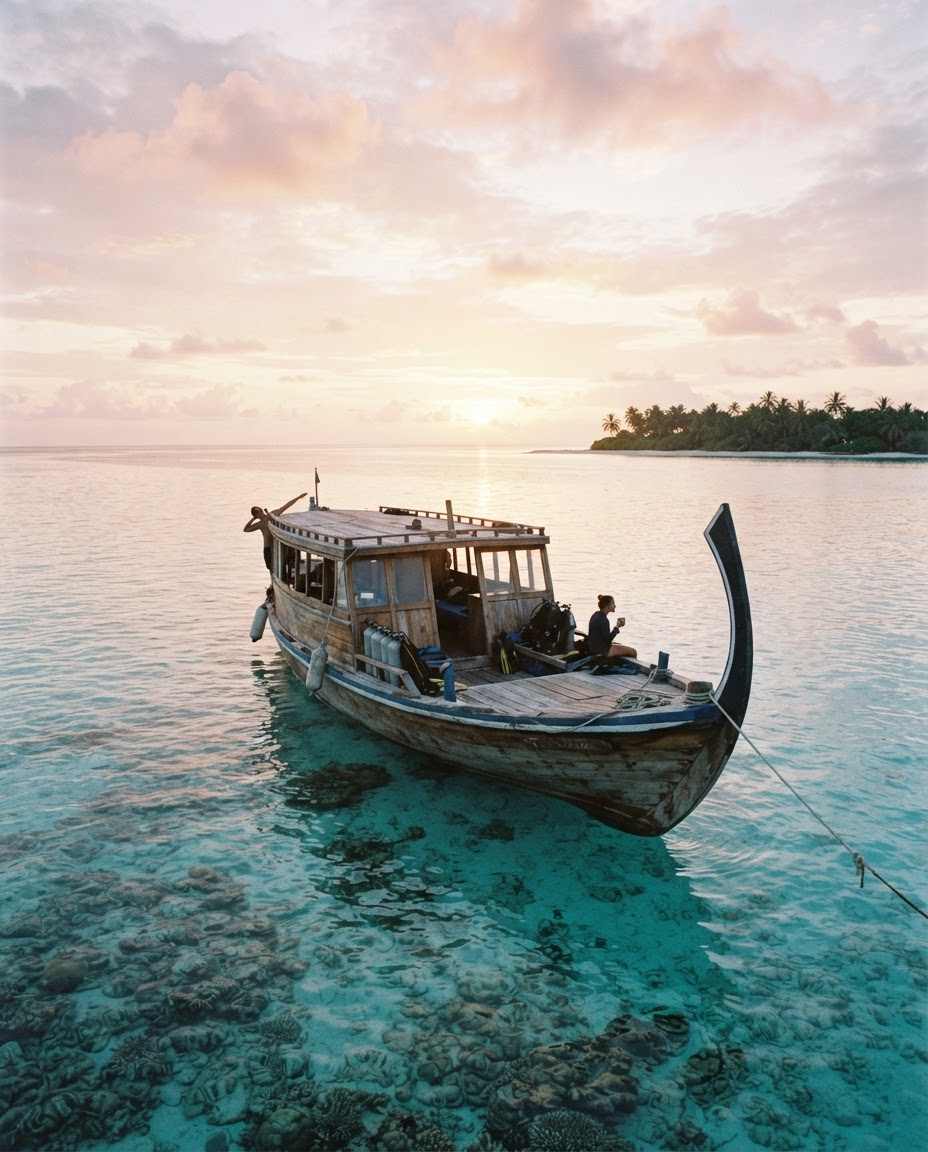
My income is a fraction of what it was. My quality of life is incalculably higher. I work harder than I ever did in corporate — physical labor, long hours, weather dependence, equipment maintenance, safety protocols that make airline checklists look casual. But the exhaustion is honest. It rebuilds instead of depletes.
The panic attacks stopped six weeks after my certification. Not because I "managed my stress better" or "optimized my workflow." Because I found a place where the nervous system can't panic. Where the vagus nerve activates automatically. Where the parasympathetic switch flips without an app, a coach, or a prescription.
The ocean doesn't care about your job title. It only cares that you showed up. That you breathed. That you paid attention to something larger than your own narrative.
From Burnout to Buoyancy: 5 Career Pivot Tips for the Dive-Curious
If you're reading this at midnight, inbox blazing, chest tight, we see you. And we want you to know: the leap isn't as impossible as it feels from the surface. Here's what we wish someone had told us before making a scuba diving career change:
1. Don't quit tomorrow. Dive first.
Take your PADI Open Water before you take your resignation letter to HR. The decision becomes clearer underwater. Test the water before you trade your suit for a wetsuit permanently.
2. Your corporate skills are transferable — just not the way you think.
Project management? That's dive planning. Risk assessment? That's safety protocols. Presentation skills? That's briefing nervous students. The ocean needs your competence. It just doesn't need your PowerPoint template.
3. Start with a side-hustle sabbatical.
Most dive professionals we know started with a "scuba gap month." Work remotely for two weeks, dive for two. Test the current before you make a full leap.
4. Build your tribe before you need them.
The dive community is small, global, and surprisingly generous. Connect with the DeepBeat Tribe community. Attend dive shows. Follow operations you'd want to work with. The tribe hires from within.
5. The fear doesn't disappear. It becomes familiar.
You will panic again. You'll wonder if you made a mistake. You'll check your bank account and swallow hard. That's not failure — that's decompression. Ascend slowly. Breathe. Trust the training.
The Invitation
The corporate world will always need its soldiers. The spreadsheets won't fill themselves. The quarterly reviews will continue their eternal march. There's no shame in that work — many find meaning in it, and the economy doesn't run on bubbles alone.
But if you're reading this and your chest feels tight right now — if you can't remember the last time you felt genuinely weightless — then consider this your invitation. The ocean is not running a recruitment campaign. It doesn't need you. But you might need it.
Ready to take your first breath underwater and connect with fellow ocean seekers? Join the DeepBeat Tribe and discover our upcoming ocean retreats and liveaboard experiences.
DeepBeatDives is a movement at the intersection of ocean exploration, underground music, and immersive travel. We don't sell tickets. We extend invitations. Request an invitation to join the tribe.